American Action Fund for Blind Children and Adults
Future Reflections Convention 2022 AWARDS
2022 NFB Scholarship Awards
Presented by Cayte Mendez
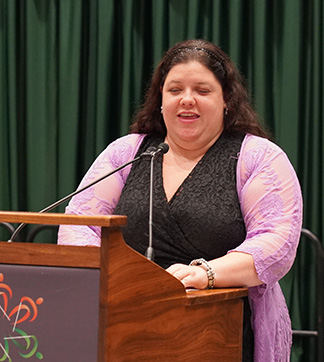 CAYTE MENDEZ: Good morning, President Riccobono and members of the board. There are so many wonderful parts of convention every year, but this is one of my favorites. I was a beneficiary of this scholarship program in 2001. It's a program that the board generously agrees to maintain and continue every year. This year the board voted to make some changes that I think will make the program more about mentorship, more about finding a home in the Federation and celebrating the folks that are honored by our named scholarships, rather than worrying about what digits are before the comma. This year the scholarship class is blazing trails with the new iteration of this program, and I hope that they're as excited as I am to be a part of this work.
This program honors academic aptitude, scholastic excellence, leadership, community service, creativity, mentorship, and all of the things that we value here in the Federation. It is my privilege to introduce these thirty finalists to all of you.
I'll announce the finalists by their first name, last name, their home state, and for some of these folks they've also asked that I identify a home country, so I'll do that as well. I'll announce their school state where they're going to school, and I'll also list their vocational goal. We have three folks in the class this year who are tenBroek Fellows. Dr. Jacobus tenBroek was a founder and renowned member of our organization. We honor his memory by awarding folks who are receiving their second scholarship with tenBroek Fellowships.
Our first finalist this year is Shawn Abraham, Maryland, United States diplomat.
SHAWN ABRAHAM: Hello, everyone. It's always been my goal to fight the limiting attitudes about disability in society, and I've done this through my intense passion for fashion, serving as a resident assistant on my campus, and competing in college wrestling at the national level. Mentoring youth and helping others has always been extremely important to me in the blind community and beyond. I have a love for learning languages, a deep belief in cultural inclusion, and a strong pride in my own South Asian identity. This is why I'm focusing my education on international relations, to fight, to continue to fight the stereotypes we all face across the globe and to build a better future for everyone. So thank you.
CAYTE MENDEZ: Nancy Aguilera, Missouri, Missouri, researcher and professor of political science.
NANCY AGUILERA: Good morning, everybody. I would say that one of my defining characteristics is determination. Determination has led me to raise two wonderful people in my life! I earned my bachelor's degree in political science and another bachelor's in psychology. And I do the everyday mundane things that people think blind people can't do. You know, even things that are challenging, like traveling alone or riding trains. You know, crazy stuff like that, right? Why do you do it? And it's like, determination—I definitely believe that without this characteristic, I would totally be a different person. And I've enjoyed every minute of being so determined. Thank you.
CAYTE MENDEZ: Tasnim Alshuli is one of our tenBroek fellows this year, Arizona, Arizona, professor and consultant.
TASNIM ALSHULI: Hello, everyone, it's such an honor to be given this opportunity a second time. I'm studying for my master's in education in technology and science, and STEM in general. My goals are always around diversity, equity, and inclusion for the blind and other intersectionalities. Also, I enjoy very much planning and organizing, and being involved, hence I'm involved in various advisory boards, committees, and so on in the Federation as well as in my community. And specifically, I'm the chair of the NFB Muslims, an active member in Arizona, and I was a scholarship recipient nationally in 2018, and the recipient of a state scholarship of Arizona in 2017. Thank you.
CAYTE MENDEZ: Katelyn Beresic, West Virginia, West Virginia, social worker for LGBTQ youth and disabled individuals.
KATELYN BERESIC: Thank you, everybody. I'm going to go ahead and start off by saying my pronouns are she/they and I identify as nonbinary and bisexual. I'm also on the asexual spectrum. Yes, there are LGBTQ people in West Virginia! Very shocking! I will be an upcoming freshman this year at West Virginia University. I was newly diagnosed with RP about four years ago, and since then I have worked in combination with my TVI, Megan Hoover, who works in West Virginia and Maryland, to learn more about myself. She's the main reason why I am pursuing social work, as well as advocacy, for individuals with a range of disabilities, including but not limited to visual impairments, hearing impairments, and other mobility-related disabilities. One thing that I hope to do is learn sign language in the future, and I really, really want to work in combination with LGBTQ youth, as I do know that that is a large portion that kind of gets overlooked a lot, especially coming from West Virginia, where it's just not talked about at all.
CAYTE MENDEZ: All right, thank you. Jovan Campbell, New York, New York, community education.
JOVAN: Good morning, everyone. How is everyone doing? In 2007 I went from totally sighted to totally blind, and I was totally hopeless. And in 2011, I got sepsis and ended up as a partial wheelchair user. I say all of this to say, I didn't know what I was going to do, but I knew I was going to go back to school. I didn't know how I was going to do it. I just had this promise to myself. And in 2021, I figured it out. How to go back to school. My arduous journey with my health led me to my major in public health, my beloved major of public health, through which I want to educate my community how to not just live, but live a life of quality. Not just quantity, but quality. So I thank you for the opportunity to meet all of you guys, meet my class of scholarship winners, and I'm honored and encouraged to just keep going, and not just keep my promise to finish this degree, but go on and get another degree and another degree. Thank you so much, guys.
CAYTE MENDEZ: All right, Justin Champagne, Louisiana, Louisiana, professor of mathematics.
JUSTIN CHAMPAGNE: Laissez les bon temps rouler, New Orleans! I'm so excited to be here in my home state of Louisiana, and I'm sure that Pam [Allen] had many protests—no, I'm kidding, I love you Pam. I'm pursuing my PhD in mathematics from LSU. And my greatest passion is to make math accessible to everyone. So, you know, math is known to be inaccessible to blind people, but the truth is, it's inaccessible to everyone. And that's a problem that I want to help solve for everybody.
CAYTE MENDEZ: Jenn Doran, Virginia, Oregon. PhD to help vulnerable communities survive climate change.
JENN DORAN: Hi, everyone. So my academic research actually involves sediment flux in the boundary layer. This is a fancy way to say I play with ocean muds. I picked my PhD advisor because he has open access books with everything we would ever need to know about climate change, but it's [usually] not accessible. In fact, climate change data is not accessible. In 2020, I found myself in a very vulnerable position as Beachy Creek Fire was not too far from me, Holiday Fire was on the south of me, and Harrisburg just set on fire, and my husband was not home. So I called my local ADA office and my local mayor, councils, all of that to see what happens if I'm an independent person living by myself, not in a group home or assisted living home, and I need to evacuate and there's nobody. Let's just say what I found there left a lot to be desired. So my goal is to work with my PhD advisor to make this data accessible so that we can be empowered to advocate for policies to mitigate the dangers of climate change that we face so that no one in our community will perish because of climate change.
CAYTE MENDEZ: Abbie Duffy, New Hampshire, New Hampshire, psychology and criminal justice.
ABIGAIL DUFFY: Hello, fellow Federationists, I'm eighteen years old, and this is my eleventh convention. My first was when I was seven years old. I'm an Alpine ski racer, and I will be skiing collegiately, and I'm also the current women's champion in three different para-Alpine disciplines, so that's a fun fact. I've been a proud Federationist for most of my life, so I'm so happy to be here today. I'd like to thank everyone that I've met along the way for helping me to get to where I am now.
CAYTE MENDEZ: This class has representatives from several countries outside of the US. The first of these is coming up next, Teresa Fabre, currently residing in Illinois, but she's originally from Mexico and going to school in Illinois, vision rehab.
TERESA FABRE: Hello, my Federation family. When I graduated from college in culinary arts in 2013, I was definitely not planning to go back to school. Then in 2016, I moved to Chicago, and I had to find a new family there, so that was a lot of fun. And that helped me be aware of the importance of having a community. And then, three years later, I lost my vision, and I decided that I wanted to go back to school because I noticed there were a lot of things that needed to be done regarding our blind and visually impaired community, but also the disability community in general. So one of my personal goals is to generate awareness within the general public about us, so we can have a conversation with them and sit with them at the table. I want them to know us, know that we are people, that we have dreams, that we have goals, that we are not lesser people, and that we deserve equality and the same opportunities as they have. So that's my passion. Thank you all.
CAYTE MENDEZ: Ethan Fung, California, California, operations management and environmental sustainability.
ETHAN FUNG: Hi, everyone, I'm sure that many of you feel that many of the world's largest businesses and corporations are environmentally draining, self-serving, and cash-hungry cows. But rather than beating a dead cow, I would like to draw your attention to the progress we have made over the last few decades. Among our most innovative companies, we have those who are putting a new emphasis on environmentally sustainable practices, which is fostering not only economic, but social benefits as well. This is why I would like to dedicate my career to helping these forward-thinking companies achieve their goal of making this world more sustainable. And I implore you to help where you can and to join together and take responsibility of your future together. Thank you.
CAYTE MENDEZ: Izzi Guzman, Florida, Florida, music educator, composer, entrepreneur.
IZZI GUZMAN: Hi, everyone, she/her. I'm diagnosed with albinism, I compose and play trombone music, but most importantly, I want to ensure that students from all cultures, backgrounds, and abilities have access to music education, that music education is accessible for everybody with jazz and popular music centered in the curriculum. Because when you think about it, what's the kind of music that you grew up with and you love? Songs that you listen to on the radio. Think about it. It's jazz and popular music. Songs from R&B, funk, and pop. Those are the songs that I want to incorporate for students to learn music and fall in love with music education. Thank you.
CAYTE MENDEZ: Michael Hardin, Indiana, Indiana, social work.
MICHAEL HARDIN: Hello, everyone. It's truly an honor to be here. I'd like to start by saying I'm an active member in the NFB Circle City chapter in Indianapolis. I'm a proud father and role model to three children. Prior to blindness, I worked seven years as a diesel technician. Right now I'm transitioning into a new career where I plan to work as a generalist social worker upon graduation, with the ultimate goal of starting my own practice. And I would like to leave you guys with a famous quote from Helen Keller that says, "The only thing worse than being blind is being sighted with no vision." Thank you.
CAYTE MENDEZ: Renae Hemmings, who is residing in New Jersey but is originally from Jamaica, going to school in New Jersey, psychologist and therapist.
RENAE HEMMINGS: Hello, everyone, I will be majoring in psychology at university in the fall, and I hope to become a psychologist to help people achieve mental stability and be able to function in their daily lives and to heal from past traumas.
CAYTE MENDEZ: Natasha Ishaq, New Jersey, New Jersey, and she has the longest vocational goal—paleoanthropological studies ... or law.
NATASHA ISHAQ: Hi, everybody! If I've learned anything over the last several years, it's that blindness does not have to translate to living a life of low expectations and ambitions. I've been studying paleoanthropology since my sophomore year and will shortly be taking part in my first excavation. I'm also interested in law and am starting an internship in law to get some experience in the legal field to see if it's a direction I want to go in. I'm also involved in activities on and off campus and am very fortunate to hold leadership positions in almost all of them, including a disability, accessibility, and advocacy organization. Thank you very much for this opportunity. I'm eternally grateful.
CAYTE MENDEZ: Hunter Kuester, Wisconsin, Wisconsin, business—brewery and kitchen owner.
HUNTER KUESTER: Good afternoon, my Federation family. I'm studying hospitality management with a minor in real estate and business. I'm a board member of Wisconsin and newly elected board member of National Association of Blind Students. But the title I hold closest to my heart is five years ago I became a member of this National Federation of the Blind. And I look forward to seeing where I can go in this organization. Thank you.
CAYTE MENDEZ: We have a number of parents in this group, including our next, Maura Kutnyak, attorney.
MAURA KUTNYAK: Good afternoon! These are the lights of my life, three children, my husband, and friends. My expression in aerial dance, finishing my study at Buffalo School of Law, and being a teaching fellow with my constitutional law professor. And serving as president of New York Parents of Blind Children, secretary of my chapter, and NFB-NEWSLINE® outreach coordinator in New York, among other things. For all of this I am tremendously grateful. Thank you.
CAYTE MENDEZ: Robert Lamm, Colorado, Colorado, environmental engineer.
ROBERT LAMM: Hello, everybody. Prior to my vision loss, I was one of the youngest certified master gardeners in Colorado. After my vision loss, that led me to deciding to become an environmental engineer, to scale up desalination processes, to try to fix the water crisis in the West. Secondarily, I want to work on pollution with microplastics. Besides giving back to the world, I look forward to giving back to the blind as well, so thank you.
CAYTE MENDEZ: Katie Lester. I do want to say our Scholarship class comes from twenty-six states, large states, small states, states that would rattle if you shook them. The person from the farthest state is Katie Lester, student, social worker, and therapist. Alaska, Alaska.
KATIE LESTER: Hello, everyone, I lost my vision in 2018 in my thirties, and various personal experiences led me to my degree to be able to counsel others who have lost their vision or have another disability who are struggling or wanting to work through and live the lives that they want. So helping them to do that, and getting more access in the education arena on the college level, or any, if I can, are my goals. Personally, I am just amazed at how quickly, and being able to remind myself through the personal experiences of everyone's help, that I'm never alone and there's always someone willing to help you and support you. I am a board member of the Alaska division of the NFB, as well as a volunteer at the Alaska Center for the Blind and Visually Impaired. Thank you very much.
CAYTE MENDEZ: Casey Martin, North Dakota, North Dakota, speech and language therapist.
CASEY MARTIN: Hello! My current research topic is people with disabilities' experience in the speech health care profession, and I look forward to an externship in a school for the blind this upcoming spring, as well as a clinical fellowship starting next summer. Through a number of different social science courses, one of my main philosophies is that personal autonomy and independence or freedom comes from choice, and in order to exhibit choice, we need to work on enhancing and empowering communication.
CAYTE MENDEZ: This next finalist is another one of our tenBroek Fellows. Daniel Martinez, Texas, Texas, educator of blind students.
DANIEL MARTINEZ: I was entered into the Disability Hall of Fame from the National Disability Mentoring Coalition in 2019 because of my efforts in mentoring. I value peer mentoring. At this convention I'm mentoring students from the Texas Mentoring Program, the best program in the state, and in the nation, in the NFB, led by Norma Crosby. And, well, I'm looking for mentors. I'm a student, and I can help you, and I'm connected with all of you. But I'm a new parent, so I'm looking for parents to talk to. Thank you!
CAYTE MENDEZ: Sarah Menefee, Texas, Oklahoma, registered dietitian.
SARAH MENEFEE: Hi, everyone. I will be attending the University of Tulsa next year, majoring in biology. I was recruited to row on their division I team, and I'm very excited about that, because it was one of my more important goals in life. As a rower, I have achieved two national championships. And I enjoy hobbies such as ceramics, hiking, biking, swimming, just generally being outdoors, and I'm so excited to be here this week. Thank you.
CAYTE MENDEZ: Selene Monjarez, Tennessee, Connecticut, mental health therapist.
SELENE MONJAREZ: I was the only student at my school to pass all my state dual credit exams. They're useless now because I'm studying out of state, so those credits don't matter. But less than 2 percent of people pass exams like the world history one, and I was one of that 2 percent in my state that did. So I learned that I'm smarter and more capable than I thought I was before. I had the honor of serving as vice president of our chapter of Special Olympics, I served in Key Club, Honor Society, and other organizations like that. And that taught me that I am capable of leading, and I shouldn't be afraid of that. I don't really have a goal right now. I'm in this weird place where I'm about to start college in the fall. So I've finished high school, about to start college. I just hope that whatever I do, I can serve the world around me, and that includes everyone in this room. You are part of the world, and I hope to serve as best I can.
CAYTE MENDEZ: Julia Murray, Pennsylvania, Pennsylvania, occupational therapist.
JULIA MURRAY: Good afternoon, Federation. Growing up, I've had many supports, such as my teacher of the Deaf and hard of hearing who has taught me how to advocate with the world around me. I also had the teacher of the visually impaired and an O&M teacher who taught me how to navigate the world around me, and also the director of the adapted sports program for the blind and visually impaired has given me so many different opportunities to play so many different sports, such as skiing, paddleboarding, and blind ice hockey. Because of these people, I want to be able to do the same they did for me for other people. So the reason I chose occupational therapy specifically is because their ultimate goal is to work with people with daily skills that they need every single day.
CAYTE MENDEZ: Finn Paynich, Washington, Washington, musical theater.
FINN PAYNICH: Hi, as stated, my name is Finn and my pronouns are they/them, and that's something that sometimes sets me apart from others. If it isn't my transness, then it's my blindness or my queer sexuality or my neuro divergence. I've been working on my pride in my intersectional identities, and safe spaces such as the theater community, Pride events, and this convention are really teaching me to take up space as a queer disabled person. In the presence of such great community, I often feel that I'm able to truly be myself. Thank you for giving me the opportunity to stand up here and take up that space, and for the opportunity to attend the arts school of my dreams. It will give me the skills I need to be a professional theater artist. I will use that platform as an artist to advocate for fellow disabled and LGBTQ people, as well as continue to be politically active.
CAYTE MENDEZ: Emily Schlenker, Kansas, Kansas, pharmacy.
EMILY SCHLENKER: Hello, everyone. We had such an amazing and dynamic NABS session last night, and one of the things that was talked about last night was building bridges. And I want to share something with all of you that happened to me in the last two years that really brought this home for me. In 2020, I received a very clear denial of my application to pharmacy school based specifically on my blindness. I was pretty much told in this letter that there were three things I could not do. I could not give vaccines. I could not look at prescriptions. And I could not find errors in those prescriptions. So I called the National Federation of the Blind, and as we talked about last night, we're always building bridges in one way or another. But what I would like to say to go along with that is that every bridge needs shoring up, and every person building bridges sometimes needs shoring up. And I was so privileged and honored to have a meeting that was basically between myself and the pharmacy school, and Scott LaBarre and Tom Page, and they shored me up, and I had a very rare opportunity to advocate for myself to the same people who had denied my entrance into the pharmacy program. And I can also say now that not only am I a proud student of the Kansas University School of Pharmacy, but I have in fact passed three of those milestones they said I could not pass. I have given an injection. I have drawn and dosed the vaccine. I have also checked prescriptions, and I have also found errors and corrected them. Thank you very much!
CAYTE MENDEZ: Carla Scroggins is also a tenBroek fellow, California, California. Global security analyst and diplomatic strategist.
CARLA SCROGGINS: Good morning, everybody. Board, thank you for this opportunity. I cannot tell you what it means for me to have the opportunity to once again be believed in by my Federation family and my tribe. I am just starting my master's program at Johns Hopkins University for a masters in global security, strategic studies. Some of the values we fight for so much in this organization come from our liberal values of equality, and that all comes from security to make it possible on a global scale, not just country or regionally specific. Thank you.
CAYTE MENDEZ: Bhavya Shah, originally from India, California, data science.
BHAVYA SHAH: Hello. I'm a regular geek. I'm majoring in computational science at college, a bunch of cool buzzwords, and when I'm not obsessing about code, I participate in debate. Very cool. I won the world championship, so people don't like to get into arguments with me, except my mother, and she always wins! I care about giving back. I'm a long-time contributor to the NVDA screenreader project, and I also serve on my university's disability task force. And I also care about learning and growing and living my best life, which is why I moved halfway across the world from the corners of Mumbai to pursue studies at my dream school, Stanford University. Which is why I'm spending this summer acquiring blindness skills and confidence at the Louisiana Center for the Blind. Thank you.
CAYTE MENDEZ: Katelyn Siple, Maryland, Pennsylvania, administrative leadership in not-for-profit ministries.
KATELYN SIPLE: One of my goals this year is to grow in confidence and be a better version of me, which includes making decisions and being decisive in what I want. My goal is to travel and do what I love. Hello, Federationists, it's great to be with you. I'm twenty-four years old, a recent graduate of the Louisiana Center for the Blind, a senior at Lancaster Bible College, and my goal is to help people in what they do in nonprofits and social work. I set up a platform on social media to be a positive role model, to encourage, and inspire, and—thank you very much for this opportunity.
CAYTE MENDEZ: Stephanie Valdez, Massachusetts, Massachusetts, interpreter and translating.
STEPHANIE VALDEZ: Good afternoon, Federation family. I want to start off by saying I was actually one of those sighted people at one point who thought that blind people couldn't do much. And when I lost my vision after graduating high school, I thought that my world had collapsed, and that was pretty much it for my life. I soon realized that was not it, and that blindness was not the characteristic that defined me. I am now majoring in French, I'm bilingual in English and Spanish, and I'm determined to break the barriers that are put in place by languages in society to give the opportunity for people to have a better quality of life and equality. At the same time, I strive to do that same thing for the blindness community with my everyday actions and changing people's perception of blind people one at a time, just by doing normal things like being a mother, being a wife, and attempting to launch my own business of self-care products. I hope to be an example, an inspiration to not only current generations but next generations, by simply living the life I want how I want to live it. Thank you.
CAYTE MENDEZ: Last but not least, Colin Wong, Washington, Washington, adult education and blindness education researcher.
COLIN WONG: Thank you so much. I told myself I wasn't going back to school, but life has a way of doing that today. In fall I'll be pursuing a PhD in teaching and leadership with a concentration in adult education and professional development. My greatest accomplishment so far has always been my national orientation and mobility certification, because it has provided me with an opportunity to witness how a quality education can change the trajectory of a student's life. It also has taught me that there are many students who do not get the opportunity to get a quality education that they deserve, and that there are gaps in education that are not discussed outside of this room, including the gap of quality educators needed in rehabilitation education and nontraditional students who are adults with and without disabilities. So my goal is to become a university professor and develop research to improve the educational system in both of these concentrations. Thank you.
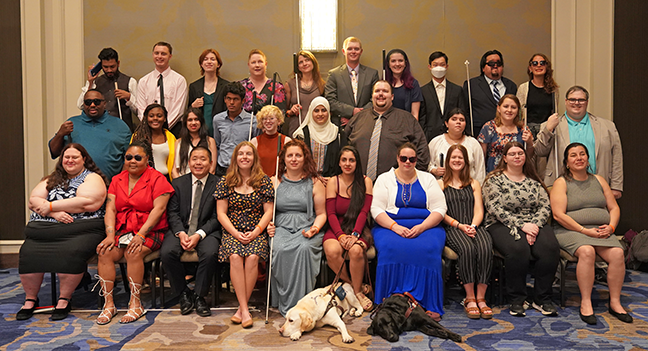
CAYTE MENDEZ: All right, Mr. President, members of the board, I present to you the scholarship class of 2022.
At the annual banquet of the National Federation of the Blind on July 10, 2022, Cayte Mendez presented the NFB Scholarship winners with their awards.
CAYTE MENDEZ: Good evening, fellow Federationists. President Riccobono earlier shared with us the story of who our organization has been, who we are, and who we will become. Such a large part of that last, the "who our future will let us be," is determined by our students. Every year it is the privilege of the Scholarship Committee to select, from our hundreds of outstanding students, thirty who will represent our organization as our scholarship class. We receive hundreds of applications every year. It's never an easy process to select those thirty. Those that we do select represent the highest academic excellence, the highest levels of leadership and community involvement. They are tremendously special individuals.
This year our scholarship program had some changes, which I'll address briefly in a moment. But the essentials of the program have not changed. We look for excellence. We expect success, and we look forward to the future that these folks will help bring to this organization.
As I said earlier, some aspects of our scholarship program have changed. As I give my presentation in the next few minutes, you will notice that the scholarship values will no longer be a part of the information I share about each finalist. For many reasons, we no longer have a tiered system of awards. The values of the awards have been flattened so that all scholarship finalists receive the same dollar amount. The true value of these scholarships is in what they represent and who they represent, not by the digits in front of the comma. Each of these students will receive a scholarship in the amount of $8,000.
This year we added a really exciting new element. The students had the opportunity, if they chose, to nominate a member of their class for the Kenneth Jernigan Scholarship. Their nominations were taken into account when the Scholarship Committee met last night and made its decisions. In this organization we choose our future, and that includes our future leaders. To give our scholarship finalists the opportunity to select the person they want to represent them, the person whose speech they want to signify the work and learning of their whole class, is a wonderful first step in making those choices that will help them make our movement stronger in the future. Now let's get started!
[Note: Cayte introduced each scholarship finalist by name, and listed their home state, school state, and career goal.]
CAYTE MENDEZ: I'm going to share with you the winners of the various scholarships that have been awarded this year. Each of our finalists will receive a scholarship, and, again, the winner of our most prestigious award, the Kenneth Jernigan Memorial Scholarship, will address the convention.
The winners of our National Federation of the Blind Scholarships are:
Nancy Aguilera, Missouri, Missouri
Katelyn Beresic, West Virginia, West Virginia
Jovan Campbell, New York, New York
Izzi Guzman, Florida, Florida
Michael Hardin, Indiana, Indiana
Renee Hemings, New Jersey, New Jersey
Robert Lamm, Colorado, Colorado
Casey Martin, North Dakota, North Dakota
Selene Monjarez, Tennessee, Connecticut
The next scholarships have been donated by various organizations and entities or are donated in memory of various individuals.
Our Edith R. and Alvin J. Domroe Scholarships will be awarded to Shawn Abraham, Maryland, Maryland; and Katie Lester, Alaska, Alaska.
The Jessie and Hertha Adams Scholarship is awarded to Natasha Ishaq, New Jersey, New Jersey.
Our three Charles and Melva T. Owens Scholarships will be awarded to Hunter Keister, Wisconsin, Wisconsin; Sarah Menefee, Texas, Oklahoma; and Katelyn Siple, Maryland, Pennsylvania.
Our two Lillian S. Edelstein Scholarships will be awarded to Jenn Doran, Virginia, Oregon; and Finn Paynich, Washington, Washington.
Our Mimi and Marvin Sandler Award will go to Stephanie Valdes, Massachusetts, Massachusetts.
The Pearson Education Award goes to Tasnim Alshuli, Arizona, Arizona.
Our Charles and Betty Allen Scholarship will go to Carla Scroggins, California, California. Carla is one of our three tenBroek recipients this year. I should add, with apologies, the previous winner, Tasnim Alshuli is also a tenBroek Fellow.
Our E. U. and Gene Parker scholarship will go to Ethan Fung, California, California.
The JAWS for Windows scholarship will go to Julia Murray, Pennsylvania, Pennsylvania.
Our NFB STEM scholarship, which is contributed by the members of the Computer Science Division, is going to Emily Schlenker, Kansas, Kansas.
Our Oracle Scholarship for Excellence in a STEM Field will go to Justin Champagne, Louisiana, Louisiana.
Our Oracle Scholarship for Excellence in Computer Science will go to Bhavya Shah, California, California.
The Jacqueline Billey Memorial Scholarship will go to Daniel Martinez, Texas, Texas.
Our Jeannette C. Eyerly Scholarship goes to Teresa Fabre, Illinois, Illinois.
The Adrienne Asch Memorial Scholarship will go to Maura Kutnyak, New York, New York.
There are two left, guys. Only two. Here we go...
Our American Action Fund Scholarship will go to Abigail Duffy, New Hampshire, New Hampshire.
And if you have been playing Scholarship Bingo, you know who is left.
Our most prestigious award, the award that honors one of our Federation's longtime leaders, the man who helped shape a generation in the organized blind movement, our Kenneth Jernigan Memorial Scholarship this year will go to Colin Wong, Washington, Washington. You can keep clapping while Colin makes his way up here to the podium.
COLIN WONG: Thank you so much for this tremendous honor. I am very blessed to be able to represent the Scholarship Class of 2022. Each of these individuals also deserves this prestigious award, and I am grateful to be here and accept this award today. I want to start off by thanking President Mark Riccobono, the National Board of Directors, the sponsors that made this possible, Cayte Mendez and the Scholarship Committee for all the support they have provided in making this scholarship a reality.
There are a couple of individuals I want to make sure to thank, because without their support and their ability to listen to all of my frustrations in this journey we call life, this Ph.D. definitely would not be possible. I want to start off by thanking Ashleigh Moon, Shawn Callaway, Marci Carpenter, Marco Carranza and Dr. Edward Bell. I want to thank my beautiful wife, Destiny Wong. Next week we will have been together for nine years. In this journey, as I'm sure we all have done, I have stumbled and made mistakes, and without her support and her love and dedication, I would have definitely fallen, but she has picked me back up every single time.
While I never met Dr. Kenneth Jernigan personally, his influence on me cannot be understated. It is an honor and I am humbled to accept an award in his name. His influence in my life has not only influenced my professional career but also my personal career. I started going to Louisiana Tech University, the Louisiana Center for the Blind, and I serve on the National Blindness Professional Certification Board, each of which involve the Structured Discovery methodology that Dr. Jernigan created. Without his influence in the area of adult rehabilitation and blindness, I can honestly say I would not have a career or a passion in order to shape the next generation of blind individuals.
I also want to note the impact that the National Federation of the Blind has on me. Dr. Kenneth Jernigan said that there has to be a day after civil rights, and that's the most powerful gift that the Federation has given me, an opportunity for dreaming and looking toward the future. It's so easy to focus on the present and the challenges we have to overcome, but it's a lot easier when we know what the future has to hold. I thank the Federation for the expectations that they have instilled in me and the opportunities that they have provided. The Federation is a place of support. It's a place of love, hope, and determination. The Federation has given me so much more than I have been able to give to it. Today it has given me an educational opportunity. Collectively it has given all of us standing on this stage a future. For that I am eternally grateful. Thank you so much. And let's go build the National Federation of the Blind!
CAYTE MENDEZ: Well, folks, I know it's late, but I think we have time for one more huge round of applause for the NFB scholarship class of 2022.