American Action Fund for Blind Children and Adults
Future Reflections Fall 2022 ADVOCACY
Bridging the Gap and Working Together: The Passage of the BRITE Bill for Blind Students in Missouri
by Gary Wunder
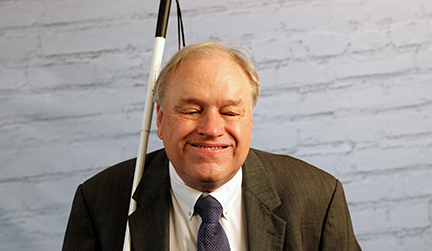 From the Editor: Gary Wunder is a long-time Federationist who has served the blind community in many capacities. He is a past president of the NFB of Missouri, and he edits the Federation's flagship publication, Braille Monitor. He is also a dedicated advocate for the rights of blind children.
On December 8, 2020, the National Association of Blind Students (NABS) posted a model legislative proposal on the web. They called this model legislation the BRITE Act. BRITE is the acronym for the Blind Students' Right to Independence, Training, and Education.
Sometimes when we get behind a piece of legislation, it is national in scope. It is considered by the United States House of Representatives and the United States Senate. In other cases we publish model bills and encourage individual states to pass them through their legislatures. This was the case with our Model Parental Rights Bill, and it was true of the Model White Cane Act passed by many states during the 1960s and 1970s. It is the case with the BRITE Bill as well.
In Missouri we have long wrestled over what to do to improve services for our blind students. Early on we passed the Model Braille Bill. However, the Missouri Department of Elementary and Secondary Education immediately issued a template that school districts could use, allowing them to claim that Braille had been considered and found inappropriate for a particular blind student. We created a task force to make frequent reports on the progress of blind students. All too often the reports were so vague that they were almost meaningless.
In addition to the work we do with the Missouri General Assembly, we help students and parents as they prepare for and attend their Individualized Education Plan (IEP) meetings. Sometimes we are able to make a real difference, but sometimes we come to the fight too late. Far too often we find that the struggle is sucking the energy away from the learning that might be accomplished for a child sitting in a classroom.
When we took a look at the BRITE Act, we were encouraged. We pitched in and did all the things we knew how to do. We talked with members of the General Assembly about the problems faced by blind children in the Missouri schools. We offered the BRITE Act as a partial solution, and we found an enthusiastic sponsor, Brenda Shields.
Brenda Shields serves in the Missouri House of Representatives, and we couldn't have had a better advocate. She took our model bill and gave it to legislative research. There the language was made to conform to that used in other bills considered by the House and Senate. The bill was introduced and a hearing was scheduled. We certainly thought the sun was shining in Missouri as we went to testify. From what we could tell, our bill had nothing but support. Unfortunately, we were wrong.
Let me digress for a moment to talk about some of our work with the General Assembly in the past. It is not uncommon for us to find an interested sponsor or sponsors, get a hearing, and give what legislators refer to as "impressive testimony," only to find that one of two things happens. Sometimes the legislation dies because there isn't enough time in the session to bring it to a final vote; or, as the bill gets close to passage, opposition materializes and the legislation goes no farther. It feels great to testify before the House and the Senate, but it is no fun to run three quarters of the way down the field and be deprived of a touchdown. It takes more than adrenaline to get points on the scoreboard, and being in the red zone only suggests what might have been, not what is.
At first we were surprised when we found that our representative was being contacted by people who said they could not support our bill. Then we were surprised at being surprised, given how often we had faced this very scenario. First we got mad. We were going to get the same kind of treatment with the BRITE Act that we had gotten when we fought for the National Reading Media Assessment and anything else to do with the quick introduction of Braille. Our sponsor was matter-of-fact. "You don't have to have everybody on your side," she told us, "but a little opposition can go a long way in derailing what you want to do."
So then we had a heart-to-heart talk with ourselves. When Representative Shields asked us whether we had contacted people in the education arena, we mumbled yes and mentioned a few folks we knew. But in our hearts we realized that the contacts we had made were sparse at best. Professionals had told us for so long that we didn't know anything about education; we just wanted to push something through and make those educators and administrators conform to what we believed blind students needed. If they wanted to shrug us off for not being professionals, we would shrug them off for not being part of the blind community. This attitude played into some popular ideas that seem to flourish today: everybody knows more about teaching than teachers do; teachers are looking out for themselves and not for their students; school administrators want to save money, not to provide service.
Although the smugness of our argument stopped us most of the time, some people in the legislature liked it. They applauded the blind fighting for education and against the establishment. Unfortunately they seldom liked our fight enough to advance our cause. If we weren't winning for blind students, why were we playing the game?
The less smug but hardly more defensible part of our argument was that we simply didn't know most of the folks who should be involved in helping us shape education law in Missouri. Besides, we were afraid that if we got the educators involved, our concerns would become diluted. If legislation finally got passed, the reforms we intended to make could turn out to be invisible.
The more we thought about how to see our bill progress, the more uncomfortable we grew with the us vs. them scenario, with the idea of their special interests opposed to our special interests. If we were more than a self-serving special interest group, perhaps they, too, were more.
We decided it was worth the risk to meet with some educators and see if we could make something of our proposal. To our surprise, the educators rather liked it. Some of the things our bill demanded they thought were impractical; yet, in some areas, they thought the bill could be even stronger. Our working group included a teacher of the visually impaired who holds certifications in orientation and mobility and assistive technology; a preschool teacher from a private blindness foundation; the parent of a blind child; and three members of our Federation affiliate: President Shelia Wright; Second Vice President Jenny Carmack; and none other than Gary Wunder, the immediate past president of the affiliate.
A series of meetings commenced in the summer of 2021 and continued for the better part of six months. Sometimes we went for two or three weeks without a meeting, but occasionally the work found us meeting two or three times in a week.
One of the things we three Federationists learned is that knowing the outcome you want is not the same as knowing how to get it within the system that exists. We learned that ignorance is no crime, but failing to learn can be fatal. We learned about things we weren't familiar with, such as the extended core curriculum and the difference between services under a 504 Plan and under an Individualized Education Plan. We learned about the various certifications that teachers can and should have if they want to claim expertise in their field and be paid for it. We learned how to discuss issues on which we could find easy agreement, and how to intersperse them with the difficult issues that threatened to cause an impasse. We learned to keep our group small enough to be fast and flexible, yet transparent enough that everyone knew what we were doing and how they could become involved at various points in the process.
Our goal was to construct a statute that would lead to better education for blind children. Along the way we were building trust. We were learning that the phrase "it's all about relationships" is more than a warm, fuzzy slogan. Building relationships produced real results for us. It is our hope that we have created a foundation on which we can build to solve problems that go well beyond the reach of this particular statute.
When we thought we were close to finishing our work, we emailed it widely to educators, administrators, and consumers. At the same time, we gave a copy of our proposal to Representative Shields to see if anything we had done might interfere with her support. To our relief, those with whom we shared the proposed text had a positive response. Their only real regret was it did not tackle all of the issues they believed we must address to create equity and equality of opportunity.
In 2022 we went back to the legislature. The legislators were impressed with our work, and they were also impressed with our unity. They were not being asked to mediate between warring factions. In a legislative session that overflowed with controversy, our education bill was a welcomed relief.
In Missouri statutes we now have a recognition that blind students need more from school than academics. They need mobility instruction at school and at home, and sometimes this requires providing service after school hours. This cost will not be passed on to parents or instructors, but will be borne by the district. Furthermore, blind students need technology, not only at school, but also at home. Again, this is not a cost for parents, but for the district. The statute still says that Braille will be the default for blind children; it also says that blind students who use Braille will be expected to be as competent in reading as their sighted peers of comparable age and ability. In its construction, the law serves to pull most statutes related to blindness and education together so that it is easier to figure out what is expected of a school district and what rights blind students and their parents have under law.
Of course, the effectiveness of the legislation that has been passed and signed will depend on its implementation. This law certainly doesn't solve all of the underlying problems that stand between blind students and the education we want them to have. We have to figure out a way to solve the teacher shortage that makes it difficult, and in some cases nearly impossible, to find qualified teachers of the blind. We also face a shortage of mobility and technology instructors. We must figure out how to deal effectively with school districts that contract for services, only to find that those with whom they contract do not have staff qualified to meet their agreed-upon obligations. We still have to work on the problem posed by geography. How can we ensure that services are available in those small communities where there may be only one or two blind students?
Some of what now lives in the statutes of Missouri will make it difficult for local education agencies and districts to comply. However, as our legislative sponsor reminded us, "You won't find people meeting obligations that aren't spelled out. What we may view today as aspirational will in the near future be expected compliance."
Only time will reveal how significant the passage of the BRITE Act in Missouri will be. For many of us who participated in its passage, working together and tearing down some of the walls that we jointly built between us has been a wonderful experience. We believe the law will help blind students, and we believe it will help the professionals whose careers revolve around meeting their students' needs. Most of us feel a bit better about being able to bridge what we so uncomfortably and uncritically thought of as unbridgeable gaps. How wonderful it is that sometimes one can fight for a cause without fighting with another human being! Being victorious is even sweeter when we look out at a win/win rather than a win/lose! Not every conflict can be resolved in this way, but it is worth the try—it is always worth the try.