American Action Fund for Blind Children and Adults
Future Reflections Winter 2023 JOURNEYS
Disability Intersections: Blindness and Autism
by Matt Langland
Reprinted from Braille Monitor, Volume 66, Number 2, February 2023
Originally published in the Minnesota Bulletin, Spring 2022
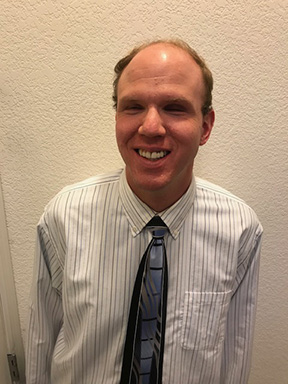 From the Editor: The intersection of blindness and autism poses a unique set of challenges for parents and educators as well as for the many people who live with dual disabilities. In this article Matt Langland shares his story of growing up as a blind person who also has autistic characteristics. He calls on people in the National Federation of the Blind to widen the conversation around blindness and additional disabilities.
I was born sixteen weeks premature in June 1986. When I was a few months old, it was discovered that I had retinopathy of prematurity (ROP). While a small amount of vision in my right eye was saved, I am legally blind. When I was about six months old, the teacher of blind students came to visit with my parents and started conducting home visits with me. My mom researched as much about blindness as she possibly could and attended her first NFB convention in 1987 to learn more.
I learned that I was considered a blind person when I was around three or four. It did not bother me that much since I had usable vision. Another funny thing was happening, though. I was also different in other ways. Not only was I blind, but other interesting behaviors were appearing.
From when I was as young as I can remember, I developed an obsession with vacuum cleaners. This obsession eventually wore off when I started school. I also would get bent out of shape and throw temper tantrums when plans changed or things did not go exactly as I wanted. I liked routines and for things to stay the same, and if they did not, that would upset me. I would get upset at the silliest little things such as plans changing unexpectedly.
Interacting with kids my own age sometimes felt forced. My mom had a few birthday parties for me when I was young, inviting kids from preschool or day care whom I knew. I struggled to play with them, as I preferred to be antisocial.
By the time I entered kindergarten, the main issue to be dealt with was my blindness. I was starting to learn both Braille and print. I relied mostly on enlarged print for my schoolwork, and I would read some books for fun in Braille. Since my vision was quite usable and I could read print, I decided at this point that I was only visually impaired, not blind. My mom tried to tell me that I was legally blind and that I really should consider myself blind, but I was insistent that, because I could see something, I was not blind. Teachers made sure I got all the accommodations I needed, such as explaining everything written on the board. I proceeded through elementary, middle, and high school in this way.
I continued to find strange new obsessions and preoccupations throughout elementary school. I started spending my free time listening to the local radio station, KTRF. I memorized the phone numbers for about every business in town. A few times I would call the businesses after hours to find out if they had answering machines and see what they said. I never had any reason to call these places; I just liked memorizing phone numbers. In fact, I did not want to talk to anyone on the phone. I had a phone phobia of sorts. If I had to talk on the phone to anyone, I would tense up, my throat would dry out, and my voice would lock up and start shaking when I attempted to talk. It was not until I got into high school that I started to conquer this fear of talking on the phone.
I had other obsessions, such as walking through the city campground on a nightly basis all summer so I could observe the campers. I also continued to struggle when plans changed or my planned routine did not pan out as I hoped.
In 1996 my mom attempted to take me to my first NFB convention in Anaheim, California. She would attend meetings for parents while I attended kids' camp. She thought it would be a great experience for me in terms of learning more about blindness and meeting positive blind role models. I had absolutely no interest. On the first day she tried to drop me off at kids' camp, I was so scared that I was crying and screaming out of fear of the unknown. I was expected to go off with all these people, knowing none of them, and make a day of it, taking the train from Los Angeles down to San Diego to visit an aquarium, among other activities. I still had the mindset that I was visually impaired, not blind, and I had no interest in the convention. Since I had just turned ten, it was out of character for a child of my age to be throwing a temper tantrum over having to leave their mother's side for a day. I can only imagine what the people around me must have been thinking!
NFB philosophy says that blind children can have all the same opportunities as sighted children and that nothing should hold them back. This incident made me look like a poorly socialized blind child; and it made my mother feel that she had failed. Other kids my age would just say, "Bye, Mom, see you later." I did not. I could not handle being with unfamiliar people in unfamiliar places. I was too afraid of something bad happening when nobody I was comfortable with was around. I had a fear of trying to interact with new people.
When I was in fourth or fifth grade, a year or two after the NFB convention incident, my mom approached me and said she had read an article and figured out I had something called Asperger's, now commonly referred to as autism spectrum disorder. I had never heard of this before, and I remember my first reaction was hating the sound of the word. My mom explained that this was why I had strange obsessions, liked routines, did not like change of plans, and did not interact well with my peers. Now she would have more understanding when I would lose it over a change in plans, and she could understand my obsessions. My parents and teacher of the blind immediately decided that we would not mention this to teachers, write it up in my IEP, or bring any attention to it in the school setting. It was thought that teachers would be stressed enough to have a blind student in their class. If we added autism to the mix, I would create unnecessary stress on my teachers. Besides, my autism did not have any effect on my academic abilities, only my social skills.
Through my K-12 school years, I had basically zero association with my peers outside the school environment. My peers in school pretty much left me alone. Luckily I never really got teased, picked on, or bullied. No girl in high school ever tried to ask me out on a date, I never attended a school dance, and nobody invited me to a gathering of any kind. I did not want to participate in any of these activities anyway. I probably would have declined if asked. My weirdness was attributed to my blindness. My participation in Key Club and the speech team was all I could handle.
Not wanting to leave the comforts of home made me decide to stay in Thief River Falls after graduating high school and take classes at the local community college. In the spring of my first year of college, I obtained a job as a people greeter at Walmart. It was the perfect job for me while I was in school. It gave me work experience, a social outlet interacting with my co-workers, and customer service skills. I had no problem putting a happy face on and saying, "Welcome to Walmart!" in a friendly tone. Small talk conversation was never a problem for me, but developing any long-lasting friendship or getting to know people my age on a deeper level just did not exist. I worked with a lot of fellow college students at Walmart and even had classes with some of them, so the job really helped me learn to be better socialized.
As I was finishing my associate's degree, I had a conversation with my parents where autism got brought up. They indicated it was still an issue I had to deal with. I said I did not understand why, since I functioned fine on a day-to-day level. My dad said, "Name a person in their early twenties, like you, who has absolutely zero close friends." It was sort of a revelation, in that it made me think my autism was affecting me more than I realized. I lived at home with my parents, so I received all my social and emotional support through them. I knew that blindness was my visible disability, and I would need accommodations for the rest of my life. It dawned on me that I needed to become more independent than I was. These things were partially due to being autistic but also due to my lack of confidence as a blind person. I needed to build my own friend circle.
I decided the answer to building my independence skills and building myself a social life was training at BLIND, Inc. While in training, I was able to attend two major events, Day at the Capitol and Washington Seminar. I could take my strong interest in politics and in blindness, an issue that impacted me personally, and I could combine them to advocate for other blind people. I jumped in and have never looked back.
Thanks to the support of the National Federation of the Blind, I found the confidence to do things I could only have dreamed of. I learned to live independently, and I obtained my bachelor's degree in social science, which I was not sure I ever wanted to do after my associate's degree. I also added a master's in advocacy and political leadership. I thank the Federation for giving me a social life and a place to feel welcome when there are so few places where I ever have fit in.
Still, very few people are aware that I am on the autism spectrum except for my immediate family and a few close friends. It is not something I advertise. To this day, it is my thought that I got a pass on my social skills in school, as teachers and peers attributed my social oddities to my blindness while not realizing there might have been something more to it. If I were just autistic and not blind, the autism may have needed to be addressed in school. Maybe my parents would have figured out I was on the autism spectrum sooner. I believe this may still be the case in some social situations today. How much of my social awkwardness can be attributed to blindness and how much is related to being autistic is a question I do not have an answer for. Another question to explore is: How many people are there in which another disability such as blindness is masking their autism, as mine did for many years?
In the NFB we are starting to talk more about multiple disabilities and people are labeling themselves as both blind and autistic. I am glad to see this conversation starting, since this secret is something I have had difficulty sharing, and I have covered it up for a long time. Sometimes we have a tendency to jump to conclusions and connect every single little social struggle to a blind person being poorly socialized. Maybe we should ask ourselves what other hidden disabilities or struggles one may be having besides blindness. These questions do not have clear and easy answers. As we in the National Federation of the Blind further explore the interactions around blindness, autism, and multiple disabilities, I would love to be a part of the conversation.