American Action Fund for Blind Children and Adults
Future Reflections Convention Issue 2023 NOPBC CONFERENCE
Reach for the Stars
by Carla Keirns
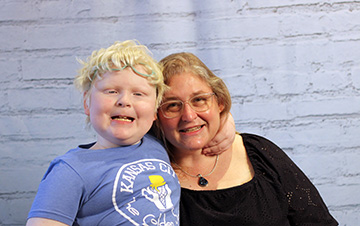 From the Editor: "Reach for the Stars" was the theme of the 2023 conference of the National Organization of Parents of Blind Children (NOPBC). NOPBC President Carla Keirns launched the conference with this presentation.
Why are we here together? Maybe it's because we want to understand what our kids need. Maybe we want to learn from our blind colleagues what we can do for our children. Here are some other reasons you may have come to Houston—raise your hand if this seems right. Who came here for the weather? [Laughter] Who came here to go to the Space Center and see the rockets? [Many raised hands] Who came here to see the latest blind tech in the Exhibit Hall? [Many more raised hands] Who came to learn about advocating for your kids? [Raised hands and applause]
Advocacy was what brought us here. When my son Russell, who's sitting in the front row, was turning three, the school said, "He doesn't need to learn Braille, he has enough vision." He is legally blind. How many people in the room would accept 'No Braille!' for an answer? I was stunned, truly stunned! I realized I needed help.
My sisters both were refused special education in the 1970s and 1980s. I knew a bit about the struggle my mother had had. I knew that I needed you, and we all needed each other. We needed our blind colleagues who had been there. Our kids are their kids, and they are the best partners I've ever known in terms of making sure we get what we need.
Russell and Robert [McKinney] came to this convention because they wanted some blind friends to play with. Some of us in the room are sighted, and some are blind. We all want to make sure our kids have the tools they need, the strategies they need, everything they need to be who they were meant to be, to live the lives they want.
Some of us have really struggled through the last few years—I won't mention why, I think you know why! Others of us have found new tools, new strategies, new ways of addressing our needs. One of the most amazing things I've seen is that some kids who were struggling with accessibility at school were able to find it at home. Kids who were struggling to get access to teachers and tech experts got access to them at home.
When everything shut down in 2020, my son was five. We tried remote speech therapy, and that wasn't so great. We tried remote occupational therapy, and that was worse. We tried remote school. Let me tell you, the model for our district was six hours a day of Teams meetings—for kindergarteners! I think that's a violation of the Geneva Convention!
After a few weeks, my kindergartener said to me, "Mommy, why should I sit in front of the computer all day to look at slides I can't see, with a program I can't operate, to learn things I already know?" I said, "Well—sometimes we just have to do things that don't make sense."
And then he asked me again.
And then he asked me again.
And then he started hiding under the bed.
We waited a few more weeks, and Mommy finally got the message. I went to the school and I said, "This is not acceptable. He can't do this." And my favorite part, I said, "He can't operate Microsoft Teams." They said, "No problem!" and they sent the instructions for using JAWS with Teams. I said to the TVI, "That is super great! Six months ago I asked you to teach him JAWS, and you said no!"
Then there's the hot key. You can use the hot key, right? Unless you're a kindergartener, and your hands aren't big enough to reach three keys at once.
On the other hand, I have friends whose kids learned beautifully at home. They weren't bullied; they weren't lonely. We were able to teach them ourselves and get them the support they needed. The community rallied in enormous ways with webinars and volunteer activities. A number of people in this room made materials to help kids learn at home. They did it on their own time because they knew it was filling a need. My son learned the entire Braille code via Zoom from a teacher in Pennsylvania. We thought about what to do and how to do it, and we improvised. We recognized that some things were not working well for some of us, and we would need to help each other. That is the power of this community!
The people who are not in this room are the ones I most worry about. We are all here because we know that our kids need us to be here. But we need to be sure that we reach out to others. We need to make sure that the kids whose parents don't have the time or money to come to a convention in another state, the folks who don't have the time to study, we have to make sure that those kids get what they need, too. That means infiltrating other organizations. It means sharing what we've learned. Our job is to pay it forward. My kid can read today because of all of you. The next kids that we teach to read because of what you taught us are going to be your legacy.
We face a daunting task in the state of Missouri, where I live. Only one in six kids who has a VI IEP is reading at grade level this year. The older kids did better, but the younger kids struggled. We are fighting for them, and we are making progress.
In the past year, we've had a chance to gather in person. We've gathered here, and we've gathered in states across the country. We're sharing advice and information by email and by phone and in other ways.
When my son decided to study piano he couldn't see the music notes he needed. I wrote to the NFB listserv, and I said, "What do you do? How do you do low-vision music?" Within hours, I had half a dozen solutions. Again, that is the power of this community!
We are planning lots more things for next year. In particular, we want to build our cadre of advocates. Believe me, I struggled with that. If you need an advocate, it's because the system is not doing what it should be doing. I hope for us, and for the future, that we need fewer advocates. I hope we'll be getting the resources we need. I hope our kids are getting what they need to be able to grow and thrive.
I'm a physician by training. One of the things I want to do is make sure that we partner with our eye doctors. Some of our eye doctors really struggle to understand brain-based vision issues, cortical visual impairment, CVI. We need to collaborate between the families, the kids, the doctors, the teachers. We need to make sure that everybody is prepared to serve our kids. We need to make sure that our school districts are able to serve our kids.
STEM is a really important area in education, and we need to make sure our kids are getting access to it. STEM teaching usually is such a visual thing! NFB’s programs in STEM really have been innovative in terms of making sure that we do things in hands-on ways. All kids, all of us, are multisensory learners. We don't learn in just one way. We need to be able to share our broader view, what we know about access, about different ways of learning. When we brought tactile learning materials to my son's kindergarten class, everybody played with them.
I want to thank you for making the time to come here. I want to thank you for making the effort to support your kid and support other kids and share what you know and learn. This is the power of this community! With everyone in this room, everyone in this movement, we can build the society that we need. We can help our kids reach for the stars. I am so excited that we are all here today!