American Action Fund for Blind Children and Adults
Future Reflections Convention Issue 2023 NOPBC CONFERENCE
Reach for the Moon
by Aunya Anderson
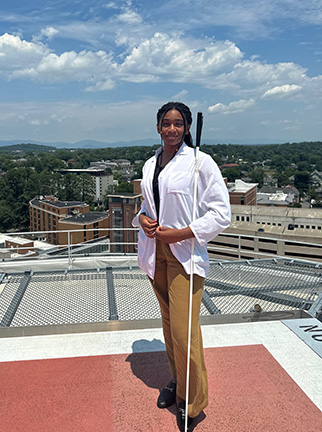 From the Editor: Aunya Anderson is a student at Southern Adventist University in Tennessee. She plans to attend medical school, and in the meantime, she's gaining a broad base of knowledge on a variety of subjects.
As you get older, people sometimes ask you, "What would you tell ten-year-old you?" And I ask myself, "What would ten-year-old me tell me today?" Ten-year-old me was doing a lot more than I might have expected.
At ten, I was at Mission Control for our space team. I was there with all the little astronauts who went out into "space." I learned one important thing from the space team program in my elementary school. The Braille teacher wrote on the decorated classroom door, "Reach for the moon, and even if you miss, you'll land amongst the stars." That thought has stayed with me to this day.
I am currently a rising junior at Southern Adventist University in Tennessee. I am studying biology with a biomedical concentration and a minor in psychology. I'm not just a student. I'm a daughter, and I'm a sister. I love reading, writing, music, and thinking—quarantine gave me lots of time for that! I'm very competitive. I've done every sport I can possibly get my hands on, no matter what anyone told me. I am a blind individual. I was born with cataracts and developed glaucoma when I was very young. I'm also an individual diagnosed with scleroderma, which is an autoimmune condition that pretty much affects every organ in my body.
These are all factors that make up me, who I am today. All of these things shaped me into the person who can sit in front of you now and say, "I want to become a doctor. I want to be a pediatric rheumatologist."
I have to take a lot of steps to get there. Education starts with elementary school. That's the groundwork. I was actually educated at home first. Before I started school my mom taught me Braille. I like to say I learned Braille before I learned how to read print. My mom knew that, as a low-vision student, I was going to face pushback about learning Braille at school. Teachers were going to say, "You don't need Braille. You can still see."
Throughout elementary school I was educated like any other student, and in addition I got Braille and access technology. When I started middle school I really began to enjoy my science classes. That's also when I started to become active in my IEP meetings. I was learning to advocate for myself. At that point I started to curate my educational toolkit, to figure out what I needed in order to be educated as a blind individual.
When I started high school, things got hard. I got really sick. I had to struggle hard to get the accessibility I needed in order to have the education that any other student was offered. After freshman year I started dual enrollment at Traverse Technical College, but things didn't get much better. Honestly, I failed my first chemistry class. I can say it with a straight face: I failed the first chemistry class I ever took! It wasn't for lack of knowledge. It was lack of access, because of people not wanting to give me the access I needed. One thing I learned from that experience was how to fight for myself. I learned to tell people, "This is what I need. This is what I need to be successful."
After two years of dual enrollment, I decided to graduate early because of COVID, and I started at Southern Adventist University. It's a very little school, and I guarantee no one here has ever heard of it. One of the joys of going to a very little school is that no one has worked with people who have intersectional disabilities. I went up there and said, "Hi! I'm me, and I'm blind, and I'm majoring in biology. This is how we're going to do it."
I have amazing professors and amazing disability services. Although no one really knew what they were doing, all of my professors and all of the administrators were amazing, listening to me, listening to what I needed to become successful. I'm very happy to say I re-took the science class I had failed, and this time I got an A!
I decided to major in biology. When I was doing my research on applying to medical school, I found that they tell you there's no particular major you have to choose. I decided I wanted to major in biology because I would have access to so many biological sciences that would be helpful to me in medical school. I'm minoring in psychology because I find the brain interesting, and I love to know why we think the way we think. Major in whatever you want to major in! College is the last time you're going to get access to so many unique classes, so take advantage of it. I will be taking a baking class. I will be taking horsemanship class! Do it all! I promise you, it's great!
I use Braille, print, and audio. I have a BrailleNote, an iPad, a laptop, a CCTV, and a LabQuest. That sounds like a lot, but I have a use for every piece of equipment. I'm nineteen years old now, and I don't use Braille every day, but I keep it in my toolkit.
So many students who feel helpless don't realize that they need access to a lot of different kinds of materials. There is no one-size-fits-all. There is no single solution that will work for you every day of the year. I may use print one day because my fingers hurt too much for me to read Braille. I may use audio the next day because my eyes hurt too much for me to look at things. Having a lot of resources allows me to have access, no matter what my circumstances.
One important thing as your children go through school is to keep up with technology. We live in a time when everything is changing very quickly. One of the best things you can do for yourself and your child is to make sure you know all the options that are out there. You'll be surprised by how many things you can find that can help your kids out!
Science is amazing! It's great! But, do what you want to do. Don't let anyone tell you no. There are going to be so many people questioning your child, so many people asking, "How are they going to do this?" Be the one to tell them they can do it. I let everyone's questions roll off my back because I had a mom who, from the day I came out of the womb, told me no matter what I wanted to do, I could do it. Just remember, reach for the moon, and even if you miss, you'll land among the stars.