American Action Fund for Blind Children and Adults
Future Reflections Winter 2024 PERSPECTIVES
Navigating Invisible Disabilities Alongside Blindness: A Discussion Moderated by Seyoon Choi and Isabel Rosario
From the Editor: The blind/low-vision population is diverse in innumerable ways. In addition to our diverse racial, ethnic, religious, and gender identities, a large portion of the blind/low-vision population consists of people who have disabilities in addition to blindness. Learning differences, mental-health issues, or being on the autism spectrum are sometimes referred to as invisible disabilities. The combination of blindness with one or more invisible disabilities can pose a set of complex challenges. Some of these challenges are explored in this article, which is based on a podcast created by the National Association of Blind Students (NABS) and hosted by Seyoon Choi and Isabel Rosario. You can find this NABS podcast and a trove of others archived at https://nabslink.org/listen-our-nabs-now-podcast.
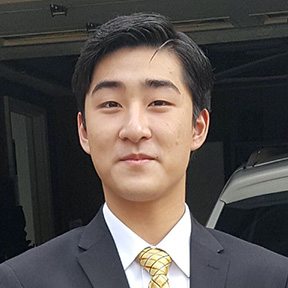 SEYOON CHOI: Not all disabilities are visible, which is why this episode is dedicated to exploring this topic. I'm excited to be joined today by two wonderful guests, and I'll let them introduce themselves.
LINA HOWARD: Hello, everyone! My name is Lina Howard. Along with being blind, I identify as neuro diverse.
ROGER SUAREZ: Hello! My name is Roger Suarez. I am blind and I have a hearing loss.
SEYOON: Thank you both for joining us today.
ISABEL ROSARIO: How do you both define invisible disabilities, and how do they intersect with your blindness?
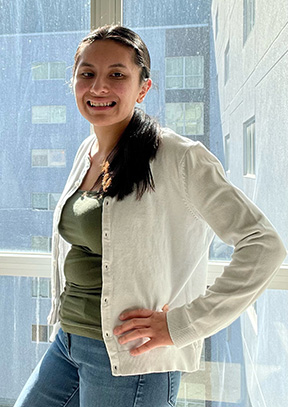 LINA: Wow! This is a good question! I feel like "invisible disabilities" is definitely a term that speaks for itself. They are disabilities that are not easily seen or noticed in any way, shape, or form just by looking at someone. I feel like my invisible disabilities intersect with my blindness in a way that not a lot of people notice. Unless you are in an academic setting with me, you wouldn't know that I have a learning disability. You wouldn't know that I struggle with math to the point of only being at about a sixth-grade level. In that sense I am able to conceal my invisible disability pretty well, and it doesn't necessarily intersect with my blindness on a daily basis. But when it does, it definitely takes a lot for me to reinvent the wheel, to make sure that not only am I getting the accommodations that I need for my blindness, but that I'm also getting the accommodations that I need to comprehend the material that I might be learning.
ROGER: I went to the DBVI Center [Department for the Blind and Visually Impaired] here in Virginia, and I use Braille and a white cane. But with my hearing loss it's a lot more complicated. I use hearing aids, but right now they're not of very good quality, and the poor audio affects me. It's also complicated because English is my second language; my first language is Spanish. My hearing loss and language issue give me some trouble with learning in general; some letters, such as t and p, b and v, or n and m I sometimes I cannot identify. I can't hear those sounds very clearly. Sometimes I don't understand, and then usually ask for repetition. Understanding is not impossible, but it can be difficult sometimes.
SEYOON: Thank you both for sharing. That was so full of insight! How did you first become aware of your invisible disabilities? Was it challenging to receive a proper diagnosis?
LINA: I first actually became aware of my invisible disability when I was quite young. I was originally told about it when I was five or six years old. I was told that I have a learning disability. At that age it doesn't really register that you learn differently from everyone else. After I was told I went about life still thinking that everyone learned the way I did. Then I started looking around my classroom one day and realized that I was one of only a few people getting one-on-one help. I was one of only a couple of kids being pulled out of my classroom at inconsistent points throughout my school day to work individually or in small groups on assignments or on concepts that other classmates were able to grasp in a heartbeat. That's how I started to realize that I learned differently from other people. I started to become observant, and I compared myself with other people my age. That was definitely a challenge, academically and socially, because it led to social isolation. It led to me not being able to relate to my peers in some ways, because I couldn't do math the way they did and I couldn't read as fast as they could. I couldn't grasp social situations in the way they could. So yes, it was very much a challenge.
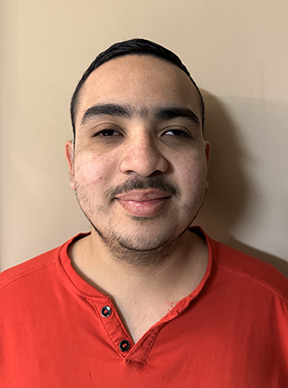 ROGER: I lost a lot of my hearing from taking a medication. There were five or six months when I couldn't hear a lot. My hearing loss was moderate to severe. I didn't have hearing aids for about six months. When I first wore hearing aids, everything was so different! For example, my hearing aids have a microphone, and outdoors when it's windy, when the wind is hitting the microphone, it really affects my orientation and mobility. I can't hear my instructor, and when I'm listening to traffic it's a little complicated. It's still kind of hard. I'm still trying to get accustomed. I'm still in the process of adapting.
ISABEL: You've shared a little bit about the challenges you face with your invisible disability. What are some unique challenges you face as someone with both a visible and invisible disability?
LINA: The first thing that comes to mind for me, given that I have a learning disability that affects my ability to do math, is the way I learned basic math skills. Many blind students who don't need any supplemental learning can replace a lot of the visual graphics with tactile work, such as math manipulatives that are easily comprehended for tactile learning. But for me it was all that and then some. I needed the tactile feedback, and I needed all of the supplemental material that was in print to be replaced. It resulted in a lot of trial and error for me, especially when I was learning basic math skills. I needed help comprehending the Nemeth Code for Braille mathematics. I needed to have more tactile graphics and more physical elements to help me learn basic math skills. Learning basic skills in the adaptive ways that most blind students learn, combined with having supplemental materials to help me comprehend, is a lot. It can be very stressful, especially for a student who is five or six years old, as I was.
ROGER: When it comes to my blindness, people can see the cane or the Braille. When I'm around other blind people, like when I go to an NFB National Convention, they cannot see my hearing aids. Even sighted people don't always see them, because they're black in color, and they blend in with my hair, which is black also. In the classroom it's hard for me to listen. Sometimes there's an echo or background noise. People don't always understand that I have a hearing loss.
SEYOON: Do you have support networks within and outside the Federation? Are there spaces specifically tailored to individuals with intersecting disabilities?
LINA: The short answer for me is no. Within the Federation I think we are still dealing with a bit of a philosophical change in the way we view blindness as it intersects with other disabilities, both visible and invisible. I think we're definitely moving forward in being more accepting of and catering to people who have additional disabilities. But I think we still have a way to go before we get to a point of having a good, solid support system within the Federation for people with a wide variety of other disabilities. As far as things outside the Federation, I have found a few Facebook groups that cater to people who have blindness along with invisible disabilities. I've been able to make a few connections through those Facebook groups, and I've been able to talk one-on-one with some other people who have been in relatively the same situation that I have been in. Unfortunately, aside from being able to make those one-on-one connections from those Facebook groups, there's not really a solid support system that's widely known out there—not one I've found, at any rate.
ROGER: There are a lot of resources focused on blindness. But as far as blindness plus hearing loss—maybe I didn't investigate enough yet. I found out there are guide dogs trained to help blind people who have hearing loss. I actually want to get a guide dog in the future. I'm still not sure how those guide dogs actually work with their owner.
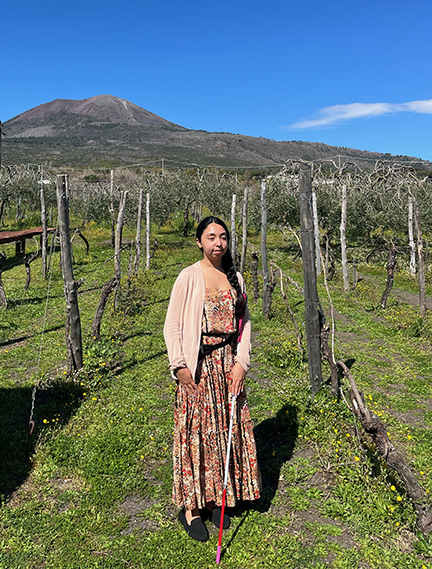 ISABEL: I'm excited to hear your perspectives. What role does advocacy play in creating inclusive environments and addressing the needs of individuals with invisible disabilities and blindness?
LINA: I'm so happy about this question—you have no idea! I think that advocacy plays a very integral role in making sure we can get comfortable with disabilities that are not just our blindness. Sometimes we can get very caught up in one disability or another, and we can make that disability our entire identity. But in reality some of us may be struggling with multiple disabilities. I think it's a very fine balance that we need to be able to learn not just about ways we can make the world better for those who are blind, but also ways we can celebrate other disabilities as well, making the world a more accessible place for people who are blind and have multiple disabilities. I think we as blind people need to keep open minds and be willing to learn about multiple identities and about how invisible disabilities intersect. I think that will be really important in furthering our advocacy skills, both in and out of the Federation, to make sure that EVERYONE has a shot at living the life they want.
ROGER: Sometimes disabilities come for different reasons and at different times. I think we need to know other people and be able to understand those disabilities all together. We know a lot about helping blind people, but we need to know more about helping people with other disabilities.
SEYOON: This upcoming question happens to be one of my favorites. Are there any specific assistive technologies that have helped you overcome challenges with your intersecting disabilities?
LINA: For me not so much now, because my learning disability doesn't tend to affect my day-to-day life, given where I'm at in my academic journey. But when I was first learning to navigate the world with the learning disability I have, it definitely helped to have auditory feedback. Technology that talked to me was very helpful. I was able to get all of what my peers were learning visually. I could hear it back and repeat it back if I needed to. Talking computers and calculators were very helpful when they were available. So were talking toys that had to do with math and numbers when I was a young child trying to navigate the world with my learning disability. All auditory feedback was very helpful.
ROGER: Sometimes my hearing aids are great, but as I said before, each hearing aid is different. A couple of years ago I got a device where my hearing aids could connect by Bluetooth to a device such as a cell phone or tablet. That helped a lot! It was great in an open space, where I could hear very well the computer or the laptop. One time in middle school there was a device where the teacher had a microphone and I could listen to the teacher through my earphones. It didn't work very well for me because there was a problem with the device. I think it was a problem with the hearing aids I had at that time.
ISABEL: Can you share any personal stories that highlight your journey of growth and resilience, things that helped you deal with your challenges?
LINA: The experience I will share is the first time I was really comfortable with verbally expressing the fact that I have a learning disability. It was my sixth-grade year. I had just started middle school. It was the beginning of the year, and everyone was still being placed in classes. All of my support staff came to discover that I still needed help with math skills. Therefore I could be placed in a smaller class compared to the mainstream class where most of my peers were placed. In past years I would have been very resentful and felt very insecure about it. But as the decision for me to be placed in a smaller class was explained to me, I had kind of an epiphany. I realized that this placement wasn't meant to be a punishment. It wasn't meant to be anything negative in any way. It was meant to help me. Because of the way it was explained to me, and because of the way my support staff was able to help me rationalize what was happening, I came to terms with this special placement. I hadn't been able to do so in past years. I was able to accept that every support person and every supplemental piece of education that I was getting was going to benefit me rather than hurt me.
SEYOON: Okay, let's go to the wrap-up. This is something we've been doing for the past few months. I'm going to give each of you one minute on the clock, and you will share a piece of advice. If someone had only one minute to listen to this podcast, what would you say to them? What advice would you give to individuals with intersecting disabilities who may be struggling with acceptance?
LINA: If I were to say something to my younger self about my intersecting disabilities, it would be that it's okay that you learn differently. It's not a sprint, it is a marathon. Comparison is a very hard thing to overcome, especially when you are of the age where social situations and academic situations are very much on display for your peers to see. It's okay to feel insecure, it's okay to name that, as long as you go to the right support people. If you go to people you know can help you on your journey to acceptance, you will be much better off than if you stay silent and struggle along. In short, it's okay to be yourself and not worry about what other people think.
ROGER: When you have a hearing loss, using a hearing aid will help a lot. It's okay for you not to feel shy or bad about asking for repetition. There may be situations where you feel very frustrated, very stressed, but there's always going to be a solution, a different way for you to learn. You still can work to do your best.
ISABEL: Thank you both so much for joining us! It's not easy to come on here and be vulnerable, talking about your disabilities. I know there are a lot of misconceptions about blindness and intersecting disabilities. I hope that the audience learns about the different kinds of intersecting disabilities alongside blindness and the challenges people face. For people out there who are experiencing intersecting disabilities and feel like they're alone, I hope this podcast showcases the idea that you aren't. The Federation has a diverse group of members, and there is a place for everyone. Thanks, you guys!
SEYOON: This episode really underscores that this podcast is a space and an outlet, along with many other resources, for people with intersecting disabilities to find their allies and make connections. Thank you both for being with us!