American Action Fund for Blind Children and Adults
Future Reflections Winter 2024 NOPBC NEWS
Meet the New NOPBC President: Cassandra "Cassie" McNabb McKinney
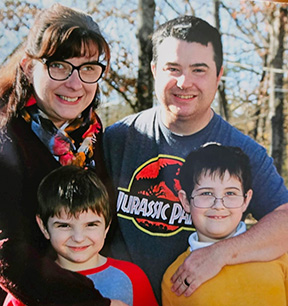 From the Editor: In December 2023 Carla Keirns stepped down from her position as president of the National Organization of Parents of Blind Children (NOPBC) due to her heavy professional responsibilities. Fortunately, NOPBC First Vice President Cassie McKinney was ready and willing to take on the duties and challenges of NOPBC leadership. In this interview she introduces herself and shares her plans and hopes for the parents' organization.
DEBORAH KENT STEIN: How long have you been involved with the NOPBC? What first drew you to the organization?
CASSIE MCKINNEY: I've been blind all my life. I have an eye condition called atypical nystagmus, which means I have quite a bit of vision, but I'm legally blind. I have trouble focusing because my eyes move around uncontrollably. My mother also has this condition, and so does one of my first cousins.
I got involved with the NFB in 2003. For several years I served as president of the New Hampshire affiliate.
I have two children, and my older son, Robert, inherited my eye condition. Two years ago, when Robert was six and starting school, I realized I needed to get involved with the NOPBC. I wanted to learn everything I could from other parents of blind kids, and I wanted to be able to advocate for Robert more effectively. I hoped I could learn to help other parents, too.
DKS: What was your experience like, growing up as a blind child?
CM: I grew up in west Tennessee. My parents divorced when I was nine, and I ended up living with my dad and my step-siblings. My parents made sure I learned to do all the usual household tasks—cooking and cleaning. I also learned to do yard work, like watering and mowing the lawn. When I was thirteen my dad taught me to change a tire.
My dad never went to college, but he was very education oriented. We watched lots of documentaries, and I was fascinated by Albert Einstein. Dad bought me a large-print encyclopedia. I loved to browse through it, learning new things.
DKS: What was it like for you at school?
CM: I never had an IEP [Individualized Education Plan] until I started high school. In grade school they made sure I had large print for standardized tests, but that was my only accommodation. Then, in high school, I finally had a teacher of the visually impaired [TVI], and I also started to get orientation and mobility [O&M] training. That really helped me build confidence!
DKS: What did you do after high school?
CM: My parents really wanted me to go to college. I was the first person in my family to go. By the time I went, I was pretty confident as a self-advocate.
I started out as a chemistry major, but I struggled with calculus. After I graduated I decided to use my science background in a way most people think is very unusual. I enrolled at the John A. Gupton College of Mortuary Science.
DKS: Did you know of any other blind people in that field?
CM: As far as I know, I was the first one. Fortunately the school was very receptive, very willing to work with me. I had open communication with my instructors, and we were able to work through any issues that came up. My self-advocacy skills were really a help!
Not many women worked in mortuary science back then, and there I was, a blind woman trying to find a job! I was willing to relocate, and I ended up getting an offer in faraway Keane, New Hampshire.
DKS: As president of the NOPBC, do you have any particular goals in mind?
CM: Through my own experience I know that advocacy and self-advocacy are really important. Blind children need to learn it's okay to say they can't do something in a typical way. It's okay to say, "I need something different so I can participate." Parents need to advocate for their kids when they're little, and bit by bit, teach their kids to advocate for themselves.
DKS: NOPBC is a national organization. What are your thoughts about building the parents' division?
CM: I'd really like to see the division rebuild into the dynamic group it was in the past. I'd like to see POBC (Parents of Blind Children) groups in every affiliate. We need to reach more families in every state. We need to build and cultivate relationships between our national organization and our NFB affiliates.
Right now we're beginning to reach out to our NFB affiliates to find out where they are in terms of parent involvement. How many affiliates have active parent chapters? We need to reach out to more parents and develop leadership. The PLP is one way for us to do that.
DKS: What is the PLP?
CM: PLP stands for Parent Leadership Program. We bring in parents from across the nation in conjunction with our annual Washington Seminar. We meet with the parents and try to infuse them with Federation philosophy and the history of the parents' division.
Later the PLP parents go to the NFB National Convention. They attend the NOPBC conference, and they connect with blind mentors. They attend two nights of PLP meetings as well as IEP Night, learning about advocacy at IEP meetings.
DKS: What advice do you have for parents of young blind children?
CM: When their child gets a new diagnosis, most parents really struggle. They have so many questions! They need to talk to other parents who are farther along on their journey. They need to connect with blind adults who are living active, productive lives. They also need help advocating for their kids.
DKS: Do you think your own experience growing up as a blind child will help you in this work?
CM: I've been a Federationist for a long time, and I know how powerful this organization can be. I'm the first blind person to serve as NOPBC president. I hope I can be a positive role model for other parents and for their children.
Last summer I saw firsthand the power of bringing blind children to our national convention. At home Robert didn't use a cane. He was very resistant to the idea. Then, when we went to convention in Houston, he saw kids with canes moving confidently all over the hotel, being very independent. Next thing I knew, he was saying, "Mom, can we go to the Independence Market? I want to get a cane. You know, sometimes I don't see stuff."
He got a forty-seven-inch cane, and he started using it right away. He knew just what to do. He used to walk very cautiously, but now, using his cane, he just takes off.
I want parents all over the country to know that their kids can gain that level of confidence. By working together I believe we can empower families of blind children all over the country, and we can give freedom and confidence to blind kids everywhere.