American Action Fund for Blind Children and Adults
Future Reflections Summer 2024 NEW DIRECTIONS
Cerebral/Cortical Visual Impairment: A Parent-Child Perspective
by Katie Lane-Karnas and Mae Lane-Karnas 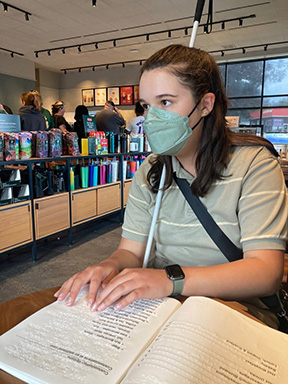
From the Editor: Like most of the general public, I once assumed that blindness and low vision are due strictly to anatomical differences in the eye or the optic nerve. In recent years, however, educators, physicians, and the world at large have begun to recognize cerebral/cortical visual impairment (CVI) as a form of blindness that originates not in the eye, but in the visual processing centers of the brain.
In this issue I am excited to present two thoughtful articles by and about young people who live with CVI. The following piece was written as a mother-child collaboration.
Mae Lane-Karnas (they/them) is a teen who loves Braille, math, and art. Mae has multiple neurological visual impairments as part of CVI, causing them to function at the level of legal blindness. Mae co-organizes an ongoing CVI discussion group at Smith Kettlewell Eye Research Institute and has co-presented nationally to clinicians, scientists, inventors, educators, and medical students about their lived experience. Mae emphasizes the need for nonvisual access for all blind students, including CVIers. Mae serves on the board of the National Federation of the Blind of Vermont.
Katie Lane-Karnas (she/her) is a long-time homeschooling parent. She facilitates her teen CVIer's learning in Braille, Nemeth code, access technology, and Orientation and Mobility (O&M). Katie authored a paper on her family's journey, "A Case Study on CVI, Reading, and Braille" that was published in 2023 by the Journal of Visual Impairment and Blindness (JVIB). Katie can be reached at [email protected].
Katie Lane-Karnas: We first learned about CVI when Mae was eleven years old. We were trying to figure out what was going on with Mae's print reading and writing difficulties. We had never gotten answers to our questions about the problems Mae had, and we realized that a number of their challenges are typical of people with CVI. For example, Mae struggled with extreme dysregulation in highly complex sensory environments such as crowded stores or parties. Mae had trouble following the movements of dogs or toddlers that appeared in their lower visual field. Navigating near traffic was another challenge.
From the time Mae was seven we were extremely concerned about their social and emotional difficulties. Mae had difficulty in groups with other children. Mae became stressed, controlling, terrified, and even enraged. I observed this reaction firsthand, since I almost always was present. Mae wasn't able to be in groups without adult support, and since we homeschool, I was usually available.
After a children's party Mae would return home emotionally and physically fatigued. They would lie in their room and zone out for hours or even days. When we discussed a difficult experience afterward, Mae would be intrigued and surprised to hear what I observed. When we exchanged our experiences of a difficult scenario, I discovered that Mae had missed a lot of visual and auditory information, as well as contextual clues and nonverbal body language. Often Mae's conclusions about what was happening were far removed from what others experienced. Lacking visual information, Mae was making guesses.
We sought help from doctors and other professionals, but no one suggested a sensory impairment or any other specific cause for Mae's difficulties. For years we addressed Mae's problems through the arts, sensory play, and a trauma-informed approach to nervous system regulation. We explored parent-supported friendships, exposure to nature, and deep dives into Mae's academic interests.
Finally, at age twelve, Mae was diagnosed with CVI. By that time Mae had the ability to self-reflect and to describe their visual experience. We made notes on the difficulties Mae described. Mae had no ability to imagine visually anything in their mind's eye, and there were no visual elements in Mae's dreams. Mae had no ability to form a visual memory. The only exception is color. Mae described a constant shaking of the visual world and difficulty perceiving motion. In any environment Mae only saw one small thing at a time. Among the other issues we discovered were Mae's inability to recognize faces, places, topography, objects, and letters.
Mae Lane-Karnas: I think what I noticed mainly were print problems that were hard to link back to my vision. My best way of explaining it was through oculomotor challenges. I had trouble with my eyes moving smoothly across lines and finding the next line down. I got headaches and eye muscle strain from reading and from looking at text that appeared to move on the page. Looking back now, I can definitely see how my CVI was having an impacta on me in quite extreme ways. Everyone around me assumed that my vision was normal, so I really didn't know that my vision was different from anyone else's.
The symptoms I experienced couldn't easily be linked back to visual problems unless one had an understanding of CVI. For instance, when I was in a less well-known environment like a museum or a playground, especially with groups of people, I would get extremely dysregulated and be stomping around. I tried to do everything as though I were playing a game. I had "teams." I could control my team and try to be a leader. In that way I could control my understanding of what was happening. My experience often had a physical element. It was a tactile way of getting information and feedback. Those symptoms were all caused by my visual challenges. I was trying to identify people around me when I couldn't see their faces. I was dealing with motion perception difficulties, topographical disorientation, and extreme visual fatigue that caused nervous system dysregulation.
Katie: Mae's childhood vision screenings were normal. They only test for acuity, and Mae's acuities were typical. Like many families of people with CVI, our path to evaluation was difficult and lengthy, and led to many dead ends. Eventually we sought out a doctor who was recommended by a CVI community member. He had published and spoken widely about the diversity of CVI presentations. His low-vision clinic was professional, and he welcomed family documentation. We traveled to another state to see him.
This doctor had a framework for how visual impairment at the brain level affects various developmental stages, including for those with CVI and typical acuities. A medical diagnosis was positively life-changing on a personal level, and it established documentation for Mae to have access to services and accommodations.
Mae: Before I was diagnosed, I was prescribed glasses with slight magnification. I almost feel they made things worse, unless I was focusing a very steady stream of vision at one place, such as sewing. But that was hard for my ocular muscles to adjust to. Glasses did not really help at all, and I would get quite frustrated because some eye doctors insisted that I use glasses, which was not the problem here. For a while I was extremely light sensitive. I got a special brand of light-blocking sunglasses, and we got light-blocking shades for our home. As I discovered more nonvisual ways to access my education and independent travel, my light sensitivity diminished greatly. I notice it comes back a bit if I try to use my vision beyond my capacity.
Before I got my CVI diagnosis, we were thinking about my visually-based academic challenges as general reading problems, and we addressed them with dyslexia interventions. My CVI diagnosis was like a new door that said "Vision Problem! Let's see what the reading strategies and accommodations are for that!"
Because literally nothing had worked with print, Braille was another thing to try. My mom and I started by ourselves, using mini muffin tins and balls of clay so I could learn the Braille alphabet. I learned five letters the first night, and I really, really wanted to start writing something! For the first time I realized that words are made up of letters, and those letters can be rearranged to make new words. I wanted to apply that knowledge! I got a piece of craft foam, a piece of paper, and a sewing pin head, and I started punching oversized Braille into my piece of paper. I wrote one sentence, and I was so excited! I had both my mom and my dad read it; I wrote another one, and had them read that. I was SO happy!
When we started really learning Braille, I was very scared. I was afraid that if I wasn't good enough at it, my Braille instruction would be dropped. I would lose the opportunity to learn Braille because others couldn't see how important it was. At that time I didn't have the words to express that learning Braille was the first time I had access to basic literacy, and I needed time to build up all my skills. Sighted children get chances to interact with print constantly, because print is everywhere. Braille is not, and it takes time to build up those skills. You shouldn't drop it after the first few experiences if a kid isn't picking it up "fast enough."
Katie: Mae says it so well! Mae had had years of highly modified, one-on-one print learning strategies, which only caused fatigue and stress. Now we observed that the access barrier to print was alleviated with Braille. We took it one step at a time. Mae's joy and mastery strengthened our resolve to proceed with Braille learning.
Mae is homeschooled, and Braille instruction is at home. As Mae said, we started completely on our own as a family; there is no support for special education of homeschoolers in our state. Slowly we built a support network, and now we have the help of professionals and blind adults. At fourteen Mae was able to access transition-age services through our state Division for the Blind. Mae now has greater access to support services such as instruction in the use of accessible technology. We have obtained Braille materials through our regional and state Braille libraries, NLS BARD, Bookshare, social media groups with free books to pass on, National Braille Press, NFB BELL® Academy, Seedlings Braille Books for Children, and through Federal Quota Funds.
Mae: In addition to Braille, I use a lot of other nonvisual tools. I use a long white cane, and I use JAWS and VoiceOver screen readers. I use a Brilliant BI-40X as a Braille display with my laptop, and I also use a Perkins Braillewriter. I also use various home modifications, such as putting tactile markers on the microwave.
Using my vision always has a price tag of energy. Before I discovered nonvisual ways to access the world, I was chronically visually fatigued. My autonomic nervous system was constantly disregulated from using my vision to do everything. Now that I have learned to use nonvisual techniques, I'm able to do SO much more! I pace my day so when I want to use my vision, I will have the remaining energy I need. Mostly I use my vision for hobbies (drawing and illustrating) and to supplement navigation and cooking. I use my vision to look at shows, along with the audio descriptions.
It's important for me to have nonvisual ways to do important things, because external factors can affect my vision dramatically. Sometimes I have no control over how much visual energy I will have available. Some common factors that affect me are heat; crowded, noisy, or cluttered environments; illness; emotional stressors; unfamiliar environments; and lack of sleep. My vision varies when I'm in the car and depending on how hard I have been trying to pay attention to something.
I think if I were in school, I might run into more problems around fitting in socially. My friends are very accepting, and they have reacted the best to my CVI. When I need to self-advocate, it always goes over fine. My friends will help me if I need it, such as providing me with information. They have needed little to no information about my functional vision. I think they understand quite well what my access needs are, and they always stand up for me. I feel I don't need to tread lightly around how I express my blindness with my friends.
One hard thing when I'm in a group of sighted peers is learning people's names and getting social context. Usually I request an accommodation, such as asking people to speak their names if they have a question or before commenting. I use a more auditory-based style of interaction. I've learned a lot from being in blind-led spaces with peers. I've learned how I want to interact and show up in spaces that are majority sighted people. I think carrying a blind identity with me (that I have learned mostly through the NFB) helps me feel confident. I know how much space I want to take up and who I want to be friends with, based on how they react to me being confident in my identity. I appreciate not having to explain when I use vision and when I do not.
If I could give advice to parents and teachers of kids with CVI, I'd tell them, Don't judge a person's functional visual ability based on what you see them do on the outside. A CVIer's internal experience may be drastically different from what you think you are seeing. The number of compensatory strategies in use can be astonishing. If you don't have a way to communicate about this with your child, please find adult CVIers who can share their experience.
Also, I want parents and older CVIers to be aware that medical professionals cannot always be trusted to understand what your child is experiencing. They don't always know to ask what the child's internal experience is, so they might not actually see any of the child's challenges. You have to get the professionals to help you. Document what you need them to know.
Katie: There is a history of children with ocular blindness and low vision having difficulty accessing Braille and blindness skills training. This is not a problem unique to CVI. The "threshold" of vision loss that is expected to be met before nonvisual learning becomes "warranted" is subjective, regardless of the cause of vision loss. I wish we had had the encouragement we needed from the beginning. Mae deserved Braille and a white cane. Intentionally developing and strengthening the use of touch, hearing, proprioception, and haptics does not diminish Mae's functional vision. In our experience, a child's increased facility to understand the world through nonvisual learning serves to better inform and solidify the visual information they receive. In Mae's case, we have seen that functional vision doesn't improve with training or other visually-based interventions. However, Mae's understanding of the visual world is strengthened, contextualized, and made less terrifying through the use of nonvisual senses, especially the sense of touch.