American Action Fund for Blind Children and Adults
Future Reflections Convention 2024 PROFESSIONALS IN BLINDNESS EDUCATION
Seeking the Holy Braille: The Promise of the Monarch
by Paul Schroeder
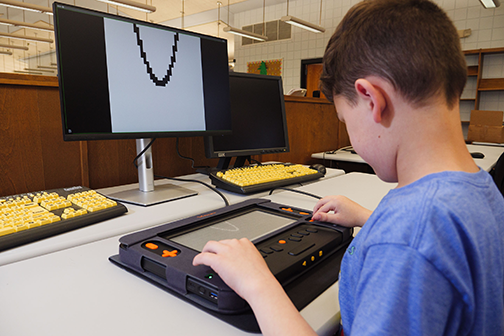 From the Editor: In the field of Braille technology, the Monarch is one of the most exciting developments to appear in recent years. At the 2024 NFB Convention, visitors to the Exhibit Hall had the chance to experience the Monarch firsthand. In this article, Paul Schroeder of the American Printing House for the Blind (APH) reviews the history of the Monarch and suggests how it can become available to more of the Braille readers who need it.
As a lifelong Braille reader and writer, I cannot imagine how I would have succeeded in education, employment, and life without ready access to Braille. I am now proud to work for the American Printing House for the Blind (APH), which has a longstanding commitment to providing access to Braille material. From improved embossing to portable Braille technology, APH is committed to putting Braille under students’ fingertips, whether on paper or through electronic displays.
It’s likely that many of you have heard about the Monarch, a revolutionary piece of technology that displays both Braille and tactile graphics, developed by and for people who are blind or have low vision. The Monarch is approximately the size of a 15-inch gaming laptop and weighs 4.5 pounds. It features a display surface that accommodates up to ten 32-cell Braille lines and has a total of 3,840 equidistant pins (dots). The Monarch has a standard Perkins-style Braille keyboard and HumanWare’s KeySoft interface, plus important controls such as page up/down and zoom in/out. It comes with USB and HDMI ports and Bluetooth and Wi-fi connectivity, as well as stereo audio output and an internet browser. It boasts a battery strong enough to keep the unit powered for a full day. The Monarch connects with APH’s free Tactile Graphics Image Library, allowing a student instant access to more than two thousand tactile graphics. Through a partnership with Desmos, students can graph tactile functions on demand with the built-in graphing calculator. Even more apps and functionality are on the horizon.
From the time the first device capable of rendering refreshable Braille appeared more than forty years ago, Braille readers have longed for a device that could deliver multiple lines of Braille. Developing such a device has proved extraordinarily difficult. Though many inventors have tried to develop a multi-line Braille display, our longing has remained unsatisfied. Some have described this quest as the search for “the Holy Braille.”
Just over four years ago, APH partnered with HumanWare to develop a portable device with multiple lines of electronic Braille. HumanWare devised the design for a multiline Braille display based on the Dot Braille cell technology developed by a South Korean company. This new Braille cell technology has the capacity to add extra dots for displaying tactile graphics. On September 17, 2024, a day I hope we celebrate for years to come, APH began shipping the Monarch to students.
APH has partnered with access technology companies such as HumanWare before, working together on Braille technology including the Mantis and the Chameleon. However, we knew that to bring the Monarch to fruition we needed deep engagement with our key stakeholders. Throughout the development of the Monarch, we met with blind students at the Center and worked in partnership with the National Federation of the Blind (NFB). This partnership provided ongoing feedback, testing, direction, encouragement, and advocacy support. We also engaged teachers. We solicited their feedback and let them test and train on the device.
Our priority in developing this new technology was to make textbooks available more efficiently, with the added functionality of navigation, search, and access to the entire textbook by harnessing the advantages of electronic Braille. As any consumer of Braille material knows, paper Braille books often come in many large volumes. In contrast, numerous entire books can be stored in electronic files on modern refreshable Braille devices. However, if you’ve ever read one of those Braille book files (usually called a BRF), you know that there are deficiencies with the format. To cite just one example, most books using BRF are set for a 40-character line. Reading them on a 20- or 32-cell display causes weird breaks and spacing in the middle of a line of Braille text. Since there is very little formatting in a BRF, navigation by elements such as headings is not available.
Furthermore, with only a single line available at a time, standard electronic Braille files are incapable of producing maps, diagrams, or other tactile graphics. For the Monarch to deliver the holy Braille, a better format for electronic Braille would be essential.
Fortunately, after some discussion and advocacy, the community of Braille producers and consumers was ready for a better Braille file format. More than forty international organizations coalesced to form a working group to support a new format in Braille. The Daisy Consortium, an international consortium of consumer organizations and producers of accessible materials, agreed to develop the new file format known as eBraille. Earlier this year, the first draft of the eBraille format was released.
In another important development, Duxbury, the company that produces the most widely used Braille translation software, agreed to adopt eBraille as an output format. Transcribers of textbooks and other material soon will be able to produce greatly improved electronic Braille. In addition, a converter to change BRF files to eBraille is moving toward production. It will provide a much better reading experience for existing material in BRF. In fact, eBraille will lead to a better experience with all Braille technology.
At this point, it may be helpful to understand what APH is and how it works. APH, as many likely know, was chartered back in the nineteenth century to make books to support the education of students who were blind. Eventually, technology and other educational materials were added. APH received a federal mandate in 1879 when the US Congress passed the Act to Promote the Education of the Blind.
This act designates APH as the official supplier of educational materials to all students in the US who meet the definition of blindness or low vision and who are studying below college level. By this federal act, Congress provided annual funding for APH to manufacture and furnish books and other materials specifically adapted for the instruction of students in the United States who are blind or have low vision. The system through which these specialized materials are distributed is known as the Federal Quota Program. Through it, textbooks and instructional aids are provided free for eligible students.
At the heart of this program is a partnership with schools for the blind, state departments of education, and other agencies that are responsible for ordering material from APH to supply the students they serve. You may hear the term “Ex Officio Trustee.” It refers to the individual at each of these agencies who is responsible for working with APH to identify and provide material for students.
The revolution sparked by the Monarch is in its very early stages. The students who start using the Monarch in this school year will have access to a powerful device, with much more to come. In fact, it may be more appropriate to think of the Monarch as both a Braille/graphics device and a digital content access platform. Digital content is now central to classroom education as well as to many jobs. Textbooks have largely been replaced with online course content, and schools and workplaces are filled with information conveyed through charts and images. With its Braille and graphics display and network connectivity, the Monarch will evolve to support on-demand access to digital content as it is posted and to enhance collaboration with sighted peers.
To address the age-old problem of making maps, graphics, and images accessible, APH has already developed a drawing app to allow anyone to create images for tactile display on the Monarch. We are expecting many more apps as developers take advantage of the opportunity to add to the Monarch’s functionality.
While the Monarch is ushering in a new era of access to Braille and tactile graphics, significant challenges remain. Electronic Braille is expensive. No doubt some of you have tried to obtain one of the excellent electronic Braille notetaker or display devices on the market today, only to find that the price point was difficult to meet. For many reasons, it is challenging to manufacture and deliver a robust and effective electronic Braille device, and we acknowledge that cost is a serious issue for consumers.
Fortunately, the federal government has seen fit to help support education for students who are blind or have low vision through the appropriation to APH. The Monarch is available through the federal quota program, and many of our eligible agencies already have made purchases. Other organizations have been able to use alternate funds to procure the Monarch. Parents and advocates can make sure the Monarch is included in a student’s IEP (Individualized Education Plan).
At APH we are launching our own student pilot program to ensure that at least one student in every state has access to a Monarch. This is only the beginning, but with a quota price of $14,900, we know that cost will be a challenge, even for the federal quota program.
As Federationists know very well, your collective voice can move policymakers to action. One potential way to help ensure that Monarchs migrate to blind and low-vision students is to convince Congress to increase the appropriation for APH. Most of the funding provided to APH by the federal government comes right back to the states and schools to procure books, aids, and technologies through the federal quota program. Persuading Congress to increase this funding partnership is a great way to invest in the education of students who are blind or have low vision, with products such as the Monarch. If you are interested in advocating for additional funding, I would welcome hearing from you at [email protected].
Meaningful progress in the realm of technology for blind people has come in fits and starts. I left high school more than two generations ago, and the technology available to accomplish classroom work was truly primitive. I managed, as most blind students do, through a mix of valuable support, perseverance, and brute-force memory. I longed for better ways to do math, explore maps, and appreciate scientific principles. I am truly grateful that I get to play a small part in giving this next generation of blind students and workers a remarkable tool that will put so much creativity and learning into their hands.
You can find more information about the Monarch at APH’s Meet the Monarch page: https://www.pathstoliteracy.org/@meet-the-monarch-from-aph/#main.