American Action Fund for Blind Children and Adults
Future Reflections Convention 2024 AWARDS
The 2024 Distinguished Educator of Blind Students: Dori Senatori
Presented by Carla McQuillan
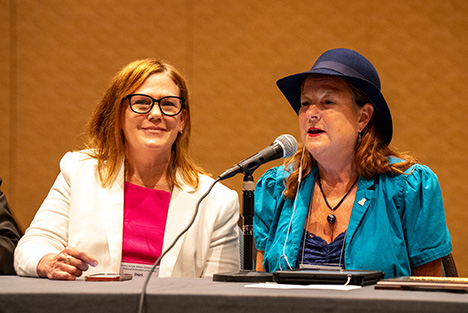 From the Editor: At the annual board meeting of the National Federation of the Blind, Carla McQuillan introduced the winner of the 2024 Distinguished Educator of Blind Students Award, Dori Senatori. Ms. Senatori received a prize of one thousand dollars, an expense-paid trip to the convention in Orlando, and a plaque in print and Braille. The plaque reads:
NATIONAL FEDERATION OF THE BLIND HONORS
Dori Senatori
As Distinguished Educator of Blind Students
For your skills in teaching Braille and other alternative techniques of blindness, for graciously devoting extra time to meet the needs of your students, and for empowering your students to perform beyond their expectations.
YOU CHAMPION OUR MOVEMENT. YOU STRENGTHEN OUR HOPES. YOU SHARE OUR DREAMS.
July 5, 2024
As Distinguished Educator, Dori Senatori had the opportunity to address the board of the National Organization of Parents of Blind Children (NOPBC). Here is what she shared about her experience and philosophy.
Hi, everyone! I’m Dori Senatori, and I teach at the Texas School for the Blind and Visually Impaired [TSBVI] in Austin, Texas. I’m incredibly honored to be selected as this year’s Distinguished Educator of Blind Students! I really have worked hard over the years to ensure that the students I work with have the services and supports they need, including ABLE accounts for financial security. I taught students ages eighteen plus for eight years, and that was one of the services I helped set up. I also worked on transitions, helping students shape their plans for the lives they wanted to live.
Our program is called EXIT, Experiences in Transition. Each year my students were different, and I would individualize the curriculum for each one. Everybody had different goals, but I always tried to teach the Core Curriculum, empowering students to live independently in their own communities. I always told my students, “You have a lifetime warranty with me after you graduate.” When they leave our campus, I want to be a resource to them and help them in any way I can. I still get emails years later, asking, “Do you still have my résumé? Can you share it with me?” or “Can you write me a letter of recommendation?” I help them connect with community agencies and other resources. What I love most is when former students call just to say hi and give me an update.
In the EXIT program at TSBVI we provide many opportunities for community connection. I realized a class needed to be added, so I implemented a class where we connected students with professionals in the community, and people working all throughout Texas. One way I did that was by coordinating guest speakers, usually in person, to talk with the students about their career paths and various resources. It was always helpful for the students to hear how someone else achieved their goals.
COVID necessitated that we had to move to having virtual speakers. As I was scrambling to figure all that out, I was put in touch with Rosy Carranza at the National Federation of the Blind. That was my introduction to the NFB. Rosy sent me virtual speakers, sometimes two or three people a month.
One of the things we did as community exploration was to meet each year with the NFB chapter in Austin. A group of NFB members would meet with my students. They talked about the NFB and explained how to join. We did that several years in a row, but I don’t think anyone ever joined the organization.
Then, as we listened to guest speakers, came a turning point in the way I taught. A lot of students came to the EXIT program with some idea of what they wanted to see in their future, but they had no good idea how to get there. Perhaps that was because they really had never seen examples of what that process might look like for them.
In my first few years of teaching at the Texas School, I tried to figure out how to combine my students’ perspective with my perspective as a teacher with vision. I knew something was missing from my curriculum. I really wanted to raise the bar and expose my students to different experiences, experiences I wanted them to integrate effectively as they transitioned into their adult lives.
By having NFB guest speakers, we started to have multiple perspectives. We heard from blind professionals all over the US. They were doing things that my students wanted to explore. I noticed that as they listened to guest speakers talk about their past experiences and how they reached their goals, our students began to get inspired. They got excited about who was coming next and what they were going to talk about.
After that year of virtual guest speakers from the NFB, I took part in the Teachers of Tomorrow program. That was back in 2021. It was as though a lightbulb came on! I thought, That’s what’s missing!
In the fall of 2021, I reached out to the Career Mentoring Program, which is for students ages fourteen to twenty-two. I asked them if they would be part of my class. I had seven students, and I wanted to teach them how to use mentors. I thought I could teach the overall program and collaborate with NFB mentors. The whole Career Mentor team was thrilled to work with us, and that’s when we embarked on this journey. We started the Career Mentoring Program at TSBVI.
We started with a handful of students. The first meeting was virtual; everybody met the mentors on Zoom. Then, in January of 2022, our in-person sessions began. Mentors come to the school and facilitate activities each month. I remember I was having students sign up for the program, and some of them were saying, “Wait! What? We have to do this every month? Why do you want us to talk to blind people, Miss Dori?” I was surprised by that one! Or they’d say, “This application is way too long! What am I going to say to these people? I don’t know them!” It was outside their comfort zone and maybe a little scary, but I knew this collaboration would turn into something really great. It’s exactly what I thought was missing in our transitions program.
To get back to one of the students who complained so much in the beginning. After a few months in the program, her attitude started to change. She happily participated in the monthly mentoring sessions. Instead of asking why we had to have all these meetings, she began looking forward to them. After graduation this student decided to go to the Louisiana Center for the Blind for training. Today she has her own apartment and attends community college.
Today that former student reminded me I used to say, “You’re in the driver’s seat.” I wanted my students to be empowered. I wanted them to understand that they can do it. It was just a matter of figuring out how to get there.
This past school year I was thrilled because my former student came back to mentor my current students as part of the Career Mentoring Program. I think that helped my current students. They saw an example of how someone can go from being a mentee to becoming a mentor. I’m honored to have served as their teacher.
This year we had a record twenty-two students participating in the program. I think the growth of this program can be attributed to the shared passion for teaching of all the wonderful NFB mentors who have worked with me and the students over the years. The program gave students experiences using nonvisual skills for everything from navigating a buffet line, calling for and riding in an Uber, and camping in a state park to traveling by plane on their own for the first time to attend the NFB Convention or Washington Seminar. Each session and all of these activities were facilitated by NFB mentors on and off the TSBVI campus.
Many students choose to continue participating in the NFB after they graduate from TSBVI. They can continue in the mentoring program through their postsecondary education. I’m always excited when I run into them at Convention! At this convention I counted seven, and in the past there were zero.
The mentoring program starts by matching my student with a mentor, possibly someone located in or near their home town. Because of their attachment to their NFB mentors I see many of my past students here today, rising as active participants in this community. I have witnessed students growing in ways I had not observed before they got involved with the mentoring program. I’m grateful for each and every opportunity I’ve had to serve Texas students and their families. I couldn’t have done it without the support of the NFB, as well as TSBVI colleagues and administrators. I will always keep this moment in my heart. It means a lot to me!