American Action Fund for Blind Children and Adults
Future Reflections Special Issue on Technology ADVOCACY
IEPs In the Twenty-First Century: How to Get the Technology Your Child Needs
by Sanho Steele-Louchart and Ather Jammoa
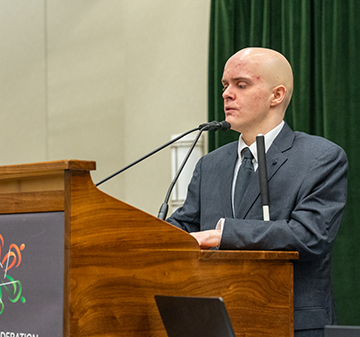 From the Editor: Sanho Steele-Louchart is a Legal Program Coordinator at the National Federation of the Blind. Ather Jammoa is an assistive technology trainer and a graduate of the NFB’s IEP Advocacy Academy. He contracts with the Departments of Education and vocational rehabilitation agencies to teach blind students of all ages.
Today a well-written and enforceable Individualized Education Program (IEP) is more important than ever before. As accountability for school districts diminishes, the success of blind children depends upon specialized instruction, materials, and technologies that are advancing every day. Regrettably, practical constraints often combine with attitudinal barriers, resulting in districts that are content to give blind students tools that are decades behind those of their sighted peers—and sometimes no tools at all.
The National Federation of the Blind hears regularly from families of blind children that their local school districts fail to provide accessible technology or the services required to ensure that a student can use that technology effectively. Section 300.105(a) of the Individuals with Disabilities Education Improvement Act of 2004 (IDEIA) states: “Each public agency must ensure that assistive technology devices or assistive technology services, or both . . . are made available to a child with a disability if required as a part of the child’s (1) Special education plan . . . (2) Related services . . . or (3) Supplementary aids and services.” The Act also states, “the use of school-purchased assistive technology devices in a child’s home or in other settings is required if the child’s IEP team determines that the child needs access to those devices in order to receive [a free and appropriate public education] FAPE.” This means that a district may not implement a practice, policy, or procedure barring blind students from learning and using accessible technology at home and in the classroom as needed. Parents of blind public-school students cannot be forced to pay for their blind children’s accessible technology, hire teachers to train them on that technology, or to leave it at school if the child needs to use it at home.
Section 300.5 of IDEA defines assistive technology as “any item, piece of equipment, or product system, whether acquired commercially off the shelf, modified, or customized, that is used to increase, maintain, or improve the functional capabilities of a child with a disability.” Importantly, this means that anything from a cane or tactile graph paper to a laptop or Braille notetaker falls neatly within the definition of assistive technology. School districts may not withhold these materials or the training to use these materials from the students who need them.
.png)
The other complaint we receive most often from parents is that the district will not or cannot teach their child to read and write Braille. Here again, the Act mandates: “The IEP Team must ... in the case of a child who is blind or visually impaired, provide for instruction in Braille and the use of Braille unless the IEP team determines, after an evaluation of the child’s reading and writing skills, needs, and appropriate reading and writing media (including an evaluation of the child’s future needs for instruction in Braille or the use of Braille), that instruction in Braille or the use of Braille is not appropriate for the child.” We argue successfully that this is an extremely high bar to clear. It is the rare district indeed that is willing to commit in writing that a blind student will never need Braille in the future, regardless of how much residual sight that student has currently. It is also the case that the advent of Braille displays, Braille notetakers, and Braille screen input have made Braille more ubiquitous than ever. Far from obsolete, Braille input and output are now go-to methods for using everything from cell phones to e-readers.
It’s one thing to recite the law. It’s another thing entirely to get the school district to follow it. We appreciate that age- and stage-appropriate Braille, technology, and orientation and mobility skills are usually the most contentious issues at a child’s IEP meeting. Unless the family intends to move, they will be working with that district for years to come. This is why, no matter how well versed in the law someone is, we recommend bringing an advocate or ally to a difficult IEP meeting whenever possible. This person is best situated to read the room, remain calm, and remind everyone of their legal obligations while remembering to center discussion around the child.
When we examine a proposed IEP, we ask several key questions.
- What are the student’s present levels as recorded in their last evaluations?
- How recently were those evaluations conducted?
- Were the evaluations accessible, reproducible, and valid?
- Which services are being provided, how often, and by whom?
- How many service minutes does the student receive according to the existing IEP, and are those minutes being provided?
- Which accommodations are being provided for the student? Is the student receiving materials in an accessible format and at the same time as their sighted peers?
- Is the student being taught effective communication skills, including Braille and accessible technology?
- Is the blind student independently doing everything their sighted peers are doing, including reading, writing, traveling, self-advocating, and accessing devices?
A district will sometimes claim that, because their teacher of the visually impaired (“TVI”) doesn’t know how to teach Braille or access technology, the district doesn’t have to provide instruction in these areas. This argument is incorrect. Section 504 of the Rehabilitation Act of 1973 and Title II of the Americans with Disabilities Act of 1990 both contain clear requirements that someone with a disability has the right to receive government communications in an accessible format, while the Individuals with Disabilities Education Act of 1975 and the Individuals with Disabilities Education Improvement Act of 2004 stipulate that the school district must provide the services for a student to access that effective communication. Areas without teachers of blind students aren’t exempt. Instead, such districts are expected to contract out, in-person or online, to ensure that blind students have the instruction they need. The availability of remote instruction in 2025 means that no student should go without.
Once evaluations are done, present levels established, and services promised, the IEP team must create goals and benchmarks that are legally binding. These goals must be relevant, measurable, and valid. A new teacher must be able to read the IEP, know which goals the child is working toward, know when the child has reached each goal, and recognize the conditions under which they should be able to do it again. The structure of a goal should read in this way: “Student will do A in B out of C trials with D or fewer E as measured by F.” Once age- and stage-appropriate goals and benchmarks are created, the team must assign sufficient monthly service minutes to meet those goals. Students who have been denied appropriate services may receive compensatory education (“comp ed”) before, during, or after the school day to help make up for lost time. Students needing additional services beyond the typical school year may benefit from an extended school year (ESY).
Finally, we know that many instructors and administrators sincerely don’t know where to start. Professionals seeking Braille fluency may contact Louisiana Tech University to inquire about Braille classes specifically for practicing teachers and paraprofessionals. Instructors wondering which technology skills students of different age ranges will need can review lists maintained by the NFB’s Center for Excellence in Nonvisual Accessibility, the Perkins School for the Blind, and other organizations. Anyone wondering how to teach those technologies may contact the device manufacturers directly, download user manuals, and watch training videos online.
For more information, teachers and school administrators may contact Karen Anderson, Education Program Coordinator, at [email protected]. Families seeking advocacy assistance may contact Sanho Steele-Louchart, Legal Program Coordinator, at [email protected] or Ather Jammoa at [email protected].