American Action Fund for Blind Children and Adults
Future Reflections Convention Issue 2025 NOPBC CONFERENCE
The Challenges We Face
by Conchita Hernandez
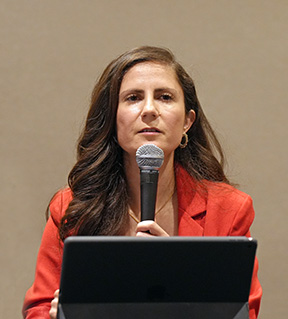 Introduction by Cassie McKinney: We’re very honored to have Conchita Hernandez with us today. She’s going to talk about some of the efforts we have been making to broaden the reach of our organization.
It is an honor to be here and to speak with you all. Actually, I’m going to go off script today. If you thought I was going to talk about my story, I’m sorry to disappoint you. The issues we’re facing right now are far too important, and I want to share that with you. You can Google me if you want to learn about me. Now please find something to take notes with, because what I’m going to say is really, really important. A lot is happening right now that specifically impacts our blind children. I want to share with you the urgency of those things and the steps you can take. I want to talk about federal funding and the misinformation around it.
When people talk about federal funding, many times they have no idea what it actually means, or all of the things that the federal government actually pays for, supports, and provides. Cutting federal programs is going to be devastating for our children. The federal cuts that have been taking place and others that have been proposed will affect every single aspect of your child’s life, from education to employment. This includes bills that have passed and others that are being proposed. This includes both short-term and long-term goals. I want to be clear—this has nothing to do with Republicans or Democrats. I want to let you know specifically what you can do to support the future of your child, and I want you to be informed and understand what it means.
If you think that these things do not impact you because you homeschool your child, or you think IDEA is going to be fine, I want to give you a little reality check. I need you to understand that by two years after your child graduates from high school, they have received at least a million dollars in federal funding. If you thought your child is valuable, just know how valuable your child actually is! You have a million-dollar baby walking around that gets funding in many, many different ways, ways you don’t even realize.
I’ll give you some examples of what that looks like. In public schools students receive OT and PT services—occupational therapy and physical therapy. Some, though not all of it, is funded through Medicaid dollars. You may think, that’s okay—my child doesn’t receive those services. Well, let me tell you what. When those positions are cut, it is absolutely going to impact your child. A school is an ecosystem. I have worked in schools everywhere, and when one position gets cut, everyone else is left to fill in the blanks. Our children have never been the priority in public schools. They never will be the priority, unless you show up and demand it. Schools already are making difficult decisions about what to cut, and they will never protect our kids first.
Whether you know it or not, your blind child in public school receives blindness-related products through the American Printing House for the Blind. These products include your child’s Braille display—Braille displays don’t just show up out of nowhere! This includes your child’s magnifiers. This includes your child’s JAWS license if they receive it through school. American Printing House for the Blind is federally funded. They receive an appropriation from the government, and they are being targeted for cuts. That would mean no Braille displays for your children, no magnifying devices, no JAWS licenses.
Teacher training. We already hear about the shortage of teachers of the visually impaired or teachers of blind students. The federal government funds teacher preparation programs. How many of you are from Louisiana Tech? Great! I’m a proud Louisiana Tech grad myself. Louisiana Tech receives federal funding to pay the cost of tuition to help support students going into the field of blindness and visual impairment. If these proposed cuts happen to these programs, we’ll have an even greater shortage of teachers for your children than we have now.
Has your child ever attended a special camp—a space camp? a STEM camp? any other recreational program? Guess where that money comes from! It’s federal money! Those programs are going to lose funding. Has your child ever participated in a program where they stay away at a college or university? That is going to be impacted; university programs are currently losing funding. Remember, we’re the smallest disability group. They’re not going to give us priority over research needs—they’re just not. Everything is connected.
Transition services. If your child is fourteen or above, they should be receiving transition services in public school. If they’re not, check with your IEP team. Those services help your child transition from high school to college. All those transition services and programs are being targeted.
Blindness training centers. How many people here went to a blindness training center? Training centers that are private and those that are public all receive federal vocational rehabilitation money. All NFB training centers receive that money. In fact, your child or student cannot go to a center unless they receive the federal money that goes along with it. Do you want your child to attend a blindness training center when they grow up? This training is in jeopardy.
Does your blind child receive books from the National Library Service for the Blind (NLS)? Guess what—NLS is federally funded! These libraries specifically are being targeted for defunding. Your child will have even less access to Braille and audiobooks than they have now.
Does your child use Bookshare for free? If you don’t use Bookshare, get it! It’s an amazing free service for students. But Bookshare is federally funded. If you have signed up for Bookshare’s newsletter, they sent a bunch of emails: please donate! Please donate! That’s because they can see the writing on the wall. They know they’re being targeted, and they may lose their federal funding.
There’s a lot more I could talk about pertaining to the public schools but now let’s move on to your child after high school. Your child’s success as a blind adult depends upon federal funding. Let me break it down. No other population depends more on federal funding than our blind population does. That’s because people don’t want to hire us, and they tell us straight to our faces. I am highly qualified. I have a doctoral degree, I have many years of experience, but I was told to my face that they would not hire me because I am blind. Our degrees, our experience, our affiliations, even with all that, most people see us as “less than.” That may not be the case when we’re in settings like this with such amazing people, but it is the reality in the wider world. Every single blind person has at least one story of being humiliated, discriminated against, or right out excluded. Many of us encounter this on a daily basis.
Contrary to popular belief, when this happened to me, I did not sue. I don’t have time for that—I need to pay bills. Many of us do not sue. Discrimination is a reality for all blind adults. We all have stories of being denied job opportunities.
The programs that ensure that your blind child is employable go through vocational rehabilitation services. Vocational rehabilitation is federally funded. Yes, rehab is state-run, but it receives federal money.
The Office of Civil Rights is the office that defends Americans against discrimination. Many people think of the Office of Civil Rights as just to protect people of color from discrimination. Did you know that the largest cases with the Office of Civil Rights involve discrimination against people with disabilities? We are being denied employment, being denied housing, and being segregated.
These cuts impact every aspect of your child’s life—where your child is going to work, where they’re going to live, and how they’re going to function in society. All of the protections through the Office of Civil Rights are at risk. The Office of Civil Rights has been gutted. If you decide you’re going to sue your school system and take your case to the Office of Civil Rights, good luck right now finding someone to take your case!
The employment status of your children is at risk. The work status of your children is at risk. Their ability to find housing and be allowed into the community is at risk. Does your child take alternative transportation? Guess what! It’s federally funded!
Why do you think so many blind people work for the federal government? (By the way, many blind people already have been fired.) It’s because the federal government has specific anti-discrimination policies in place that allow blind people to be hired. No other organization has these protections.
We currently have protections in place, and the unemployment rate for blind individuals is still abysmal. Some people quote it at seventy percent. If we lose the protections we have had, I shudder to think what that’s going to mean for us!
For those of you with kids who have multiple disabilities, these cuts will mean institutionalization. The programs that currently keep kids living in the community are federally funded. States receive federal funding for community living grants to pay someone to come to your home, to pay medical bills if your child has complex needs. All of that is in jeopardy. Right now, conversations are taking place about building institutions for people with disabilities and having nationwide registries. This should scare the heck out of us!
So, I’ve laid out the issues. Even though I may not sound very optimistic, I believe that with collective action we can turn things around. The reason blind people have the best Social Security benefits (we get more benefits than anybody else!) is because of the collective advocacy of the NFB. The reason there are some protections on accessibility in higher education is because of the NFB. The reason content must be made accessible online is because of the NFB and all our combined efforts. The reason you see so many competent blind adults here today is not by chance. Our training and opportunities have been won by the sweat, tears, protesting, advocacy, and legislative action of the people here. Many of the older blind people you see here today are responsible for the changes that we take advantage of. And—it’s all federally funded.
Perhaps you’re asking what life was like for blind people before all this federal funding was in place. Let me tell you. We were not allowed to attend public schools. Often, we were institutionalized. Sometimes we were sterilized. Most of us were unemployed. We are not willing to go back to that!
What can we do? Either we can get anxious and sit and watch things fall apart, or we can be part of the solution. I’ll tell you three things you can do immediately that will have a huge impact.
The first one is legislative advocacy. You need to build relationships with your members of Congress, both at the state level and the national level. You can learn to speak their language. Take your children with you. Your elected officials need to hear from you. You should know who they are by name, and they should know you by name, too! You need to share how these threatened programs impact your family—not by being confrontational, but by being respectful, honest, clear, and concise.
You can share data and heartfelt stories. Learn to tailor your message based on who you are talking to. If you’re speaking to Democrats, you need to use word such as equity and inclusion. Speak to the importance of the programs and how you are counting on them to vote in your interest, to protect the future of your child. If you’re speaking to Republicans, use words such as job readiness and future taxpayer. Talk about long-term savings due to short-term costs. Praise them for things they have voted on that have benefited your child, because they have done that! They have voted on things that have benefited your child. Do your research on areas that they specifically care about and connect those areas to your child. Make them a champion for your cause.
Do not believe the inaccurate idea that you should not visit your members of Congress who you disagree with. All of this is far too important for that nonsense! You need to set political affiliations aside and become friends with them. Offer yourself as a resource if they need information on the education of blind children. Believe me, they will come to you if they feel they can trust you!
You need to be strategic. If you’re trying to build relationships with your members of Congress, please don’t be the same person protesting against them! Decide who in your group is going to do the protesting and who is going to do the policymaking! (Laughter) We need both. You need to be strategic. No one, and I mean no one, is going to save your kid for you—not Democrats, and not Republicans. You need to step up, tell your stories, be present, and change minds.
I often say it’s really, really hard to be an introverted blind kid. You always have to be speaking up for yourself, saying, I need this, I need that. I’m going to say the same thing to you parents. You need to learn your rights! You need to visit your Congresspeople. You need to speak up for the education and future of your blind children. If you don’t, no one else will. The NFB needs you to be allies, because the NFB cannot do it without you.
You are raising the child you have, not the child you imagined. In the same sense, we live in the world we have, not the one we imagined our children would grow up in. Being passive is no longer a choice or a path you can take. Decisions are being made right now, with or without your consent.
Item A: How do you find out about what is taking place? Obviously, I recommend participation in this organization, the NFB. Follow the NFB on social media. You also can follow the American Association of People with Disabilities—they constantly post information on action such as calling your Congresspeople. Reach out to the NFB legislative director. They can help support you in being politically active—because your blind child is federally funded!
Item B: You need to be the leader in the education of your blind child. Is your child a Braille reader? I’m so sorry, but there is no longer any excuse why you should not be learning Braille yourself. There are YouTube videos, there’s the Hadley School for the Blind, and there are lots of blind people here who can help you. You need to step up your education for your child, because no one else is going to do it for you. Learn about something called the Expanded Core Curriculum. It covers areas that your child needs to learn.
You are your child’s best teacher. Ask your child’s teachers how you can reinforce at home what they are teaching in school. If you expect the school system to teach your child everything they need to know in order to be successful, let me tell you something: there are not enough hours in the day for them to do that! And there is a shortage of teachers.
Item C: The biggest thing you can do at home to support your child is to give them chores. You don’t know how to teach them about doing chores? There are literally thousands of people here for you to ask, and there are going to be sessions on this later today.
Find blind mentors, not just for your child, but also for yourself! Ask them all the questions you have. Gather their contact information. Stay in touch. Get as many perspectives as you can from the people who are here today. Use this opportunity to change things for yourself and for your child.
I will leave you by saying that the future of your blind child is in your hands. You need to know now more than ever how to advocate and how to step it up. Together, and only together, can we create a world where every blind child has the best opportunity possible. Thank you!