American Action Fund for Blind Children and Adults
Future Reflections Convention Issue 2025 NOPBC BOARD MEETING
Skills for Success: A Conversation with Sarah Kassim, Briley O’Connor, and Roland Allen
Introduction by Cassie McKinney: I’d like to introduce the panel that will lead our next discussion. This afternoon we have Sarah Kassim, who is the parent of a blind child and a teacher of blind students. Next to her is Briley O’Connor, who is also the parent of a blind child. Finally, we have Roland Allen, who works at the Louisiana Center for the Blind as an orientation and mobility instructor. I’ll let each of them have a minute or so to introduce themselves, and then we’ll ask them some questions.
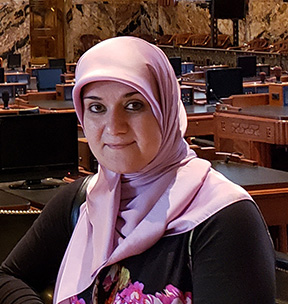 SARAH KASSIM: Hello everyone! My name is Sarah Kassim. I actually live in New Orleans, so this convention is in my back yard. I also happen to be president of the Louisiana Parents of Blind Children, and a lot of my board members are here with me today. My daughter Narjis is in the back of this room. She recently was diagnosed as a deafblind student. My husband is here, and my older son Amir is here for the very first time.
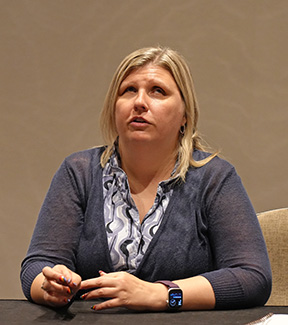
BRILEY O’CONNOR: I’m executive director of the Minnesota Center for the Blind, formerly known as BLIND, Incorporated. I’m also the parent of Silas, who is ten. He’s blind, and he’s at Grandma Camp this week. Next year he’ll be old enough for Youth Track, and I’m going through things about that!
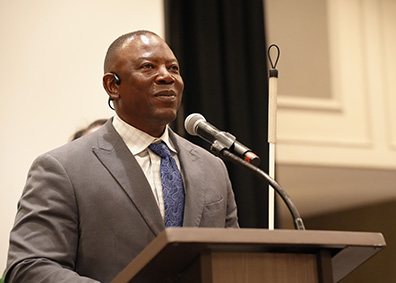
ROLAND ALLEN: Hello, everybody! I’m Roland Allen, and I’m a cane travel instructor at the Louisiana Center for the Blind. I’ve been teaching travel since 1995. I went to the training center in Ruston in 1986. This is my thirty-ninth national convention! [Applause] I was born in New Orleans, on the West Bank, which is across the river. It’s so good to have you guys here!
CASSIE MCKINNEY: A lot of times families come to us fairly early in their child’s education. One of the questions we get asked a lot is, “How soon should we begin independent travel with our child?” Who would like to answer that question?
ROLAND: When should you start? I believe that the process of moving toward independence starts right away. As soon as that child can hold a cane, put a cane in their hand. We have some great kids’ canes at the Independence Market. It’s important that kids get connected with someone who can show them how to use the cane, but as a parent, you’re going to be their number one cane instructor.
 BRILEY: When I was an instructor, I had a lot of students who had been blind all their lives and had an incredibly low threshold for discomfort. If you would let your sighted ten-year-old walk to the gas station to get a candy bar, that’s a goal you should also have for your blind ten-year-old. Encouraging age-appropriate goals builds your child’s threshold for discomfort. That’s not just a life skill to do with travel. It’s a skill that can help your child move through life as a blind person. What happens when you get lost? What happens when you wander through the lobby of this hotel thirty-seven times because it’s so loud? Do you stand still and quit and wait for someone to come along and save you? I’ll tell you what—a lot of the students I’ve worked with, that’s exactly what they do! They will stop and not engage because they think somebody will come rescue them.
SARAH: Before she used a cane, my daughter Narjis bumped into things a lot. She wore out so many shoes because she’d use the front of her foot instead of a cane. She had some vision, and I didn’t really think the white cane would benefit her at all. I was one of those ignorant people asking, “What can a white stick do for a kid?” I’d never been exposed to the blind community. This was one of the gifts we received as parents. We got to learn that the opportunity remains.
My first NFB convention was the state convention in Louisiana. Apart from that I had many mentors. I had a close connection with the director of the Instructional Materials Center, Robin King. Robin introduced me to Jennifer Hart, who’s here with us today. She told me I needed to go to the Louisiana Center for the Blind [LCB], which was the best gift anyone could have given me! I went to the LCB, I learned about technology, and I got to take their O&M class. I experienced the benefit of the cane; how wonderful it can be.
 ROLAND: As a cane travel instructor all these years, I’ve worked with a lot of people. I’ve met blind adults who had never crossed a street by themselves! I put together an entire list of things my students had never done! You don’t want your kids to be like that. I’ll be happy to train them, but it’s much better if you give them the opportunity to be kids and to experience things. If they bump into things, so what? Start them early! You guys can help them a lot if you start now.
CASSIE: A lot of the technology that’s available today was not around in 1986, when Roland came to his first convention. It was not available when I came to my first convention in 2003. Technology has advanced so much! In a world of technology, what are the advantages of pushing for Braille? Do you think that technology should be pushed over Braille?
BRILEY: I think it’s a mistake to believe it’s an either/or proposition. It’s not. We need to focus on the outcomes. Braille is analogous to print. Braille is literacy for your blind child. There are some rare exceptions, but most children with visual disabilities can be proficient and functional Braille readers if they have the appropriate time to learn it and if it’s integrated into their curriculum.
Sometimes a professional will say to you, “Braille is obsolete, and it’s going to go away.” They’ve been saying that for twenty-five years, and we still use Braille. Sometimes when professionals tell you your child won’t need Braille, it’s because they’re not comfortable with Braille themselves. What they’re telling you is code for, “I don’t really know Braille, and I don’t know how to teach it.”
To be successful under those circumstances, it helps to bring in an advocate. I’ve been an advocate for many, many families. When it’s your own young’un in that IEP meeting, and your blood pressure is really high, don’t be nervous about bringing an advocate with you. Have someone look at your IEP. If you’re not sure where these results came from, if you don’t know how they got these present levels of performance, ask for their assessment data.
What I’ve found to be most successful is to meet with the teachers separately and try to get to the root of the issue. Usually, it’s not about Braille versus technology; it’s more likely that the teacher is not equipped to serve your child.
Provide your teacher with resources. Connect them with Casey Robertson. Connect them with people who have the skills to help them be better teachers. Start with the presumption of best intent. Most teachers are not in it for the pay! They’re in it because they want to help. They want to do a good job, but many of them just don’t know how. Direct them to our Teachers of Tomorrow program and other resources.
If you are wondering whether your blind child needs Braille, the answer is yes! You use print, right? For blind kids reading Braille is the equivalent to reading print.
SARAH: You need Braille and technology both, alongside each other. It isn’t one versus the other. Braille alongside technology can be very beneficial. I wouldn’t start with Braille and then say, “Once she gets old enough, let’s bring technology on board.” Kids need to learn both at the same time. As we know, it’s really hard to get Braille books on time, especially school textbooks. If we can download a book as an electronic file, our kids can get instant access. It might not be exactly the same access, with the graphs and everything, but it’s access. Now we have the Monarch, which is going to be a great thing when it comes to graphics.
ROLAND: This is great information. I believe that it’s very important to start with Braille. I’m pretty old school when it comes to technology versus Braille. I believe that Braille is the foundation. Besides, technology is very expensive. The slate and stylus is low tech that you can carry around anywhere.
CASSIE: Who in this room knows that the NFB gives away free slates and styluses? [cheers] We give away free white canes, too! Go to nfb.org and search for Free White Canes. You can get one every six months if you need one. You can get a free slate and stylus, too. The NFB also gives away free Braille books to children. Please take time to sign up for all of those programs.
Before we wrap up, does anyone in the room have a question?
CAROL CASTELLANO: Can you speak a bit more to early cane instruction for kids with low vision?
BRILEY: I have always been blind, and I was raised full NFB, with Braille and a cane. I was really lucky in that sense. My own kiddo, Silas, is blind with quite a lot of functional vision. If that’s your kid, pay attention to me now. Listen!
It is challenging for you as a parent, and it’s also challenging for your kiddo in ways I have had to learn to appreciate as a blind parent. I have had to figure out how to navigate the system. If Silas were totally blind, print wouldn’t be an option. The school would have to provide everything in Braille. But I hear, “It’s just in print this time, because we forgot to send it to the teacher,” or, my favorite, “It’s just in print because he likes it better.”
Learning the Braille code is great, but it doesn’t matter unless kids have real curriculum access in the classroom. For Silas as a dual media learner we determined that, for anything literacy related, he would produce and receive all assignments in Braille. Other subjects, for the moment, he does in print. That system has been successful.
I understand we don’t want to force our children to do things. But sometimes they don’t want to eat green beans, and we make them eat green beans. Should your child learn Braille? Sometimes the answer is simply, “You have to do this.” When they’re seven or eight, they won’t understand the long term. They won’t understand, “When you’re eighteen or twenty you’ll appreciate this.” Set clear expectations and give the teacher permission to set boundaries and expectations, too.
Last year Silas was supposed to get Braille instruction four days a week. The IEP looked great! Then I found out two months later that he was not getting his pull-out services because “He didn’t want to come.” They didn’t tell me! You can imagine when that boy got home that day!
If you establish that you’re on their team, then the teachers have permission to set boundaries and expectations with your children. When a teacher looks at you and says, “Braille is always going to be slower,” get a new teacher if you can, or connect that teacher with someone who can educate them.
SARAH: I think the most important thing we need to do is set high expectations. Just because a child is blind or deafblind, we can’t say, “We’ll exempt them from this assignment.” Anything the sighted students are doing, we should expect our children to be capable of doing, too. [Applause] As a parent I have the benefit of knowing how to read and write Braille, thanks to Casey Robertson, who was my mentor. She always helped me and supported me in any way she could. If my daughter didn’t have access to something, I told her teachers, “Let me know. Text me. I’ll make sure she has it. She has the will to do what her classmates are doing, even to go above and beyond.” Narjis’s expectations are way above those of the rest of her class.
CASSIE: If you have more questions, you can go to nopbc.org and send them to the president’s email. I’ll make sure they get to one of these folks, and you will get an answer.