American Action Fund for Blind Children and Adults
Future Reflections Convention Issue 2025 GENERAL SESSIONS
Building a Constellation of Opportunities: A Blind Astronomer Researching the Cosmos with Multisensorial Perception
by Wanda Díaz Merced
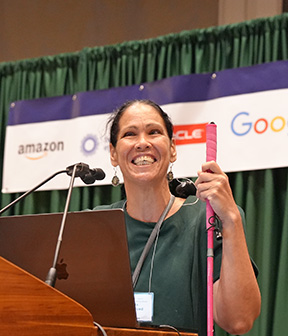 Introduction by President Mark Riccobono: Our next speaker became blind as a teenager, and like many of us, she was unsure what that would mean for her life. Fortunately, she learned about a radio astronomy project. It captured her imagination and gave her motivation for an entire career.
One of my first assignments as a staff member for the National Federation of the Blind was to put together a science program. Starting in 2003 I was part of our key relationship team with the folks at the National Aeronautics and Space Administration (NASA). I spent a lot of time with the folks at the Goddard Space Flight Center. In 2005 there was a lot of talk about a young blind woman who was an intern at Goddard. I don’t think we actually met at that time, but I heard a lot of talk about Wanda Díaz and the work she was doing as an intern. Our stories intersected there, and they come back at this moment twenty years later. Today we have the opportunity to hear from a blind woman who is living the life she wants, pursuing research in astronomy. She’s a leader in her field, especially in sonification and many areas that I don’t well understand. I connected with her when I had the opportunity to attend the convention of the National Federation of the Blind of Puerto Rico last year. Here to speak with us about her work and to inspire us by talking about opportunities for blind people in science, technology, engineering, and math is Wanda Díaz Merced.
President Riccobono, thank you so much for the very kind invitation to present here at the convention. It is the highest honor. I wouldn’t be anywhere else! It took me almost twenty-four hours to arrive. It was supposed to be six hours, but then it multiplied by four. But before it multiplied to infinity, it stopped. I said, “I need to be in New Orleans, and you better take me there!” Sometimes we have to be firm, right? Respectful but firm.
I also want to thank my people from the National Federation of the Blind of Puerto Rico who are here in this room with all their energy. With their love and support and advice, many things in my life have begun to move in the direction of victory. Many victories are cooking right now.
I will tell you a little bit of my story. It’s a story that is unconventional. I humbly begin my story based on conversations I have had with scientists who are blind and conversations with scientists who have early onset disabilities. They study science, but they end up working on accessibility or education—doing something else not directly related to science, which is what they trained to do. Education and outreach are very important! They are the basis of everything else. But if I didn’t study to do education, why divert me to that field?
I have been diabetic since I was a child. My sight loss progressed severely and aggressively. By my early twenties I was almost totally blind. I have only peripheral vision in one eye. I do not know if there is light in this room; I assume there is, because sighted people need to orient themselves, right? I cannot orient unless I have my very good friend, the cane. [Applause]
I trust that we will reach a time when, if we do education and outreach, it is by choice and not because we have been diverted to those fields. I trust that a time will come when, as we are getting educated, we will be able to worry only about getting good grades and not about making our field accessible. I grieve at the thought of the countless people who give up, who end up feeling that they cannot contribute to society.
Today I am here as a scientist who uses multisensorial perception, or the many human senses. I use a combination of human senses, multisensoriality, to explore, to scrutinize data sets of astronomy information. I do not do accessibility! When people ask me about accessibility, I tell them, “Go and ask an accessibility specialist. I am a scientist doing research and producing results.” [Applause] Thank you!
The lack of access led me to do an interdisciplinary doctorate on human/computer interaction in astrophysics. As I was doing my PhD in astrophysics and analyzing data, I had to build the prototype I would use in order to analyze information. I had a good mentor at NASA Goddard Space Flight Center. His name was Robert Candey. He gave me the opportunity to work with him as an intern.
My grades were very very bad! They were the shame of the university! My best grade was a D, almost an F. But I was determined to pass the class. I was studying hard, hard, hard, but not understanding anything that was happening in the classroom. Perhaps you have heard this before. When I brought a recorder into the classroom, the only thing I was able to understand was, “You put this here, there, and substitute here, and then, after you do this, this, this, this, and this, this is the result.” [Laughter] Nothing else. Not even my professors had the skill to convey with words what they were explaining. I was completely left out.
When I started working with Bobby at NASA, he said, “I want you to do a project. Translate the data that is saved in paleo-physics data facility databases into sound for blind people to become familiarized with the data.”
I said, “I don’t want to become familiarized! I’m already familiarized. I want to do the science.”
He said, “Well then, make it so.”
I began working twenty-four/seven in order to make this data not only accessible to Wanda, but for Wanda to be able to listen and find ways for other people to extract science from the data. My advisor was asking for blind people to become “familiarized,” and I didn’t want to become “familiarized.” Now he was giving me a scenario to move things forward. I wanted to demonstrate to my mentor, who trusted me, that he was not wasting his time with me.
I worked twenty-four/seven. I didn’t go out. I didn’t socialize with the other interns. Why would I socialize with them? I wouldn’t understand what they were talking about! They would talk about these huge projects, saying words that I had never heard before. I couldn’t read. I couldn’t imagine how those words were written! It was a very, very bad situation. But my mentor very patiently, very respectfully, answered all my questions. One day I said, “Bobby, I don’t know if I will be able to reach my goal.” He said, “The only thing I need is for you to continue doing what you are doing—working really, really hard. What I like is that you are not waiting for someone to come and do it for you.”
At the end of the summer I published my very first scientific paper on the most energetic explosions in the universe, called gamma ray bursts. We also released the first edition of the sonification prototype. Why were people not using sound? These people are very smart! They know it all. So, there must be a reason.
Through experiments with professional astronomers at the Harvard University Center for Astrophysics, we proved that sound increases sensitivity to astronomical events that by nature are hidden from the human eye. Our work transformed us from beneficiaries, only focusing on education and outreach, to benefactors who can come to science and, with our skills, make more discoveries.
Our work revealed a huge fracture in the sciences. Because of the evolution of machinery focusing on monosensorial technology and monosensorial productivity, other performance styles had been left out that could produce better results for society.
I went from one observatory to the next, to the next, to the next, to the next, always being diverted to education and people outreach. When they tried to divert me to education and people outreach, I said, “No, I didn’t come here to do that. You need to hire someone else for that. When I’ve done my science, then I’ll go and do education and people outreach.”
I went to Italy, and my mentor in Italy said, “I trust sound to allow us to peruse more information from gravitation wave telemetry, or measurement.” We analyzed a very well-known event in the gravitational wave community. We did it so that no one would be able to contradict my findings. If I found something new, I could say, “You have perused that data over and over, and you couldn’t find what I found.”
We analyzed the data using audio, and we were able to find things that were hidden to artificial intelligence and to the other collaborators in the gravitational wave sciences. I want to play the sounds for you. You need to notice the change. It’s very subtle and fast, but it’s at some point in the data.
[The audience heard a series of rhythmic tones with subtle changes at several points.]
After working with my mentor in Italy I realized that the work for equality and the work for us to mainstream in the job market—those two tasks are equal and prestigious. We should pay the same attention to both tasks. They are equally important.
Looking to the future, a new organization has been established under the Royal Academy of Sciences International Trust. This organization is called Science in Braille. The members are professional scientists. They are working to transform not only the scientific economy but the work economy into a multisensorial economy that will allow us to perform at our own maximum. It will support and enhance the ways we have to perform at our own maximum.
This work includes having very difficult conversations with many people. The economy depends on monosensorial technology. Sometimes it means convincing stakeholders this is the way to go, because our skills produce more science and more benefits to society.
Multisensoriality is not for accessibility—not yet. It is to produce more results for society and the economy. You are the ones with the skills. You are the ones who can come into that economy and transform it into one that will autonomously give the chance to everyone. [Applause]
Sonification has gone to Luxembourg. The Asteroid Foundation is using it for defense. It’s being used for diagnosis on neonates. It is being explored for use in flight with astronauts. It is being used for training with people on the autism spectrum and many other things. Some of my students didn’t know how to divide when they were in high school. Now they build antennae, they do calculations, and I think they are the most outstanding people in the world! They didn’t allow any social stigma to stop them. They took things into their hands and they didn’t give up.
We are all at a stage in life where the future is in our hands. The decisions we make here at the National Federation of the Blind move the country forward. They move each of our lives forward. This is our time to win. We will achieve equality by staying focused, not being diverted, and by not giving up. Remember, to win is to never give up! Thank you!