American Action Fund for Blind Children and Adults
Future Reflections Convention Issue 2025 CONVENTION EXTRAS
“I’m Going to Make You a Heart!”
by Shelly Smith
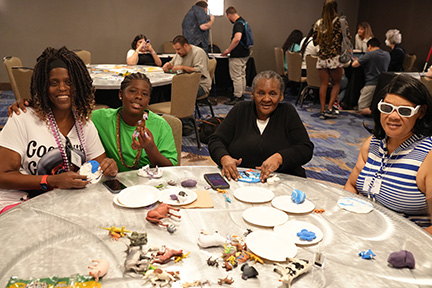 From the Editor: A popular feature of the NFB National Convention every year is the Art Room. Started by sculptor Ann Cunningham in 2013, the Art Room is now a favorite destination for convention-goers of all ages. In this article Art Room volunteer Shelly Smith shares her experiences and impressions.
I met Ann Cunningham in Colorado last May, when I attended the Tactile Art Teach-In at the Colorado Center for the Blind (CCB). Attending that three-day program was a life-changing experience for me! I’ve always had low vision, and now, in my forties, I’m finally getting in touch with myself in new ways.
Discovering that I can express myself with raised-line drawings and clay sculpture was truly amazing! So when Ann Cunningham invited me to help out at the Art Room during Convention, I jumped at the chance.
When I got to the Art Room, I wasn’t sure how I could make myself useful. Ann suggested I greet people at the door and help orient them to the room. That felt like a fit, so I stationed myself by the door to see what would happen.
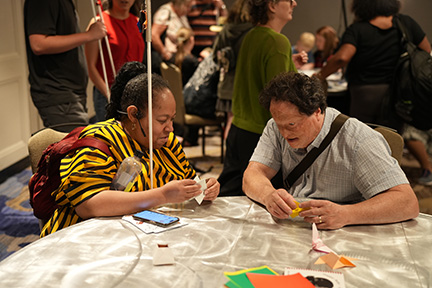 What happened was a stream of people for two days, from the time the doors opened at one on July 9 until we finally packed up at six on July 10. It’s hard to estimate how many visitors we had altogether. Sometimes the room was fairly quiet. People wandered leisurely from table to table, making sure they didn’t miss anything. At other times the room was packed, and people waited in line for a seat to open up at one of the tables. I’d say that two to three hundred people visited the Art Room, at least briefly, but that’s only the roughest estimate.
Most of our visitors were families with kids, and we also saw a number of students in college or graduate school. I remember one mom who stood by while her daughter worked with clay at one of the tables. She said it was the first time she’d seen her daughter come out of her shell. A little boy sat down with a lump of clay and announced, “Mommy, I’m going to make you a heart!”
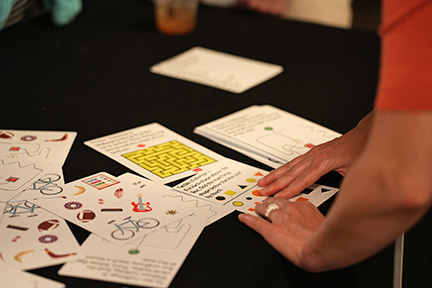
Some kids were shy and didn’t know where to begin. I’d tell them they could draw or work with clay, do puzzles, learn origami, or check out our collection of books with tactile pictures. Once they got their hands on the materials, they were really excited! There was no stopping them!
I noticed that a lot of parents had a tendency to hover over their children. If a child seemed hesitant, Mom would rush in with suggestions. Some parents even tried to direct their kids’ hands to whatever they thought would be interesting. We did our best to encourage parents to step back and give their children space to explore.
 Our list of volunteers looked like the Who’s Who of blind people in the arts. MacArthur Genius Award winner Josh Miele demonstrated incredible paper folding at the origami table. Beside him was Chancey Fleet, who produces tactile diagrams at the New York Public Library. Minh Ha helped out with tactile drawing; she chairs the Accessibility Task Force at Perkins School for the Blind. Marco Salsicha shared his ideas about using SVG code (Scalable Vector Graphics) to create tactile graphics.
When the Art Room opened, everything was carefully organized. We had tactile coloring books on one table, raised-line picture books on another. Other tables featured puzzles, origami, and embroidered pictures. Before the Art Room closed its doors for the last time, crayons, papers, paper plates, chunks of dried clay, and empty Play-Doh containers were scattered across the tables and the floor. It was really wild! The art room had been a busy place!
When I went to the Teach-In last May I heard a new term for the first time: image poverty. Most blind people live in a world of words. They hear verbal descriptions of everything from ants to jet planes, but they seldom have the chance to explore models, tactile pictures, or even real objects. In a small but important way, the Art Room at Convention helps to open up a host of new possibilities.
If you didn’t get to the Art Room last summer, be sure to drop by in 2026. We’re already making plans for offerings that will be even more exciting and intriguing. Feast your hands and stretch your imagination. Unlock your creativity and see where it will lead you.