American Action Fund for Blind Children and Adults
Future Reflections Winter 2026 FEATURE
Connecting the Dots: A Late Lesson in Why School Matters
by Gary Wunder
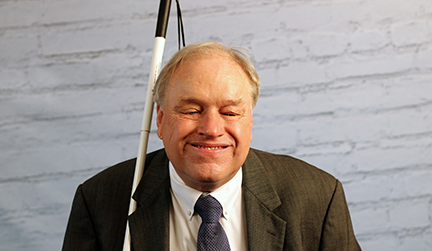 From the Editor: Many readers of Future Reflections know Gary Wunder as the long-time former editor of NFB’s flagship publication, Braille Monitor. Gary is also a past president of the NFB of Missouri, and for many years he served on the NFB’s Board of Directors. Within this organization and beyond, Gary is someone who takes the long view. He thinks carefully and shares his ideas with grace. In this article he reflects upon his personal journey and the way he came to value his education.
When I was growing up, the messages I received about my potential were as mixed and confusing as any young person could hear. On one hand, I was told that I was bright—perhaps very bright, in fact. On the other hand, the quality and quantity of my schoolwork never seemed to live up to that intelligence. The adults around me sadly concluded that I must be lazy.
Laziness was an easy label to apply, even though it never fit the way I understood myself. If I wasn’t doing the things I ought to do, the explanation seemed simple enough to others: I wasn’t trying. Nevertheless, I cannot look back and say that I ever felt lazy. I was praised for faithfully doing my chores, but schoolwork was often far down on the list of things I cared about. I simply could not explain why the tasks I was given at school really mattered. I could not see how schoolwork could help me become the kind of adult everyone said I was capable of becoming.
I grew up in a family that worked hard with our hands and our machines. We ran a dirt-moving business. The sights, sounds, and conversations of that business shaped my world from the very beginning. We used high loaders, backhoes, motor graders, and dump trucks. Even the supervision was done from a truck that was driven from job to job. The work was physical, productive, and immediate. You could look at a freshly graded lot or a newly dug foundation and know exactly what you had accomplished that day.
My mother and father could read, but nothing in our home celebrated reading. There were no lively discussions about authors or characters. My dad read the newspaper, and my mom read the magazines placed near the grocery store checkout. Those reading moments filled idle time; they weren’t about learning or self-improvement. No one around me modeled how reading might broaden a life or offer a wider future.
As a result, when someone asked me to memorize the eight parts of speech or diagram a sentence, I saw no connection with the world I knew. In my house no one ever paused to admire a well-structured paragraph. When teachers gave assignments on grammar, I couldn’t imagine where such knowledge would get a person in life—not in the life I expected to live.
After a few years of school, I understood the math that mattered: addition, subtraction, multiplication, and division. We used those skills every day in the business. I could count, measure, and figure quickly. Those skills earned nods of respect from my father, who talked to me with the expectation that I was keeping up. But algebra? Why on earth would someone want to solve for X or Y?
Looking back, I think my blindness should have pushed me to value academics. It should have been obvious to me that I wouldn’t be driving a high loader or a dump truck for a living. Yet somehow I didn’t draw that conclusion. My family and I had seen astronauts land on the moon. My parents truly believed that someone would find a way to restore my sight by the time I grew up. “They’re working on the eyes all the time,” people said, as though it were simply a matter of waiting my turn. The only time my parents read to me was when they came across an article about the restoration of vision. All I had to do was learn enough blindness skills to wait out the miracle. I didn’t need grammar or science any more than my parents needed those arcane studies, because technology would solve the problem of blindness for me.
I liked school, but the truth was that I wasn’t connecting the dots. Beyond the canned answers I could recite if asked, I had no understanding of why I was required to go to school. I could say that going to school was about “preparing for the future” or “becoming productive,” but those words had no hold on me compared with the lure of riding my bicycle, listening to music, or hopping on a horse with my brothers. School simply didn’t feel like a path to anything that mattered.
It wasn’t until my early teens that something finally lit the spark. I became fascinated with radio, and I decided to study to become a licensed amateur operator. Suddenly, learning wasn’t just a chore—it was a window into a world I couldn’t yet describe but desperately wanted to enter. I needed to learn about electronic circuitry, radio wave propagation, and the basics of physics. None of that knowledge lived in my family’s sphere.
My parents had no idea how a radio station worked. They had even less idea where I would find the books I wanted in Braille or on the reel-to-reel tapes that blind people used back then. They thought that radio equipment was too expensive. Besides, the activity was pointless if all I would do was talk with someone a few hundred miles away about the weather and his station.
But I wasn’t just talking about the weather. Through international Morse code—slow though it was—I found myself chatting with professors, engineers, and scientists. They talked about chemistry and physics as if they were as real as the machines my father drove. They asked me what I wanted to do when I grew up, and I realized that I didn’t know. They spoke about the kinds of jobs people could obtain because they had mastered the very subjects I thought were meaningless.
Those conversations grew me up. They did not transform me overnight, but they gave purpose to subjects I had once dismissed. Knowledge wasn’t just for people who lived somewhere else; knowledge could be for me.
Today, scientists tell us that the parts of the brain responsible for long-term planning, weighing consequences, and linking effort to future opportunity do not fully mature in early adolescence. Some children appear mature because they can hold a good conversation with adults. I certainly fooled people that way. But the ability to say, “This hard thing today will open doors for me tomorrow” is a different kind of maturity altogether.
I do not write this to excuse poor performance or to suggest that children should be allowed to ignore their schoolwork. I write because I think that many parents, including parents of blind children, may see the same pattern in their children that my parents saw in me: intelligence without consistent effort. Before assuming laziness, I hope parents will ask: Does my child understand why this schoolwork matters?
Here are a few ways parents can help spark the kind of maturity that turns effort into motivation:
- Talk explicitly about the future. Ask what your child imagines and help fill in the realistic steps that can lead from school to those dreams.
- Make learning concrete. Connect assignments to real-world tasks: not “Now you’re going to learn to divide,” but “Let’s figure out how many boards we need for this project.”
- Introduce blind children to working adults—and it will help if some of them are blind. The earlier they meet people who use knowledge as they earn a living, the more possible those paths can become.
- Encourage curiosity through hobbies that stretch the mind. For me, ham radio opened a horizon no one around me could describe. Your child may find that spark in robotics, cooking, coding, nature study, crafts, or music production.
- Check whether a particular lesson has meaning, not just whether it is done. Give space for the “why” along with the “what.”
I had to learn as a teen what school was really about. I wish I had understood sooner that knowledge was my road to independence, a way for me to escape the stigma my family would never have tolerated—being seen as capable but unwilling.
Eventually, I did connect the dots. I discovered the value of learning how to learn. Nevertheless, I cannot help wondering how much smoother the road might have been if someone had helped me see that connection earlier.
So, to parents who see real possibility in their child but worry about the missing drive: do not mistake late maturity for laziness! Sometimes a young person needs to make one meaningful connection, to discover one reason that finally feels real. Once that happens, the rest of the dots often connect themselves.