American Action Fund for Blind Children and Adults
Future Reflections Winter 2026 BEGINNINGS
How to Raise a Blind Child: One Mother’s Perspective
by Susan Tucic and Peter Tucic
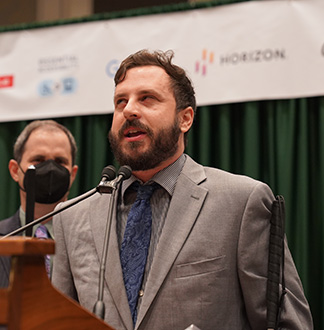 From the Editor: Many readers of Future Reflections know Peter Tucic. For more than a decade he represented HumanWare, one of the leading companies producing accessible technology for the blind community. As a HumanWare rep Peter traveled all over the world, spreading the word about adaptive hardware for the blind. Now that he is the father of two young children, Peter has taken a job with the Chicago Lighthouse for the Blind, allowing him to be close to his family. In this article Peter interviews his mother, Susan Tucic, about her experience with his upbringing and her philosophy about raising a blind child.
Peter Tucic: Raising a child always comes with uncertainty, learning curves, and moments of fear and pride. Raising a child who is blind adds an entirely different layer that most parents never anticipate, and few feel prepared to navigate.
I was raised in the western suburbs of Chicago by two fantastic parents, my father, Trivo, and my mom, Susan. I am totally blind, and I grew up at a time when information, resources, and community connections around blindness were far less available than they are today.
Like most parents, my mother had no prior experience with blindness before she became my mom. She had no road map—only instincts, persistence, and a willingness to learn alongside her child. From my early childhood through my years in the SASED Cooperative program (School Association for Special Education) in the Chicago suburbs, and later when I attended the University of Illinois at Chicago, my mother constantly balanced advocacy, instruction, and the everyday realities of parenting.
This interview is an opportunity for me to step back and reflect on what it truly means to raise a blind child from the parent’s perspective. My mother shares her thoughts on receiving an initial diagnosis, navigating family dynamics and expectations, learning to teach blindness-specific skills, and managing the balance between my need for independence and her concerns about keeping me safe. She also reflects on my school experiences, the introduction of Braille, social development, and the fears many parents quietly carry about their child’s future.
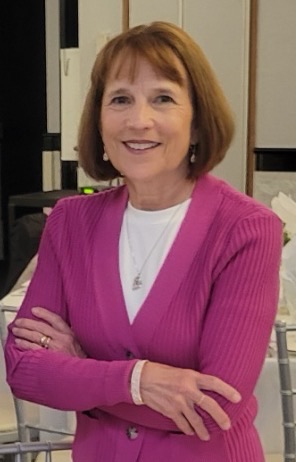 Through the questions that follow we explore the challenges, misperceptions, and emotional realities of raising a blind child, and my mother shares the lessons she learned along the way. Her thoughtful answers offer insight, honesty, and encouragement for parents who may be at the beginning of a similar journey.
Q: How did you handle my initial diagnosis of blindness? Was it difficult for you to share the news with other family members?
A: You were born a month and a half early, and you suffered a Grade 3 brain bleed. We were told that you only had a 25 percent chance of being “normal,” but that they didn’t know whether your issues would manifest physically or cognitively. When I learned that, I immediately started talking and singing to you at every opportunity, even in the wee hours when you were feeding. By the time you were four months old I noticed that you weren’t tracking visually, and you had difficulty with muscle coordination. Our pediatrician gave us a referral to Easter Seals for evaluation. You began PT (physical therapy) and OT (occupational therapy) for your conditions.
At nine months, you were referred to a pediatric optometrist. You received your first pair of glasses and a patch for your “lazy eye” and nystagmus. We continued with therapies, and when you were two years old we attended a weekend parents’ conference at the Illinois School for the Visually Impaired in Jacksonville. An evaluation there indicated that you might have a condition called achromatopsia.
We received so much support and information at the conference that I felt empowered. They recommended that we have you evaluated at the University of Illinois by a retinal specialist, Dr. Fishman. The testing and ERG (electroretinography) results showed that you in fact had a more severe condition than achromatopsia. It’s called Leber congenital amaurosis (LCA).
When I heard the news I was devastated. I felt terrible having to tell your father the news, although Dr. Fishman was very supportive. He referred you to the Lighthouse for the Blind in Chicago for ongoing support and resources.
Q: Did you find yourself having to correct misperceptions of family members in dealing with expectations at home?
A: My family and your father’s family were extremely supportive when they received the news of your diagnosis. My family jumped in to learn as much as they could to help you develop socially and intellectually. We all agreed that you should be expected to learn and do everything a sighted child your age could do. My upbringing and your father’s allowed us to expect independence and responsibility from our children. We both came from large families and weren’t catered to. We expected our children to do chores, to do well in school, to take music lessons or get involved in sports, and to practice etiquette with adults and in social environments. Persistence was also key in making sure all of our respective family members knew what our expectations were. Fortunately, it was never a problem for us.
Q: How did you go about learning to teach me everyday skills, having never interacted with a blind person in such a capacity before?
A: My background in science and education allowed me to teach skills by breaking tasks or challenges down into steps. I insisted on practice and perseverance to achieve the goal. We had a lot of fun making games out of learning how to do things, like using cheerios or chocolate chips to form letters in Braille. We focused a lot on hand-over-hand practice with tasks such as buttoning a button or scooping cereal from one bowl to another to work on fine motor skills. Later these activities transitioned into chore assignments such as cleaning the bathroom, emptying the dishwasher, or folding laundry.
Q: Were there ever times when you questioned what was being focused on at school related to blindness skills?
A: The early years of school were fairly smooth. We chose to send you to a resource program as opposed to keeping you in our home district. That way you could move through the curriculum as fast as you could, having all the specialists, equipment, and technology in place. We didn’t have to wait for it to come to you. Your TVIs (teachers of the visually impaired) in preschool and elementary school were integral in your success.
As you progressed to middle school, it became difficult to balance the resource room with the regular class, band, and gifted program. You had to learn the Nemeth Code for math, as well as continue Braille and technology while handling the regular curriculum. You asked if you could discontinue the gifted program to ease up on the pull-outs from the regular classroom.
The middle-school curriculum and VI specialists allowed your continued success, but high school became dicey. You took all of the regular high school courses, plus a few honors and AP courses, but the system wasn’t very accommodating around your blindness. You routinely were not receiving your Braille textbooks on time, but you still were quizzed and tested on the material. I discovered that the charts and graphs for chemistry were missing information that was included in the regular textbooks or Periodic Table, but you were expected to know the missing information. There were many of these issues, but you persevered and never wanted to make waves.
Q: How did you personally feel about the introduction of Braille?
A: You started Braille readiness skills in preschool and continued learning Braille throughout your education. I was so happy you had this experience, as it allowed you to develop literacy skills alongside your peers. You had the chance to adapt to the computer technology (JAWS) and Braille notetaker (BrailleNote). You also were able to be a test subject for all of the latest technology and methods being used by participating in research programs at Northern Illinois University (NIU).
Q: I remember a time when making friends was a real struggle. Can you talk a bit about that, and how you helped me get to the other side, where I was then almost never home?
A: You made friends very easily in the primary and elementary grades. Children naturally want to be helpers, and your classmates loved to help guide you or show you things by letting you feel what they were discovering. It also helped that you enjoyed LEGO® and K’nex®, and you could do those activities with your friends.
As you got older, late elementary and middle school, the boys became more interested in sports on the playground or going to movies and to friends’ houses. It became more difficult for them to relate to you, and for you to easily relate to them. We had the added factor of living out of district, which made the back-and-forth travel between friends’ houses a barrier. I remember some very challenging moments when you felt down like you did not fit in.
We devised a plan to set aside time on Friday evenings to do something that you might be interested in doing, something that would align with the things you heard the kids at school talking about. We started with trips to musical instrument or CD stores and restaurants. Then we moved on to occasional movies, sporting events, and concerts. This laid the foundation for further developing your natural love for sports and popular music/bands which allowed you to converse and engage with friends at school.
When you came home at night you were very busy with your piano and drum set, and you also played with the kids in the neighborhood. As you entered later middle school, you began to find various friend groups. I would drive you to your friends’ houses so you could do the things boys do, like riding ATVs (all-terrain vehicles) and playing videogames. You loved going to the library. You consumed audiobooks voraciously and used your down time to lie on your bed and listen to your favorite genres.
In high school your friends were able to drive. Because you learned to be funny and engaging, they were willing to come and get you to hang out. However, I impressed upon you to be careful who you were with, because you wouldn’t be able to dig out of a hole if you got in trouble. Your friends would scatter and you could be left “holding the bag,” so to speak.
Q: What were your greatest fears for my future due to my blindness?
A: I was most afraid for your future after your diagnosis of blindness. I couldn’t imagine what you would be able to do. At the time, I heard a grim statistic that only 25 percent of blind people are gainfully employed. I heard of many people surviving on SSI and living at home. I wondered if you would ever find the right woman and get married, if you would have children.
Then you excelled in school and were able to make friends. Through the SASED summer school program you were given the opportunity to work as an activity aid. It became easier for me to imagine a productive future for you. Knowing that you would be independent someday made it imperative for me to teach you daily living skills at a young age. I wanted you to be able to do laundry, make your bed, clean your room and shared bathroom, take out the garbage, empty the dishwasher, make sandwiches, use the microwave, and care for our cat. Your father would show you how to do mechanical work with the car and appliances. He taught you about plumbing, home repairs, yardwork, and shoveling snow.
We were clear with friends and family that we wanted you to do whatever you could on your own. We didn’t want them to baby you or help you with the things you were able to do by yourself.
When you were still in high school you were allowed to travel by Metra into Chicago with friends. I didn’t allow you to travel on your own until I was able to observe you safely travel and make the transfers between train stations. You had a Saturday job mentoring a blind child in the north suburbs.
Q: Did you ever feel that neighbors or relatives disapproved of the way you were raising your blind son? Did people ever suggest that you should be more protective, that you should have shielded me from potentially dangerous situations?
A: I never felt that neighbors or family disapproved of how we were raising you. However, it did drive me crazy when people thought I should be looking for miracle cures, or told me how tragic it was that I had a blind child. They would ask me if I ever tried x, y, or z to “fix” your vision. Or they’d tell me there’s a place in Russia where they can fix/heal blindness.
I didn’t feel that we were ever judged for allowing you to do what we allowed you to do, like going to the city in high school for concerts or to hang out with older friends. I think in some way they probably admired that you were trusted to experience the world and comport yourself the same way a high schooler would be who wasn’t blind.
Q: Are there any other pointers you have for parents today on raising a blind child?
A: The greatest pointers on raising a blind child would be:
- Arm yourself with as many resources as possible from the organizations in your area. Get involved, participate, and network with parents and professionals in these organizations. We used Easter Seals, Illinois School for the Visually Impaired, Illinois Parents of the Visually Impaired, Guild for the Blind/Chicago, the Chicago Lighthouse for the Blind, National Federation of the Blind of Illinois, Foundation for Retinal Research (now part of Foundation Fighting Blindness), SASED (district special education), and SEPTA (special ed PTA).
- Volunteer or advocate for organizations you feel speak to you. I was involved in our special education PTA (SEPTA) during turmoil with the possible breakup of our county’s fragmenting services and loss of resource programs and classroom space.
- Give your child age-appropriate space to explore their environment independently. Begin with the neighborhood, and move on to public transportation. Travel to other states or outside the country, if possible. Camp. Go fishing and hiking. Visit nature centers, farms, and museums. I worked full time and overtime, often including holidays and weekends. I still made time to do the “city things” and the “nature things.”
- When you feel down or sad about your child’s blindness, or when they are going through difficult times themselves, get up and get going. There is so much in life to experience! There are many activities that don’t cost anything. Look for opportunities through your city, local parks and recreation, and library.
- Teach resiliency. Get back up, try again, be flexible. Look for alternative ways to do things. Break down bigger tasks or challenges into smaller chunks. Take breaks. Everything doesn’t need to be done in that hour or day.
Look to a higher power. We don’t have all the answers, and we can’t fix all of our children’s problems. It’s okay not to know the answers or outcomes. I have a faith-based background, and I put my trust in God to give me strength, clarity, and peace to handle the most difficult, anxiety-ridden problems I face.