American Action Fund for Blind Children and Adults
Future Reflections Special Issue on Braille A LETTER FROM THE EDITOR
A Celebration of Braille
by Deborah Kent Stein
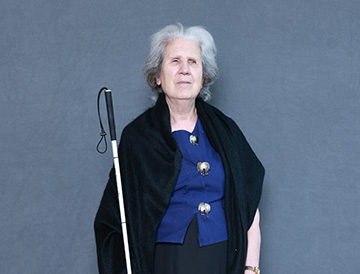 I began to learn Braille when I wasn’t quite five years old. My teacher, Helen Campbell, didn’t read Braille tactually, but she was thoroughly versed in the code. She expected me and her other students to become fluent Braille readers, and we didn’t disappoint her.
I never learned Braille letter by letter and contraction by contraction. Our books were written in contracted Braille, and we learned to recognize whole words as they appeared on the page. I learned little as a pair of vertical lines of three dots each. Go was a tiny square. And was a vertical rectangle, open on the right. You was similar, but open on the left.
We read the same “Dick and Jane” books that were being used in classrooms across the United States. The Braille lines were widely spaced, with the text in print above each line. If I took a book home and got stuck on a word, my parents could help me, even though they didn’t yet know Braille themselves.
Bit by bit Miss Campbell introduced me to words written “the long way,” without contractions, so I could learn to spell. I don’t remember feeling daunted by the fact that there were two different ways to read little or mother or day. Rows of books stood on the library shelf, full of stories that I wanted to read. Braille allowed me to unlock the adventures they held among their pages.
In 2009 the world celebrated the two hundredth birthday of Louis Braille, the teenager who developed the reading method used by blind people to this day. In celebration, the United States minted a commemorative gold coin with readable Braille letters. It was the first commemorative coin that has honored a person who was born and lived outside the United States.
In its ongoing effort to promote the use of Braille, the National Federation of the Blind celebrated Louis Braille’s bicentennial with programs and events throughout the year. As part of this celebration, the NFB presented President Barack Obama with a book entitled Let Freedom Ring: Braille Letters to Barack Obama: https://nfb.org/images/nfb/publications/books/ltobama/letterstoobamatc.htm. The book is a collection of one hundred letters from Braille readers, explaining through their personal stories why Braille is important to them.
This issue of Future Reflections is a celebration of Braille from a wide variety of perspectives. Jennifer Dunnam weaves her love of Braille into an account of her adventures baking cakes. Cassie McKinney describes her shared journey of learning Braille with her son, Robert, and Raquel Montoya writes about the many ways Braille is part of her life.
Several teachers share their thoughts about the best ways to teach Braille to blind students. Erin Zobell applies the science of reading to Braille instruction, and Casey L. Robertson introduces the natural order of contractions.
Braille has come a long way since Louis Braille walked the streets of Paris. In this issue of Future Reflections, Jonathan Mosen traces the history of electronic Braille from 1971 to the multiline displays of today. Robert Winiecki explains how Braille codes have been developed for hundreds of the world’s languages.
Sadly, too many blind students today still struggle with inadequate Braille instruction, or with no Braille instruction at all. Sanho Steele-Louchart and Kimberly Christenson explain how the law protects the right to Braille instruction for blind students. Kate Garcia shares the story of her battle to get Braille instruction for her daughter and the happy outcome for everyone involved.
My Braille teacher, Helen Campbell, lived not far from the house where I grew up. Decades after I left her class, I went to visit her and thank her for the years she spent as my Braille teacher. “You gave me a great gift,” I told her. “I feel so fortunate, so grateful I had such an opportunity to learn.”
“I never thought I was giving anyone a gift,” she insisted. “I was teaching, like every other teacher. I taught my students what they needed to learn.”
Miss Campbell didn’t want me to thank her, but I’m thanking her now. And I’m thanking all the other dedicated teachers out there who make sure their blind students have the precious gift of literacy.