American Action Fund for Blind Children and Adults
Future Reflections Special Issue on Braille LIVING AND LEARNING
Between the Dots and the Batter: Ingredients for Success
by Jennifer Dunnam
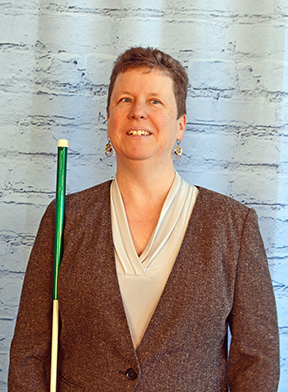 From the Editor: Jennifer Dunnam’s career has run the gamut from teaching Braille to adults and managing Braille production for the University of Minnesota, to administering the certification program for transcribers and proofreaders for the Library of Congress. She chairs the National Association to Promote the Use of Braille (NAPUB), and she is a leader in the National Federation of the Blind of Minnesota.
Baking was never my forte. If you needed someone to work up your spreadsheet formulas or assemble your Ikea furniture, call on me any time. I’d enjoy every second of getting that task done. But if you wanted a cake, you could count on me to send you info on the closest bakery. Therefore, it surprises all who know me well that I have baked thirty-four cakes since last summer!
What happened? I ask myself. Perhaps a nudge came from a few difficult life events, increasing the appeal of a low-commitment, finite activity with clear directions. For whatever reason, in the middle of the summer I began to learn the finer points of baking, to acquire the equipment that makes it possible, and to gather friends around me who have been gracious enough (and perhaps even happy) to help relieve me of the “cake backlog.”
Born with no vision, I had wonderful parents who were determined that I would grow up like my sighted sisters, as a person who could take care of myself and handle whatever life threw my way. For much of my childhood and youth (all pre-internet), my parents were not acquainted with any blind adults. They did not always know the specifics of what independence for their blind child could look like. Nevertheless, they didn’t allow blindness to be an excuse for me to let things slide—an attitude for which I am forever grateful!
My mother taught me the basics of baking during my childhood. Without those vague and distant memories, there likely still would be no cakes coming out of my kitchen.
 My mother’s father was a professional baker, but my mother is not much of a fan of cooking of any sort. She helped her working parents take care of her three much younger brothers, and then she managed her own household as a wife and the mother of three children in the 1970s and 1980s. She cooked three meals every day for decades.
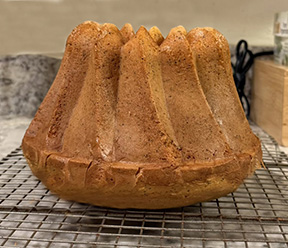
I remember one night when I was very small. The family waited excitedly for a cake Mom had made to be done. When the oven timer went off and Mom placed the cake on the table to cool, the others exclaimed over how delicious it looked. Mom allowed that, if I washed my hands very clean, it would be okay for me to touch the cake very lightly. To me, it felt like a large, well-formed doughnut. I thought my mother must be some kind of genius to get it so perfectly round. Later she showed me the round tube pan with the hole in the middle so I could understand how it worked.
When I got a little older, Mom taught me the basics of making a cake. I learned to grease and flour the pan all up the sides so the cake can rise; to tap out the excess flour; to make sure the beaters lock into the electric mixer; and, of course, to taste the excess batter as a nice bonus! Incidentally, my mother works with families of blind children to this day, and I’m sure they realize how lucky they are to have her in their corner.
Because of Mom and other supportive people around me, I learned Braille early in life. Mom became a Braille transcriber to make sure I had Braille materials for my education. Braille has remained part of my daily life in countless ways, many of which have nothing to do with reading books. For example, clear adhesive labeling material, whether full-page format or in rolls of tape, is a staple in my house. After I buy groceries, the quick three minutes it takes to create and adhere Braille labels pays big dividends in efficiency. Later on, I can distinguish the cloves from the allspice from the pumpkin spice; the peppermint from the almond or vanilla extract; the cooking spray from the baking spray (it matters!). I can tell the two kinds of flour apart and identify the three kinds of sugar. For boxes of cake mix, which I still sometimes use as a base for a recipe, I place the box in a Zip-loc bag along with an index card Brailled with the name of the mix.
As “low-tech” as these methods are, advances in technology have made them even easier to implement. An AI app on a phone can read out the item for Brailling if the grocery run includes two different cake mixes.
So why don’t I just use the phone app and skip the Braille labels? Certainly, the phone camera method alone can be a workable identification tool. But for me there is an efficiency factor to simply skimming my fingers around the spice rack rather than taking out each of the thirty plus jars to show to the camera (and likely having to rotate the jar several times to capture the name of the item).
Likewise, it’s more efficient for me to Braille out my recipes on paper with an embosser instead of accessing them electronically. Having the instructions right there on one surface makes things easier. However, the phone camera does play its part. It has been amusing and even useful to photograph my cakes and get the AI’s unvarnished assessment of how they look before another human lays eyes on them.
Access to other blind adults through the National Federation of the Blind has been another crucial ingredient in my unexpected cake journey. When I was in my late teens, I heard blind adults talk about the things they did (such as cooking for their families, shoveling snow, mowing the lawn, and doing woodworking). Listening to them helped me understand that, if I wanted or needed to do those things, blindness would not stand in my way.
These role models moved through the world with grace and confidence. They were not like the shy, anxious person I was and thought I always would be due to my blindness. When they wanted some of the coffee at the back of the meeting room, they got up and got it. They didn’t wait awkwardly for the right time to ask someone to do it for them, as I did. They were adventurous and resourceful—not terrified of getting lost as I was. They didn’t tell me what I should do; rather, they showed me what I could do. Before I met them, I had no idea that I could even hope for such a level of confidence, much less actually achieve it myself.
One stand-out incident early in my acquaintance with the Federation took place at a state convention. On one of the panels, several people shared their perspectives on rehabilitation training. A cooking instructor at a state rehabilitation program mentioned her excitement over the success of a blind student who made brownies for the first time. “Of course,” she said, “they weren’t cut straight, but at least this was something he did all by himself.”
“This student’s progress absolutely should be celebrated,” another panelist commented, “but why should it be assumed that the brownies would be cut unevenly?”
The cooking instructor was nonplussed. I wondered why the other panelist was being so picky. Then I realized that the instructor’s comment was based on the belief that blind people could not cut brownies neatly. Maybe I held that belief myself, without giving it much thought.
“Why should it matter whether the brownies looked nice?” the cooking instructor asked. “They would taste the same, regardless of how they looked.” That conclusion is perfectly valid, I thought, but what if one wanted the brownies to look nice? I didn’t care about brownies specifically at that point, but I did care about appearance. I knew what a difference appearance makes in perception, whether or not it should.
As the panel conversation continued, it became clear that in this organization there were people who cared about such things as I did. They could enlighten me on techniques to help me make it happen.
Mastering skills such as reading and writing Braille or traveling comfortably with a long white cane takes practice and commitment, and the process can seem overwhelming in the beginning. All this baking reminds me vividly how much work it often takes before the dizzying array of steps and techniques becomes automatic. I review a checklist whenever I bake a cake to remind myself of the things that are not explicitly spelled out in the recipe. “Bring the eggs and butter to room temperature before mixing; toasting nuts ahead of time brings out their flavor; if using molasses, grease the measuring cup so it will pour out more easily; scrape the sides of the bowl when mixing; tap the batter-filled pan on the counter to remove air bubbles before putting it in the oven; adjust temperatures and cooking time if using a different type of pan than called for in the recipe…” I look forward to the day when these things come as easily as determining whether I should use the “th” or the “the” contraction when I Braille the word “them.”
To be sure, not all of my cakes have turned out delicious or beautiful. A couple stuck in the pan (no doubt to remind me that pride goeth before a fall). Still, many have turned out well. Perplexing as this baking obsession remains, the challenge brings much joy. Here’s to learning new things at any stage of life!