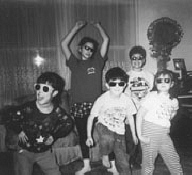
Playing
pretend games together helps these kids (one of whom is blind) develop
social skills. And they thought they were just having fun.
Developing
Skills
for Social Success
Reprinted from In Touch, the newsletter of the New Jersey Parents of Blind Children, February 2000.
|
|
Playing
pretend games together helps these kids (one of whom is blind) develop
social skills. And they thought they were just having fun.
|
The term �social skills� is an all-encompassing one. It includes:
-- Friendship-Making Skills, e.g., joining in a game, giving a compliment, sharing.
-- Skills for Dealing with Feelings, e.g., expressing your feelings, dealing with anger.
-- Skill Alternatives to Aggression, e.g., using self-control, responding to teasing.
-- Skills for Dealing with Stress, e.g., dealing with being left out, reacting to failure.
-- Classroom Survival Skills, e.g., following instructions, asking for help.
For children who show a weakness in one or more of these skill-based areas, there are many ways to help them. Teachers, parents, and other professionals such as social workers can all help to promote skill acquisition in either a group setting or individually. They can do this by modeling the desired behavior; coaching when things go wrong; role playing in a structured, protective situation; and/or by social problem-solving, which uses the child�s cognitive abilities to help self-correct undesirable behavior.
As the development of social skills is dependent on many variables and is such an individual process, each child�s needs in the end are slightly different. For example, blind children are presented with unique physical challenges and their ability to receive visual cues from others is limited. However, there is no reason why they should be any less adept in social situations because of this. Their visual impairment may preclude them from discerning visual cues; however, they can learn to become more attuned to auditory cues from others and can develop superior verbal skills to communicate. It therefore becomes the job of the teacher, parent, or social worker to identify each child�s strengths and to design an intervention that can reinforce strengths while overcoming any disability and/or weakness.
Teaching better social skills and achieving improvement is not only attainable for all kinds of children, it is highly recommended. Studies have shown that children who are continually rejected by others exhibit more sadness and anxiety and tend to withdraw from interacting with others. Conversely, those children who have or develop strong social skills receive the nourishment from others that builds self-esteem and even better academic performance.
To learn more about social skills and how to teach them, the following books may be useful:
Social Skills Intervention Guide by S. Elliott and F. Gresham, Published by American Guidance Service, Inc., Circle Pines, MN 55014-1796 (1991).
Social Skills Activity for Special Children by D. Mannix, Published by the Center for Applied Research in Education, West Nyack, NY 10995.
Skillstreaming the Elementary School Child, by E. McGinnis and A. Goldstein, Published by Research Press Co., 2612 North Mattis Ave., Champaign, IL 61821.
To speak to a social skills trainer, call Ann Hicks, MSW, at the Family Service and Child Guidance Center (New Jersey), (97--) 564-5244.