
Improving Reading Fluency in Braille Readers Using Repeated Readings
By Kathleen Stanfa and Nicole Johnson
Kathleen Stanfa is Associate Professor in the Special Education Department at Kutztown University of Pennsylvania.
Nicole Johnson is Assistant Professor in the Special Education Department at Kutztown University of Pennsylvania.
Abstract
A single subject treatment design was used to investigate the effect of a repeated reading intervention on braille reading fluency for children with visual impairments. Three children with visual impairments who utilized braille as their primary reading medium participated in the study. During intervention sessions participants read passages three times. Reading rate and error data were collected. Analysis of the data showed a direct relationship between using repeated readings and increase in braille reading rate and reduction of reading errors for all participants. Moreover, gains in fluency generalized to new text. The findings of this study indicated that using repeated readings has promising results for increasing braille reading fluency. Utilizing repeated readings can aid in fluency development and is easily implemented with little to no training.
Keywords
Braille reading, reading fluency, repeated readings
Literacy is considered the cornerstone of education. Success in other subjects is linked directly to skilled reading and writing. Research has shown that children with blindness or visual impairments do not read as proficiently as their sighted peers (Corn, et al., 2002; Fellenius, 1999). A key factor in this discrepancy is the weaker reading fluency of children with visual impairments (Trent & Truan, 1997; Wormsley, 1996). Fluency, defined by the National Reading Panel (NICHD, 2000) as “the ability to read orally with speed, accuracy and with proper expression,” is recognized as an essential correlate of proficient reading. As children progress through school it is critical that they can complete assignments in a reasonable amount of time, successfully comprehend a wide range of texts, and develop a positive attitude toward reading. Dysfluent readers decode word-by-word, struggle to construct meaning from what they’ve read, and generally experience reading as frustrating and tedious. The troubling outcomes faced by individuals who are blind and not proficient in braille are similar to the outcomes of struggling print readers. Research indicates that low levels of literacy among braille readers are associated with an array of negative long-term consequences, including unemployment and lower life satisfaction (Koenig & Holbrook, 2000; Wolffe & Kelly, 2011). If these students are to meet the challenges posed by modern literacy demands, mastery of braille is crucial.
Children who use braille as their primary learning medium typically read at a much slower rate than do their peers who read print. Evidence suggests that braille-reading students read at a rate of between 1/3 and 1/2 that of their sighted peers (Ferrell, Mason, Young, & Cooney, 2006; Legge, Madison, & Mansfield, 1999; Simón & Huertas, 1998). Moreover, as children progress through school, this discrepancy tends to widen (Corn, et al., 2002). Braille readers are at increased risk for literacy problems relating to reading speed and accuracy (Coppins & Barlow-Brown, 2006; Steinman, LeJeune, & Kimbrough, 2006) and are in need of empirically validated fluency-building interventions. Fluency has been described as one of only five critical components of the reading process (NICHD, 2000) and an essential building block for developing comprehension skills (Pikulski & Chard, 2005). Given the relationship between reading failure and general school failure, determining effective methods of reading instruction is critical. Identifying effective instructional strategies that will support students who use braille to increase reading fluency is vital for their success in school and future endeavors.
Repeated Reading
Repeated reading is an intervention strategy validated for enhancing fluency in struggling print readers (U.S. Department of Education, What Works Clearinghouse, 2014). Samuels (1979) defines repeated reading as a procedure in which the participant rereads a short text passage a specified number of times or until a predetermined criterion reading speed is obtained. Repeated reading is one of the most widely researched reading interventions and has been successful in improving reading fluency for students with and without disabilities at the elementary, middle, and secondary levels. In some studies, comprehension gains were also demonstrated. It is hypothesized that repeated readings lead to gains in comprehension because decoding becomes automatic, freeing cognitive resources from identifying individual words to extracting meaning from text (Layton & Koenig, 1998). Repeated reading is a simple and inexpensive intervention that can be easily implemented by teachers of the visually impaired (Savaiano & Hatton, 2013).
Five major reviews of research on repeated reading for print readers have been published since the National Reading Report (NICHD, 2000) first highlighted the significance of fluency in reading development (viz., Chard, Ketterlin-Geller, Baker, Doabler, & Apichatabutra, 2009; Chard, Vaughn, & Tyler, 2002; Strickland, Boon, & Spencer, 2013; Therrien, 2004). Four out of five of these reviews concluded that repeated reading interventions are generally effective. Chard et al. (2009) determined that there was not enough empirical support for the practice; however, much of the available research did not meet their methodological standards (O’Keeffe, Slocum, Burlingame, Snyder & Bundock, 2012).
The extant body of literature on repeated reading is substantial and varied. In the last decade alone, research has examined the effects of repeated reading interventions with a wide range of print readers, including: students at risk (Musti-Rao, Hawkins, & Barkley, 2009; Yurick, Robinson, Cartledge, Lo, & Evans, 2006); students with learning disabilities (Morgan, Sideridis, & Hua, 2012; Swain, Leader-Janssen, & Conley, 2013); students with emotional and behavior disorders (Alber-Morgan, Ramp, Anderson, & Martin, 2007; Escarpio & Barbetta, 2016); students with cognitive disabilities (Hua, et. al., 2012); students with autism (Reisener, Lancaster, McMullin, & Ho, 2014); and students with low vision (Savaiano & Hatton, 2013).
Although research using repeated reading has been shown to improve reading fluency for children with and without visual impairments, studies that include students with visual impairments have focused primarily on the effects of this intervention on print reading skills (Layton & Koenig, 1998; Pattillo, Heller & Smith, 2004; Savaiano & Hatton, 2013). While Pattillo and colleagues included a braille reader in their study, repeated reading was paired with the use of optical character recognition. As such, little is known about using repeated readings with students who utilize braille as their primary learning medium. We designed the present study to examine this issue.
The purpose of this research is to determine if repeated reading is an effective instructional method to increase braille reading fluency. Repeated reading was chosen as an intervention strategy because it has been shown to improve reading fluency and enhance reading comprehension for children with blindness or visual impairments in prior research. In order to determine if a repeated reading intervention promotes gains in reading fluency among braille readers, the following research question was investigated: does the instructional method of repeated reading have an effect on reading rate & accuracy of school students who use braille as their primary learning medium?
Experimental Method
A concurrent multiple-baseline across subjects design was used in this study to examine the effectiveness of repeated reading to increase the reading rate and accuracy of three school-aged students who use braille as their primary learning medium. The dependent variables in this study included oral reading rate, percentage of words read correctly, and generalization of fluency to new text. Braille reading rate and accuracy were recorded during the baseline and intervention phases of this study. A baseline was established for each participant by documenting the words read correctly per minute on four different passages administered across four days. During the intervention phase, students completed three readings each of six different instructional-level braille passages of approximately 50-150 words. Reading rate and accuracy were recorded. Data was analyzed visually to evaluate whether there was a functional relationship between the repeated reading intervention and braille rate and accuracy. This visual analysis included examination of level, trend, and variability within and across baseline and intervention phases.
Materials
The text materials used for both baseline and intervention were selected from Dynamic Indicators of Basic Early Literacy Skills, 6th Edition (DIBELS) oral reading fluency passages (Good & Kaminski, 2002). All passages used in this study were brailled by an undergraduate student and participants were not exposed to the reading materials prior to the study. In addition to the reading passages, a digital voice recorder was used to record audio during intervention sessions. A stopwatch was used to collect reading rate data.
Participants
The following criteria were used in selecting the participants: participants were diagnosed with a visual impairment as identified by an ophthalmologist and documented in their individualized educational program (IEP), participants were recorded as being blind or having a visual impairment by the Bureau of Blindness and Visual Impairments (BBVS), had braille documented as their primary reading medium through a learning media assessment conducted by a qualified teacher of students with visual impairments (TSVI), and were all under the age of twelve through the duration of the study. Three girls with visual impairments participated in this study. Before beginning this intervention, permission from the school district was granted to allow the qualified TSVI to collect data on braille reading fluency for the purpose of this study and parental consent was obtained. After students were selected, one of the researchers met with the TSVI to explain both baseline and intervention procedures and answer questions. Additionally, an interview was conducted with the TSVI prior to beginning the study in order to obtain academic performance data and gather background information about the participants.
The names of the participants are pseudonyms. All three participants used braille as their primary reading medium, with auditory as secondary, as documented in their IEP. Participant 1 (Bella) was in second grade at the time of the study. She was born at 28 weeks gestation and diagnosed with retinopathy of prematurity. She had light perception only at the time of the study. Participant 2 (Anne) was in fourth grade at the time of the study and was born with congenital cataracts that were removed, and as a result, she developed severe glaucoma in both eyes. At the time of the study Anne had light perception only. Anne also receives learning support services due to a developmental delay. Participant 3 (Jane) was in sixth grade at the time of the study and had a diagnosis of retinopathy of prematurity after being born at 30 weeks gestation. Jane has no light perception.
Procedure
The TSVI who regularly provides braille instruction to the child delivered the baseline and intervention phases. For all sessions, including baseline, data were collected on participants’ oral reading rate and reading accuracy. During the intervention phase of the study, students participated in the repeated reading by orally rereading a text passage three times. Passages were selected from the appropriate-level DIBELS material as identified by their TSVI. If a student was unable to read a word during the reading, the word was given to the student and recorded as an error. All substitutions, omissions, and mispronunciations were recorded as reading errors. If a student self-corrected after an error, the word was counted as correct.
During both baseline and intervention sessions, the TSVI timed the student reading for one minute and documented all reading errors. Reading fluency was measured as words read correctly per minute (WRCPM) and was calculated by subtracting the number of errors from the total words read during the timed reading. Baseline data was collected over 4 days and a new passage was presented each day during baseline sessions.
Intervention sessions spanned three weeks using two passages per week over four sessions per week. On the first day, the student completed an initial, or “cold,” read of the passage and then was asked to reread the passage a second time. On the following day, the student read the same passage again. On the third day, the student was introduced to a new passage and was asked to read it twice; on the fourth day, the student reread the passage given the previous day one additional time. This was repeated during the following two weeks using new passages. As a result, the student read each passage a total of three times before attempting a novel passage.
Interobserver Reliability
In order to ensure consistency in measurement, the researchers in the study calculated interobserver reliability. Interobserver agreement was evaluated for 20% of the intervention sessions via tape recordings by dividing the number of agreements by the number of agreements plus disagreements and multiplying by 100%. Interobserver agreement scores for words read correctly ranged from 96% to 100% (M = 98%).
Results
The research question posed in this study provided a framework for determining whether or not braille reading fluency would improve by using repeated reading strategies. Braille reading rate was measured by the number of words read correctly by the participant within one minute of reading (WRCPM). Performance during the baseline condition was compared with performance under the intervention condition. The purpose was to determine if a functional relationship exists between reading fluency and repeated reading intervention. All three of the participants increased their braille reading fluency from baseline to intervention sessions. Throughout intervention sessions the students showed more interest in what was being read as they repeated readings compared to frustration during baseline phases. These results show that when repeated reading is used for braille readers, they are likely to increase WRCPM over repeated reading sessions.
Results of the analyses for the two dependent variables, reading rate (WRCPM) and accuracy are summarized below for each participant. The repeated reading strategy’s effect on reading rate and accuracy was investigated by comparing level, trend, and variability in words read correctly and error rate between baseline and intervention phases. The initial reading rate and correctly read words for each new passage was analyzed to determine if the repeated reading intervention effects were generalized to new text.
Table 1. Reading Rates – Words Read Correctly per Minute
Student |
Bella Mean |
Bella Range |
Anne Mean |
Anne Range |
Jane Mean |
Jane Range |
Baseline |
11 |
8 – 15 |
18 |
14 – 19 |
69 |
55 – 81 |
1st Reading |
16 |
10 – 22 |
17 |
11 – 22 |
75 |
70 - 86 |
2nd Reading |
22 |
15 – 25 |
28 |
21 – 36 |
102 |
90 – 118 |
3rd Reading |
22 |
16 – 26 |
27 |
18 – 36 |
95 |
89 – 102 |
Table 2. Error Rates – Number of Errors per Minute
Student |
Bella Mean |
Bella Range |
Anne Mean |
Anne Range |
Jane Mean |
Jane Range |
Baseline |
2.5 |
1 – 3 |
2.25 |
2 – 3 |
1 |
1 |
1st Reading |
3.17 |
2 – 4 |
2.83 |
2 – 4 |
.33 |
0 – 1 |
2nd Reading |
2.83 |
1 – 5 |
1.5 |
0 – 3 |
0 |
0 |
3rd Reading |
1.67 |
1 – 2 |
1 |
0 – 2 |
.17 |
0 - 1 |
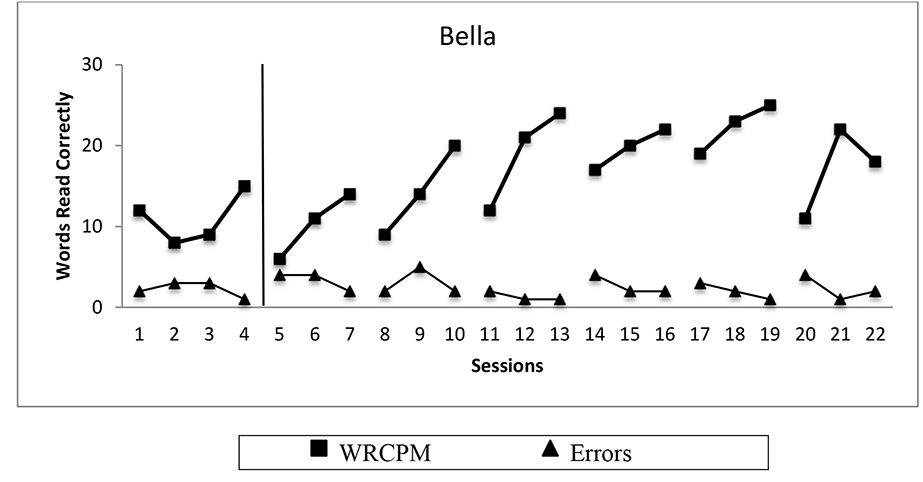
Bella: Baseline data for Bella show an average of 11 WRCPM (range, 9-15). During intervention, an increasing trend for WRCPM was evidenced with an increase to an average of 12 WRCPM (range, 6-19). Visual analysis of the results for Bella indicates improvement in WRCPM from the first reading to subsequent readings, with an average gain of 10 WRCPM (range, 5-19). This data suggests Bella’s reading rate improved with repeated readings of the same text. The greatest gains were evidenced between the first and second reading (mean difference 6.2), with more modest gains from the second to third reading (mean difference 3.5).
The initial reading rate, measured by the correct words read per minute during a first, or “cold,” reading for each passage was analyzed to determine if the intervention was generalized across time. Initial reading rate from a new text was compared to the previous text’s reading rate. During the intervention phase, Bella’s initial reading rate increased from one passage to the next for all passages, with the exception of the last passage. During intervention, five of six initial or cold readings (83%) were at or above the baseline rate. Table 1 shows the initial reading rates and mean baseline WRCPM for Bella. During the baseline phase of the study, Bella had a mean rate of 11 WRCPM. Bella’s initial reading rate decreased to 6 WRCPM during the first week of the intervention. Bella’s initial reading rate increased to 9 during the second week. The third week she had a score of 12 WRCPM, exceeding the baseline mean. Bella’s initial reading rate increased the fourth week to 17 WRCPM and again during the fourth week to 19 WRCPM. During week six, Bella’s initial reading rate fell to 11 WRCPM. Error rates for Bella are presented in Figures 1a and 1b. Visual analysis indicates an increase in reading accuracy on subsequent readings of a text. No significant changes in reading accuracy were observed from baseline to intervention.
Figure 1a: Bella Words Read Correctly & Error Rates (table)
Sessions |
WRCPM |
Errors |
1 |
12 |
2 |
2 |
9 |
3 |
3 |
9 |
3 |
4 |
15 |
1 |
5 |
6 |
4 |
6 |
11 |
4 |
7 |
14 |
2 |
8 |
9 |
2 |
9 |
14 |
5 |
10 |
20 |
2 |
11 |
12 |
2 |
12 |
21 |
1 |
13 |
24 |
1 |
14 |
17 |
4 |
15 |
20 |
2 |
16 |
22 |
2 |
17 |
19 |
3 |
18 |
23 |
2 |
19 |
25 |
1 |
20 |
11 |
4 |
21 |
22 |
1 |
22 |
18 |
2 |
Figure 1b: Bella Words Read Correctly & Error Rates (Chart)
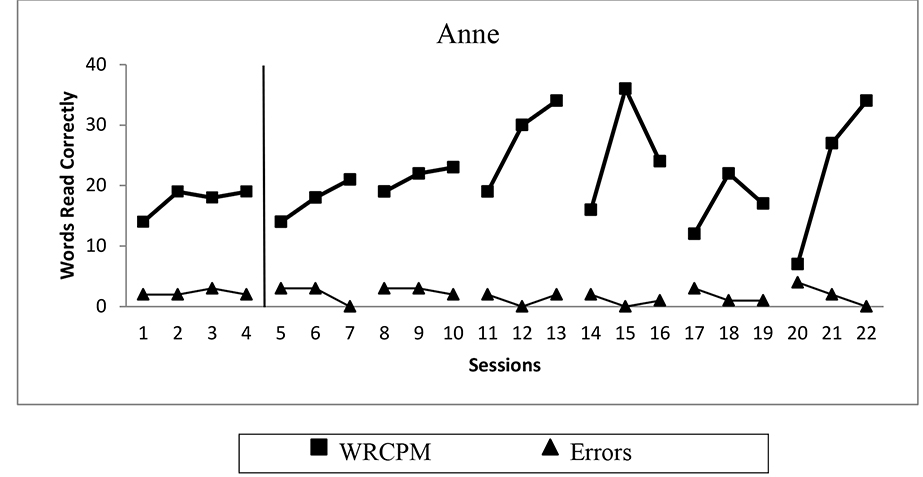
Anne: Baseline data for Anne show an average of 18 WRCPM (range, 14-19). During intervention, a decreasing trend for WRCPM was evidenced with a slight decrease to an average of 17 WRCPM (range, 11-22) on initial reading. Visual analysis of the results for Anne indicates improvement for WRCPM from the first reading to subsequent readings, with an average improvement of 14 WRCPM (range, 4-27) from first reading to highest rate achieved. From the first, or cold, read to the second reading of a passage, Anne increased WRCPM by an average of 11.5 words. The difference in reading rate from the second to the third reading was irregular, ranging from an increase of 7 words to a decrease of 12 words per minute. This data suggests Anne’s reading rate improved on a second reading of the same text; however, gains in rate for a third reading of the text were inconsistent.
The initial reading rate, measured by the correct words read per minute during a first, or cold, reading for each passage was analyzed to determine if the intervention was generalized across time. Initial reading rate from a new text was compared to the previous text’s reading rate. During the intervention phase, Anne’s initial reading rate increased during the first three passages then decreased during the last three passages. During intervention, four of six initial or cold readings (66%) were below the baseline rate. Table 1 shows the initial reading rates and mean baseline WRCPM for Anne. During the baseline phase of the study, Anne had a mean rate of 18 WRCPM. Anne’s initial reading rate decreased to 14 WRCPM during the first week of the intervention. Anne’s initial reading rate increased to 19 during the second and third weeks of the intervention. Anne’s initial reading rate decreased the fourth week to 16 WRCPM and again during the fifth week to 12 WRCPM. During week six, Anne’s initial reading rate fell to 7 WRCPM. Error rates for Anne are presented in Figures 2a and 2b. Visual analysis indicates an increase in reading accuracy on subsequent readings of a text. No significant changes in reading accuracy were observed from baseline to intervention.
Figure 2a: Anne Words Read Correctly & Error Rates (table)
Sessions |
WRCPM |
Errors |
1 |
14 |
2 |
2 |
19 |
2 |
3 |
18 |
3 |
4 |
19 |
2 |
5 |
14 |
3 |
6 |
18 |
3 |
7 |
21 |
0 |
8 |
19 |
3 |
9 |
22 |
3 |
10 |
23 |
2 |
11 |
19 |
2 |
12 |
39 |
0 |
13 |
34 |
2 |
14 |
16 |
2 |
15 |
36 |
0 |
16 |
24 |
1 |
17 |
12 |
3 |
18 |
22 |
1 |
19 |
17 |
1 |
20 |
7 |
4 |
21 |
27 |
2 |
22 |
34 |
0 |
Figure 2b: Anne Words Read Correctly & Error Rates (chart)
Jane: Baseline data for Jane show an average of 69 WRCPM (range, 55-81). During intervention, an increasing trend for WRCPM was evidenced with an increase to an average of 75 WRCPM (range, 69-86) on initial reading. Visual analysis of the results for Anne indicates improvement for WRCPM from the first reading to subsequent readings, with an average improvement of 26 WRCPM (range, 11-48) from first reading to highest rate achieved.
The initial reading rate, measured by the correct words read per minute during a first, or cold, reading for each passage was analyzed to determine if the intervention was generalized across time. Initial reading rate from a new text was compared to the previous text’s reading rate. During the intervention phase, Jane’s initial reading rate increased to an average of 75 WRCPM, only slightly above the baseline rate. During intervention, all six initial or cold readings were at or above the baseline rate. Table 1 shows the initial reading rates and mean baseline WRCPM for Jane. During the baseline phase of the study, Jane had a mean rate of 69 WRCPM. Jane’s initial reading rate was 69 WRCPM during the first week of the intervention. Jane’s initial reading rate increased to 86 during the second week, and decreased to 70 during the third week of the intervention. Jane’s initial reading rate the fourth week rose to 77 WRCPM and fell during the fifth week to 70 WRCPM. During week six, Jane’s initial reading rate increased to 77 WRCPM. Error rates for Jane are presented in Figures 3a and 3b. Visual analysis indicates little impact on reading accuracy from subsequent readings of familiar text. Jane’s error rates were quite low during baseline and initial readings of novel passages. No significant changes in reading accuracy were observed from baseline to intervention or from a cold reading to subsequent readings.
Figure 3a: Jane Words Read Correctly & Error Rates (table)
Sessions |
WRCPM |
Errors |
1 |
69 |
1 |
2 |
72 |
1 |
3 |
55 |
1 |
4 |
81 |
1 |
5 |
69 |
1 |
6 |
108 |
0 |
7 |
102 |
0 |
8 |
86 |
0 |
9 |
97 |
0 |
10 |
88 |
1 |
11 |
70 |
0 |
12 |
90 |
0 |
13 |
95 |
0 |
14 |
77 |
1 |
15 |
95 |
0 |
16 |
95 |
0 |
17 |
70 |
0 |
18 |
118 |
0 |
19 |
90 |
0 |
20 |
77 |
0 |
21 |
101 |
0 |
22 |
101 |
0 |
Figure 3b: Jane Words Read Correctly & Error Rates (chart)

Discussion
Overall, visual analysis across the three participants in this study shows that the addition of the repeated reading process to the existing curriculum has generally positive, if uneven, effects on braille reading rate and accuracy. For all participants, repeated readings of a text resulted in increased rate and fewer reading errors. The pattern of improvement for a passage was not uniform across participants. While all three readers saw the largest increase in rate from the first to the second reading; the increase from second to third reading was more variable, and, in some cases, the rate decreased from the second to the third reading. The speed drop between the second and third reading could be an attention issue or due to lack of interest in rereading. In terms of generalizing gains in fluency across passages, results of this study demonstrate mixed effects.
Social Validity
When implementing interventions in the classroom, ongoing evaluation of whether treatment procedures and outcomes are acceptable and useful to students and their teachers is important. Soliciting feedback from participants and practitioners can help narrow the gap between research and practice. When stakeholders perceive an intervention as relevant and worthwhile, they are more likely to implement it with fidelity (Wolf, 1978). Based on these principles, social validity was assessed for the participants in this study and their TSVI. In examining social validity, one of the researchers conducted an interview with the TSVI to determine if repeated reading procedures were perceived as effective in helping students read braille more fluently. The TSVI stated that students appeared more confident in their reading skills and demonstrated improved tracking of braille letters. The TSVI also noted an increase in braille reading comprehension. The TSVI indicated she would continue to utilize repeated reading strategies when the study ended. Participants in the study reported that they enjoyed completing repeated readings. The 6th grade student said this gave her an opportunity to understand what she was reading. This feedback suggests that repeated reading techniques are acceptable interventions for use in the classroom.
Limitations of the Study
Several limitations to this study should be acknowledged. The three students in this study were a heterogeneous group. It was difficult to find three students with braille as a primary reading medium on the same grade/cognitive level. This heterogeneity limited how the findings of this study can be applied to other braille readers if they differ from the participants in this research. In addition, the intervention phase was relatively short, allowing for only 18 sessions and six different text selections. Data collected over a longer period using additional reading passages may provide different results. Finally, this study would show more external validity if there were similar studies using repeated reading techniques with braille readers. Future studies are needed to support or contradict the findings in this study.
The findings from this study create a foundation for further research using repeated readings for braille readers to increase braille fluency and accuracy to either contradict or support the findings of this study. Other studies in this area focus on print or large print readers and it is important to have better knowledge on how braille readers develop reading fluency and accuracy. Additionally, this study suggests that using repeated reading strategies could greatly increase braille reading fluency and accuracy, but did not address comprehension. Further research should use repeated readings with braille readers to determine if comprehension increased by using repeated reading strategies.
Implications for Practitioners and Families
The goal of this study was to determine if the repeated reading strategy is effective in increasing reading fluency in braille readers. The premise for this intervention involved systematically providing participants the opportunity to use repeated reading strategies over the course of four weeks. According to the results, all three students increased their braille reading fluency using repeated readings compared to baseline sessions. This was verified through data collection and interobserver agreement.
The findings of this study offer some implications for practice. First, reading rate and accuracy did improve from initial reading to subsequent readings for participants, indicating that repeated reading of passages has an influence on braille reading fluency. The instructional methods implemented in this study should be used to supplement the regular braille instruction provided in the classroom. Also, this study reveals that repeated reading is an acceptable intervention that students and teachers find useful. The TSVI decided to continue the use of repeated reading strategies when introducing braille readers to new material after the study was complete.
Repeated reading procedures require little to no training and can be easily implemented by anybody in the student’s environment, including parents, paraprofessionals, and teachers. This strategy has the potential to increase learning and reading rates for children who use braille as their primary reading medium.
References
Alber-Morgan, S. R., Ramp, E. M., Anderson, L. L., & Martin, C. M. (2007). Effects of repeated readings, error correction, and performance feedback on the fluency and comprehension of middle school students with behavior problems. Journal of Special Education, 41(1), 17-30. doi: 10.1177/00224669070410010201
Chard, D. J., Ketterlin-Geller, L. R., Baker, S. K., Doabler, C., & Apichatabutra, C. (2009). Repeated reading interventions for students with learning disabilities: Status of the evidence. Exceptional Children, 75(3), 263–281. Retrieved from ERIC database. (EJ842535)
Chard, D.J., Vaughn, S., & Tyler, B. J. (2002). A synthesis of research on effective interventions for building reading fluency with elementary students with disabilities. Journal of Learning Disabilities, 35(5), 386-406. Retrieved from http://literacyconnects.org/img/2013/03/Research-Synthesis-on-Fluency-Interventions.pdf
Coppins, N., & Barlow-Brown, F. (2006). Reading difficulties in blind, braille-reading children. The British Journal of Visual Impairment, 24(1), 37-39. doi: 10.1177/0264619606060035
Corn, A. L., Wall, R. S., Jose, R. T, Bell, J. K., Wilcox, K., & Perez, A. (2002). An initial study of reading and comprehension rates for students who received optical devices. Journal of Visual Impairment & Blindness, 96(5), 322-334. Retrieved from http://www.afb.org/afbpress/pubjvib.asp?DocID=JVIB960504
Escarpio, R., & Barbetta, P.M. (2016). Comparison of repeated and non-repeated readings on the reading performances of students with emotional and behavioral disorders. Journal of Emotional and Behavioral Disorders, 24(2), 111-124. doi: 10.1177/1063426615574337
Fellenius, K. (1999). Reading environment at home and at school of Swedish students with visual impairments. Journal of Visual Impairment & Blindness, 93(4): 211-224.Retrieved from http://www.afb.org/afbpress/pubjvib.asp?DocID=jvib930403
Ferrell, K. A., Mason, L., Young, J., III, & Cooney, J. (2006). Forty years of literacy research in blindness and visual impairment (Tech. Rep.). Greeley, CO: University of Northern Colorado, National Center on Low-Incidence Disabilities. Retrieved from http://www.unco.edu/ncssd/resources/Literacy%20Meta-Analysis%20Technical%20Report.pdf
Good, R. H., & Kaminski, R. A. (Eds.). (2002). Dynamic indicators of basic early literacy skills (6th ed.) [Software and measurement instrument]. Eugene, OR: Institute for the Development of Education Achievement. Retrieved from https://dibels.uoregon.edu/docs/materials/large_print/1_bench_large_print_6th_ed.pdf
Hua, Y., Therrien, W. J., Hendrickson, J. M., Woods-Groves, S., Ries, P. S., & Shaw, J. W. (2012). Effects of combined repeated reading and question generation intervention on young adults with cognitive disabilities. Education and Training in Autism and Developmental Disabilities, 47(1), 72–83. Retrieved from http://daddcec.org/portals/0/cec/autism_disabilities/research/publications/education_training_development_disabilities/2011v47_journals/etadd_2012v47n1p72-83_effects_of_combined_repeated_readings.pdf
Koenig, A. J., & Holbrook, M. C. (2000). Ensuring high-quality instruction for students in braille literacy programs. Journal of Visual Impairment & Blindness, 94(11), 677-694. Retrieved from http://www.afb.org/jvib/JVIB941102.asp
Layton, C. A., & Koenig, A. J. (1998). Increasing reading fluency in elementary students with low vision through repeated readings. Journal of Visual Impairment & Blindness, 92(5), 276-292. Retrieved from http://www.afb.org/afbpress/pubjvib.asp?DocID=jvib920505
Legge, G. E., Madison, C. M., & Mansfield, J. S. (1999). Measuring braille reading speed with the MNREAD test. Vision Impairment Research, 1(3), 131-145. Retrieved from http://legge.psych.umn.edu/pdf/Legge99.pdf
Morgan, P. L., Sideridis, G., & Hua, Y. (2012). Initial and over-time effects of fluency interventions for students with or at risk for disabilities. The Journal of Special Education, 46(2), 94–116. doi: 10.1177/0022466910398016
Musti-Rao, S., Hawkins, R. O., & Barkley, E. A. (2009). Effects of repeated readings on the oral reading fluency of urban fourth-grade students: Implications for practice. Preventing School Failure, 54(1), 12–23. Retrieved from ERIC database. (EJ845959)
National Institute of Child Health and Human Development (NICHD). (2000). Report of the National Reading Panel. Teaching children to read: An evidence-based assessment of the scientific research literature on reading and its implications for reading instruction: Reports of the subgroups (NIH Publication No. 00-4754). Washington, DC: U.S. Government Printing Office. Retrieved from https://www.nichd.nih.gov/publications/pubs/nrp/documents/report.pdf
O’Keeffe, B. V., Slocum, T. A., Burlingame, C., Snyder, K., & Bundock, K. (2012). Comparing results of systematic reviews: Parallel reviews of research on repeated reading. Education and Treatment of Children, 35(2), 333–366. Retrieved from ERIC database. (EJ968783)
Pattillo, S. T., Heller, K. W., & Smith, M. (2004). The impact of a modified repeated reading strategy paired with optical character recognition on the reading rates of students with visual impairments. Journal of Visual Impairment & Blindness, 98(1), 28-46. Retrieved from http://www.afb.org/afbpress/pubjvib.asp?DocID=JVIB980104
Pikulski, J. J., & Chard, D. J. (2005). Fluency: Bridge between decoding and reading comprehension. The Reading Teacher, 58, 510-519.Retrieved from http://www.eduplace.com/state/author/pik_chard_fluency.pdf
Reisener, C. D., Lancaster, A. L., McMullin, W. A., & Ho, T. (2014). A preliminary investigation of evidenced-based interventions to increase oral reading fluency in children with autism. Journal of Applied School Psychology, 30(1), 50-67. doi: 10.1080/15377903.2013.869785
Samuels, S. J. (1979). The method of repeated readings. The Reading Teacher, 32(4), 403-408. Retrieved from ERIC. (EJ197688)
Savaiano, M. E., & Hatton, D. D. (2013). Using repeated reading to improve reading speed and comprehension in students with visual impairments. Journal of Visual Impairment & Blindness, 107(2), 93-106. Retrieved from http://www.afb.org/afbpress/pubjvib.asp?DocID=jvib070203
Simón, C., & Huertas, J. A. (1998). How blind readers perceive and gather information written in braille. Journal of Visual Impairment & Blindness, 92(5), 322-330. Retrieved from http://www.afb.org/afbpress/pubjvib.asp?DocID=jvib920509
Steinman, B. A., LeJeune, B. J., & Kimbrough, B. T. (2006). Developmental stages of reading processes in children who are blind and sighted. Journal of Visual Impairment & Blindness, 100(1), 36-46. Retrieved from http://www.afb.org/afbpress/pubjvib.asp?DocID=JVIB000106
Strickland, W. D., Boon, R. T., & Spencer, V. G. (2013). The effects of repeated reading on the fluency and comprehension skills of elementary-age students with learning disabilities (LD), 2001–2011: A review of research and practice. Learning Disabilities: A Contemporary Journal, 11(1), 1–33. Retrieved from http://textmapping.weebly.com/uploads/2/4/6/8/24683091/rereading_for_fluency.pdf
Swain, K. D., Leader-Janssen, E. M., & Conley, P. (2013). Effects of repeated reading and listening passage preview on oral reading fluency. Reading Improvement, 50(1), 12-18. Retrieved from http://digitalcommons.unomaha.edu/spedfacpub/9/
Therrien, W. J. (2004). Fluency and comprehension gains as a result of repeated reading: A meta-analysis. Remedial and Special Education, 25(4),252-261. doi: 10.1177/07419325040250040801
Trent, S. D., & Truan, M. B. (1997). Speed, accuracy, and comprehension of adolescent braille readers in a specialized school. Journal of Visual Impairment & Blindness, 91(5), 494-500. Retrieved from http://www.afb.org/afbpress/pubjvib.asp?DocID=jvib910509
U.S. Department of Education, Institute of Education Sciences, What Works Clearinghouse. (2014, May). Students with learning disabilities intervention report: Repeated reading. Retrieved from http://whatworks.ed.gov.
Wolf, M. M. (1978). Social validity: The case for subjective measurement or how applied behavior analysis is finding its heart. Journal of Applied Behavior Analysis, 11(2), 203–214. doi: 10.1901/jaba.1978.11-203
Wolffe, K. E., & Kelly, S. M. (2011). Instruction in areas of the expanded core curriculum linked to transition outcomes for students with visual impairments. Journal of Visual Impairment & Blindness, 105(6), 340-349. Retrieved from http://www.afb.org/afbpress/pubjvib.asp?DocID=jvib050605
Wormsley, D. P. (1996). Research note: Reading rates of young braille-reading children. Journal of Visual Impairment & Blindness, 90(3), 278-282. Retrieved from http://www.afb.org/afbpress/pubjvib.asp?DocID=jvib900322
Yurick, A. L., Robinson, P. D., Cartledge, G., Lo, Y., & Evans, T. L. (2006). Using peer-mediated repeated readings as a fluency-building activity for urban learners. Education and Treatment of Children, 29(3), 469-506. Retrieved from http://www.jstor.org/stable/42899897
The Journal of Blindness Innovation and Research is copyright (c) 2017 to the National Federation of the Blind.