
Online Mentor Education for Mentors of Youth With Visual Impairments
By Laura Lunsford, Sunggye Hong, Garrison Tsinajinie, Sanlyn Buxner, and Irene Topor
Laura Lunsford is a professor of psychology and Assistant Dean of Psychology and Social Work at Campbell University. An expert in leadership and mentoring she has published over 50 scholarly papers and books on these topics. Her PhD is from NC State University.
Dr. Sunggye Hong, an associate professor of the Department of Disability and Psychoeducational Studies at the University of Arizona, currently assumes the faculty chair position for the Special Education Unit. He has conducted research in the areas of braille reading, assistive technology, and expanded core curriculum of students with visual impairments. He served as the project PI for Project-Based Learning Opportunities and Exploration of Mentorship for Students with Visual Impairments in STEM, a project funded by the National Science Foundation project for STEM.
Garrison Tsinajinie is an assistant professor of practice in the Department of Disability and Psychoeducational Studies at the University of Arizona.
Sanlyn Buxner is an associate research professor in science education in the Department of Teaching, Learning, and Sociocultural Studies at the University of Arizona. Her research interests include supporting STEM teachers in engaging students in science and engineering practices as well as investigating how research experiences empower students and teachers.
Dr. Irene Topor was an associate professor of practice for the program to prepare teachers of children with visual impairments at the University of Arizona in Tucson, AZ for 26 years. She was the project director of Project POEM for 5 years. She retired in 2022.
Abstract
In this paper, we examine the effectiveness of the content and delivery of online training for mentors, some of whom had visual impairments, of middle and high school students with visual impairments in a STEM-oriented program. Data from online surveys, an online mentor training knowledge quiz, and phone interviews were analyzed to assess the mentor training. Twenty-one of the university mentors and industry mentors (N = 26), who had visual impairments, participated in the study. Findings suggest the mentoring training content was useful, valued, and retained. Use of podcasts to deliver the content was effective.
Keywords
Mentorship training, visual impairments, youth, STEM
Online Mentor Education for Mentors of VI Youth
We know little about what constitutes effective mentor preparation, especially for mentors of students with disabilities. Training of mentors is touted as a best practice for mentoring programs (DuBois et al., 2002) that is associated with positive program outcomes (DuBois et al., 2002; National Academies of Sciences, Engineering, and Medicine, 2019). What do mentors need to know about effective mentorship? What delivery modality for training works best for mentors with visual impairments? This study sought to answer these questions.
There are many youth mentoring programs (Rhodes, 2008) and substantial evidence for positive outcomes (Raposa et al., 2019; Rhodes, 1994) from such programs. Youth mentorship increases academic aspirations, school retention, and grades (Rhodes & DuBois, 2008) and is associated with positive psychological, cognitive, social, and health outcomes (Raposa et al., 2019). Science, technology, engineering, and math (STEM) focused mentoring programs are associated with an increase in student aspirations for STEM careers (Burgstahler & Cronheim, 2001; Gregg et al., 2017).
What about mentorship for students with visual impairments? Peer mentoring is beneficial for students with disabilities, especially if the mentor has a similar disability (Sword & Hill, 2002; Whelley, 2003). Mentoring has been viewed as a career developmental tool for youth with visual impairments (VI; Bell, 2012; O’Malley & Antonelli, 2016). Young adults with VI, who were seeking employment after college, were found to have increased assertiveness in their job search after mentor guidance (Antonelli et al., 2018).
Scholars report that STEM mentor preparation should include information on the fundamentals of establishing a mentoring relationship, program-related information, and STEM-specific information (Stelter et al., 2020). Stelter and colleagues’ (2020) review found that most training programs were in-person and failed to include even a knowledge test of the content.
Pfund and colleagues (2014) are among the few scholars who have provided evidence for the effectiveness of their STEM-focused Entering Mentoring training curriculum. The delivery is facilitated discussion. They found, using a random control trial, that mentor training, in areas like assessing understanding and fostering independence, was associated with greater self-reported skill development for undergraduate researchers.
The study presented here describes the development and assessment of mentor training for a STEM mentoring program for youth with VI. We first describe the program elements and how mentorship fits into the larger program. The curriculum of the mentor training is described next along with our assessment of the training effectiveness. We conclude with suggestions for implementation of mentor programs for students with VI. The research questions we examine in this paper are listed below.
- Can training modules for mentors be effectively distributed asynchronously and online?
- How easy is it for mentors with VI to access online training for mentors?
- What content for mentor training is valued by mentors, including program-specific topics?
Program Description
The mentoring component was one element in the Project-Based Learning Opportunities and Exploration of Mentorship (POEM). POEM provided experiences to middle and high school (grades 7-11) students with VI to encourage their interests in STEM subjects and careers. Each youth with VI was paired with a university mentor (UM) in a STEM-related major and with an industry mentor (IM) who was also VI. The exploration of mentorship element of POEM was combined with Project-based learning (PBL). The intervention had three components in the following sequence: a week-long residential Readiness Academy, nine monthly Exploration Activities, and a week-long residential Enrichment Institute.
Readiness Academy
The Readiness Academy focused on outdoor science education and introduced mentees to each other, to their mentors, and to the program expectations. On the last day of the Readiness Academy, the participants met their IM and UM face-to-face or through video conference.
Exploration Activities
The Exploration Activities consisted of nine monthly assignments, using PBL that aligned with Next Generation Science Standards. Mentees worked with their mentors and submitted these assignments electronically. PBL is an instructional strategy where a teacher facilitates a student’s learning through inviting inquiry for an area of interests. Once an inquiry is identified, students follow through four phases of PBL and they are creating hypotheses, collecting data, analyzing data, confirming primary outcomes, and presenting findings. The heterogeneous composition of students with VI requires a unique instructional approach. PBL compliments well the needs of students with VI who do not learn incidentally about their world, but instead must have multisensory, hands-on learning opportunities from infancy through the school years (Chen, 2014; Allman & Lewis, 2014).
Enrichment Institute
At the end of the program, mentees returned to the university campus for a week-long Enrichment Institute. Mentees visited local laboratories, STEM-related job sites, and the university’s disability resource center. They worked in small groups and presented their work at the Project POEM Symposium to family, friends, mentors, and panel of community judges.
Mentors and Mentees
Industry mentors were adults with visual impairments employed in a STEM-related career. Industry mentors (a) had a visual impairment, (b) were employed in a STEM related-related field for the duration of the 14-month intervention, (c) agreed to a minimum of 3 hours per month to fulfill project mentorship requirements.
University mentor participants: (a) were enrolled in an undergraduate or a graduate program, (b) had a major(s) in at least one STEM area, and (c) agreed to attend a 6-hour mentoring training, and (d) agreed to commit a minimum of 4 hours per month supporting students and other project activities. We had three UMs and three IMs return to participate in Project POEM year 2 whom had already participated in the mentor training year 1.
There were 23 mentees; nine in year 1 and 14 in year 2. The mentees’ ages ranged from 12 to 17 years old (M = 14.65) and mentees spanned grades 6-12.
Both types of mentors worked with the mentees on their Exploration Activities, however, UMs primarily assisted the mentees with the Exploration Activities that were delivered as a series of nine monthly assignments. The mentees also completed monthly assignments to engage with their IM. For example, mentees might virtually job shadow their industry mentor, or inquire about how his or her industry mentor negotiated transportation as a person with VI.
Development of Mentor Training
The POEM mentor training was adapted from the Entering Mentoring curriculum, which was developed to prepare mentors of undergraduate researchers through eight weekly discussion seminars on (a) getting started, (b) communication, (c) goals, (d) identifying challenges, (e) resolving challenges, (f) evaluating progress, (g) elements of good mentoring, and (h) developing a mentoring philosophy (Handelsman et al., 2005; Balster et al., 2010). We adapted the content to eight modules, which were delivered in year 1 through an online learning management system. In subsequent years, we provided a link to the podcasts and emailed the worksheets to the mentors. The adaptations we made to the content were based on a review of the literature and the program needs, specifically to prepare UMs to work with students with VI and to understand the PBL approach. We chose to create podcasts as we hoped they would be more interesting and accessible to use, especially for mentors with VI, rather than having other visual means of communication. The approach to the podcasts was to take an informal, conversational approach between two individuals on the topics. The topics covered, in order, were:
- Getting Started
- Developing High Quality Relationships
- Assessing Understanding
- Establishing Expectations
- Mentoring Ethically
- Ending Well
- Learning About Visual Impairment (optional for industry mentors)
- Mentoring Through PBL (optional for industry mentors)
Each module had a 15-20 minute podcast, a worksheet to support mentors’ learning, and an evaluation survey. Mentors had 1 month to complete the training and were asked to take an online knowledge quiz at the end of the training.
Methods
Measures
The effectiveness of training was assessed in three ways. First, each training module had a seven-question evaluation. The questions asked about how many minutes they spent on the training module, how useful it was perceived, what was confusing about the material, and what stood out to them. The questions about usefulness had a 4-item Likert response scale, where 1 = “strongly disagree,” 2 = “disagree,” 3 = “agree,” and 4 = “strongly agree.”
Second, there was a knowledge quiz at the end of the training. This quiz had 21 items for the UMs and 16 items for the IMs, reflecting the difference in the two optional modules for the IMs. A representative item is “the best time to talk about expectations in the relationship is ____” with multiple choice options presented.
Third, mentors participated in a semi-structured interview, which included questions about mentoring, at the halfway point in the program. The interviewer asked mentors to reflect on the quality, efficacy, and completeness of the training and how they were using the knowledge and skills they had learned in their mentoring.
Procedures
This project, including the mentoring component, was approved by the University of Arizona’s Human Subject Office. Participants’ consent and minor assent forms were obtained from all participants.
The online mentor module evaluations and the training quiz were in a learning management system (Desire to Learn) in year 1 and in Qualtrics in year 2. The interviews were conducted by telephone.
Thirteen interviews were conducted with UMs halfway through the year (eight in year 1 and five in year 2) and five were conducted at the end of year 1. Across years 1 and 2, a total of 13 interviews were conducted with IMs halfway through the year (seven in year 1 and six in year 2) and six were conducted at the end of year 1.
Findings
Participants
We report data across 2 years of the program. There were 12 IMs, from 26-65 years old (M = 44.92), five women and seven men. Self-reported race/ethnicities included White (n = 7), Asian (n = 2), Arab (n = 1), Middle Eastern (n = 1), and White/Cuban (n = 1). The highest advanced degree types included: bachelor’s degree (n = 2), master’s degree (n = 3), doctoral degree (n = 6), and doctoral candidate (n = 1). Eight people served as a mentor for only 1 year: five people in year 1 and three people in year 2. Four mentors participated in both years and were encouraged to complete the training each year. IMs self-reported the following eye conditions: congenital cataract (n = 1), macular degeneration and cone rod dystrophy (n = 1), microphthalmia (n = 1), myopia and nystagmus (n = 1), ocular albinism with nystagmus (n = 1), optic nerve atrophy (n = 1) retinopathy of prematurity (n = 2), scleral cornea (n = 1), retinitis pigmentosa (n = 1), retinitis pigmentosa and macular degeneration (n = 1).
There were 14 university mentors between 18 to 35 years old (M = 22.58), seven women and seven men. Self-reported race/ethnicities were White (n = 8), Hispanic (n = 1), Mexican (n = 1), Middle Eastern (n = 1), and White/Asian (n = 1). Twelve mentors served in only one year of the program: seven students in year 1 and five in year 2. Two people were UMs in year 1 and in year 2 and were asked to complete the mentoring training both years. The majors of the university mentors included astrophysics (n = 1), biomedical engineering (n = 1), geology (n = 2), geosciences (n = 2), hydrology (n = 1), neuroscience and cognitive science (n = 2), physics/mathematics (n = 1), planetary science (n = 1), as well as teaching and teacher education (n = 1). Eight mentors were completing bachelor’s degrees, and four mentors were completing doctoral degrees. No demographic data was available for two UMs.
Accessibility of Mentor Training
Nine of 12 IMs and 11 of 14 UMs completed the mentor training module evaluations, which provided information on how long mentors listened to the module and how useful they viewed the module. On average the mentors listened 21.65 minutes to each module and for 161.29 minutes in total for the entire training (see Figure 1).
IMs reported spending an average of 14 more minutes per module as compared to UMs. The IMs listened the longest to “Mentoring Ethically” (34.22 minutes) and “Ending Well” (34.00 minutes), while UMs listened the longest to “Mentoring Through Project-Based Learning” (20.58 minutes) and “Mentoring Ethically” (20.00 minutes). Three IMs completed one or both of the optional modules listed above.
When asked about how they listened to each podcast, more than half (n = 7) of the UMs listened to the “Assessing Understanding” podcast once. However, more UMs “backed up and listened again” to “Developing High Quality Relationships” (n = 4), “Establishing Expectations” (n = 3), and “Mentoring Ethically” (n = 5) as compared to IMs.
More than half of IMs listened to the “Developing High Quality Relationships” (n = 5), “Establishing Expectations” (n = 6), and “Mentoring Ethically” (n = 5) podcasts once. More IMs than UMs “backed up and listened again” when listening to the “Assessing Understanding” (n = 4) module (see Figure 2).
Ten of the mentors (UM and IM) listened once to three of the modules: “Developing High Quality Relationships,” “Assessing Understanding,” and “Establishing Expectations.” University and industry mentors most often “backed up and listened again” to “Getting Started” (n = 9) and “Assessing Understanding” (n = 8). Twice the mentors listened to a podcast more than once. The UMs were required to take the “Learning About Visual Impairment” and “Mentoring Through PBL Modules”, which were optional for the IM. Seven of the mentors “backed up and listened again” (n = 7) to PBL podcast.
Changes From Year 1 to Year 2
In year 1, one industry mentor pointed out that the set-up of the training was difficult for mentors with a VI. These mentors had difficulty navigating the learning management system. We consulted with the IMs about their preferred delivery. Based on their responses, changes were made to delivering the training in year 2 by providing mentors a Word document with links to the podcasts and associated surveys.
Usefulness of Mentoring Training
Data from the module evaluations and from the interviews suggest that the content was useful. All but one of university and industry mentors agreed or strongly agreed that the modules were useful. One mentor commented that the comprehensive training demonstrated that the program took the mentoring part of the project seriously.
“Mentoring Through Project-Based Learning” had the highest usefulness by both IMs (M = 3.67) and UMs (M = 3.92). “Mentoring Ethically” had the lowest average usefulness among the modules by both IMs (M = 2.67) and UMs (M = 3.00). A closer examination of the frequency distribution showed half of the IMs strongly agreeing this module was useful and the other half strongly disagreeing. The UMs’ average scores showed the same pattern.
In the interviews, which were months after the training, all the mentors reported that the online training was of high quality and helpful. Mentors new to mentoring, new to working with students with VI, or new to working with high school or middle school students, described specific information from the training that assisted them in their mentoring experiences, including how to communicate effectively with a VI student or how to build rapport. A representative comment was:
The online training was really awesome because I had personally never worked with a visually-disabled student….it allowed me to learn the culture and learn what was okay and what wasn't okay…. It helped me to also understand exactly how we're going to be communicating this really complicated science to somebody who doesn't necessarily have the same abilities that we all do.
During the interviews, several mentors reported that the training had been beneficial in other mentoring and teaching aspects of their life. For example, a mentor said, “I’ve also been able to apply it with my undergraduate research assistants, and even students I teach for teaching assistantships, so it’s been a great professional development tool overall.” Experienced mentors felt that the training included good reminders and reinforced their existing knowledge.
Finally, in the module evaluations, mentors shared “what stood out from the training.” UMs reported learning about students with disabilities, including that many VI students have multiple disabilities and how to productively talk about “seeing” with them. Both UMs and IMs reported learning about rapport and the difference between middle school and high school students stood out to them. Mentors described the importance of learning about PBL, techniques for working effectively with their mentors, and how much they enjoyed the module on the ethics of mentoring. Lastly, mentors reported learning about learning styles and how to end a mentoring relationship well. In their open-ended responses, mentors reported the modules to be straightforward. The suggestions for improvement were to add a script with the most important points and provide more mnemonics for new terms.
The scores on the knowledge quiz at the end of the training suggest the mentors learned the material. Nine of the 12 IMs completed the 16-item knowledge quiz. Their average score was a 94%; the range was 88-100%. Eleven of the 14 UMs completed the 32-question knowledge quiz with a 90% average; the range was 68-97%. Corrected responses were available after the mentor completed the quiz.
Discussion and Implications
Scholars have called for more information about the content and delivery of mentoring training (Stelter et al., 2020). This study answers that call to learn more about what content and delivery was effective for mentor training in a STEM focused program for youth with VI.
Our paper makes three contributions. First, the content of the mentor training was useful and was mastered by the mentors as shown by the module evaluations and knowledge quiz. Information from the interviews indicated the mentors valued the material presented in the training. There were six modules required of IMs and eight required by the UMs (see Table 1). The UMs found the information about working with mentees who had VI as especially useful.
Second, mentor training can be successfully delivered online and through a podcast format. This point is especially important in programs with mentors who are not co-located or in situations that preclude in-person attendance. The podcast format to deliver the training worked well for the UMs and the IMs. The IMs all had a VI. However, the data suggest that relying more on an auditory format worked well for both mentor types. The IMs spent more time on listening to the podcasts and were more likely to relisten to parts of them. As professional adults, they may have been more motivated to make sure they understood the material. It is unclear exactly why they would spend more time on the training. However, data from the first year showed it was a problem for IMs to access the learning management system. Thus, in the second year the podcasts, worksheets, and surveys were removed from the learning management system and shared through links in a single Word document that was emailed to them. This delivery method worked well for the IMs, who reported that it was easy to access the information.
Third, POEM staff identified a list of topics for mentor training that were specific to the training of mentors in this project, based upon available research recommendations. Thus, two additional modules, The “Learning About Visual Impairment” and “Project-Based Learning” modules were originally meant for the UMs, but IMs voluntarily participated in the “Learning About Visual Impairment” module. The “Learning About Visual Impairment” module included the basics on how to work with a learner who has a visual impairment, the basics of getting around in the world as independently as possible, definitions of what it means to have a visual impairment, what language to use (e.g., yes, include the words “see” and “look,” as one would for any learner to understand a concept), and the importance of multisensory, hands-on experiences for learners who are VI that want to learn about STEM. The “Mentoring Through Project-Based Learning” module was also developed specifically for the Ums, so that they could guide their mentees to become critical thinkers in working through their POEM assignments and was rated highly.
Professional organizations in support of mentoring, such as the International Mentoring Association and the European Mentoring and Coaching Council, highlight the importance of mentors’ knowledge about ethical mentoring in their standards. Yet, the bimodal ratings of the usefulness of the “Mentoring Ethically” module suggest that half the of the mentors found this to be new and important information, while the other half of the mentors did not. Mentoring ethics are just beginning to be part of a national conversation on mentorship preparation in the United States and we suspect our mentors’ relative interest in this topic reflect the state of the field at present.
In summary, our findings about the mentor training suggest that general themes of mentorship education can and should be tailored to the specific needs of a mentoring program. In this case, the additional content focused on problem based learning and working with youth with visual impairments.
Implications for Friends and Families
This paper presents the results of mentorship education for mentors of youth with VI, who were participating in a year-long program to increase their interest in careers in science, technology, engineering, and mathematics. Our work shows that sighted mentors can be prepared to mentor youth with VI by listening to eight podcasts that cover general mentoring information about how to get started mentoring, along with a unit on mentoring youth with VI. Accessibility of the platform where the training materials are placed is equally important and professionals and providers of mentoring training programs can elect to choose the platform that utilizes most accessible means. Mentors with VI learned more about mentoring through the podcasts and were provided seamless experiences in accessing provided information. This project provides eight free podcasts and worksheets for preparing mentors, that can be used in mentoring programs involving youth with visual impairment. The podcasts can be accessed at https://podcasts.apple.com/us/podcast/project-poem-podcasts/id1362109033?mt=.
The Project-Based Learning Opportunities and Exploration of Mentorship for Students with Visual Impairments in STEM (POEM) Project is funded by the National Science Foundation’s Innovative Technology Experiences for Students and Teachers (ITEST) program. Award DRL #1657201.
References
Allman, C. B., & Lewis, S. (2014). ECC essentials: Teaching the expanded core curriculum to students with visual impairments. American Foundation for the Blind.
Antonelli, K., O'Mally, J., & Steverson, A. (2018). Participant experiences in an employment mentoring program for college students with visual impairments. Journal of Visual Impairment & Blindness, 112(3), 274-286. https://doi.org/10.1177/0145482X1811200306
Balster, N., Pfund, C., Rediske, R., & Branchaw, J. (2010). Entering research: A course that creates community and structure for beginning undergraduate researchers in the STEM disciplines. CBE—Life Sciences Education, 9(2), 108-118. https://doi.org/10.1187/cbe.09-10-0073
Bell, E. C. (2012). Mentoring transition-age youth with blindness. The Journal of Special Education, 46(3), 170-179. https://doi.org/10.1177/0022466910374211
Burgstahler, S., & Cronheim, D. (2001). Supporting peer-peer and mentor-protégé relationships on the internet. Journal of Research in Technology and Education, 34(1), 59–74. https://doi.org/10.1080/15391523.2001.10782334
Chen, D. (2014). Essential elements in early intervention: Visual impairment and multiple disabilities (2nd ed.). American Foundation for the Blind.
DuBois, D. L., Holloway, B. E., Valentine, J. C., & Cooper, H. (2002). Effectiveness of mentoring programs for youth: A meta‐analytic review. American Journal of Community Psychology, 30(2), 157-197. https://doi.org/10.1023/A:1014628810714
Gregg, N., Galyardt, A., Wolfe, G., Moon, N., & Todd, R. (2017). Virtual mentoring and persistence in STEM for students with disabilities. Career Development and Transition for Exceptional Individuals, 40(4), 205-214. https://doi.org/10.1177/2165143416651717
Handelsman, J., Pfund, C., Lauffer, S. M., & Pribbenow, C. M. (2005). Entering mentoring: A seminar to train a new generation of scientists. The Wisconsin Program for Scientific Teaching. https://undergradresearch.illinois.edu/assets/docs/OUR_Faculty_Mentoring.pdf
National Academies of Sciences, Engineering, and Medicine (2019). The Science of Effective Mentorship in STEMM. The National Academies Press. https://doi.org/10.17226/25568
O'Mally, J., & Antonelli, K. (2016). The effect of career mentoring on employment outcomes for college students who are legally blind. Journal of Visual Impairment and Blindness, 110(5), 295–307. https://doi.org/10.1177/0145482X1611000502
Pfund, C., House, S. C., Asquith, P., Fleming, M. F., Buhr, K. A., Burnham, E. L., Eichenberger Gilmore, J. M., Huskins, W. C., McGee, R., Schurr, K., Shapiro, E. D., Spencer, K. C., & Sorkness, C. A. (2014). Training mentors of clinical and translational research scholars: A randomized controlled trial. Academic Medicine, 89(5), 774-782. https://doi.org/10.1097/ACM.0000000000000218
Raposa, E. B., Rhodes, J., Stams, G. J. J. M., Card, N., Burton, S., Schwartz, S., Sykes, L. A. Y., Kanchewa, S., Kupersmidt, J., & Hussain, S. (2019). The effects of youth mentoring programs: A meta-analysis of outcome studies. Journal of Youth and Adolescence, 48(3), 423-443. https://doi.org/10.1007/s10964-019-00982-8
Rhodes, J. E. (1994). Older and wiser: Mentoring relationships in childhood and adolescence. Journal of Primary Prevention, 14(3), 187–196. https://doi.org/10.1007/BF01324592
Rhodes, J. E. (2008). Improving youth mentoring interventions through research-based practice. American Journal of Community Psychology, 41(1-2), 35-42. https://doi.org/10.1007/s10464-007-9153-9
Rhodes, J. E., & DuBois, D. L. (2008). Mentoring relationships and programs for youth. Current Directions in Psychological Science, 17(4), 254-258. https://doi.org/10.1111/j.1467-8721.2008.00585.x
Stelter, R. L., Kupersmidt, J. B., & Stump, K. N. (2020). Establishing effective STEM mentoring relationships through mentor training. Annals of the New York Academy of Sciences, 1483(1), 224-243. https://doi.org/10.1111/nyas.14470
Sword, C., & Hill, K. (2002). Creating mentoring opportunities for youth with disabilities: Issues and suggested strategies. Issue Brief, 1(4), 2-6.
Whelley, T. A., Radtke, R., Burgstahler, S., & Christ, T. W. (2003). Mentors, advisors, role models and peer supporters: Career development relationships and individuals with disabilities. American Rehabilitation, 27(1), 42-49.
Table 1
Mentor Education Modules by Average Time on Module
Module |
Required for |
Average Time for UM, IM |
|---|---|---|
Getting Started |
UM, IM |
16.67, 27.00 |
Developing High Quality Relationships |
UM, IM |
14.08, 26.67 |
Assessing Understanding |
UM, IM |
16.50, 26.00 |
Establishing Expectations |
UM, IM |
15.67, 30.22 |
Mentoring Ethically |
UM, IM |
20.00, 34.22 |
Ending Well |
UM, IM |
19.00, 34.00 |
Learning About Visual Impairment* |
UM |
18.67, 15.00 |
Mentoring Through PBL* |
UM |
20.58, 20.00 |
*Industry mentors were not required to complete these modules. However, two industry mentors completed the “Learning About Visual Impairments” module and three industry mentors completed the “Mentoring Through PBL” module. Their responses are included in the average times.
Alternative text for table: There are three columns and nine rows in table. The first row contains three titles: “Module,” “Required for,” and “Average Time for UM, IM.” Table presents the eight modules in the mentorship education. All were required by university and industry mentors, except two that were required only of the university mentors. The table presents the average time both groups of mentors listened to each module.
Figure 1
Average Number and Range of Minutes Mentors Listened to Modules
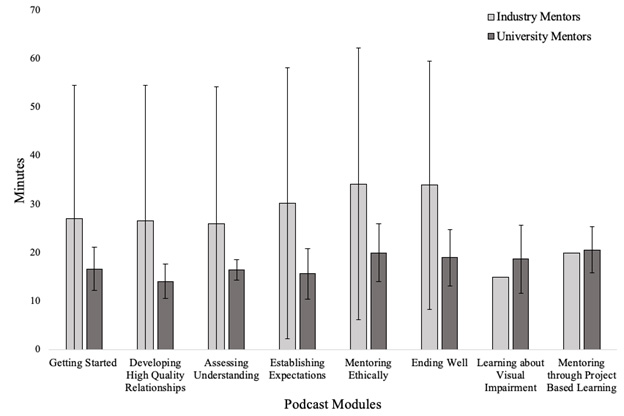
Figure 2
Frequency Counts: How Mentors Listen and Re-listened to Podcasts
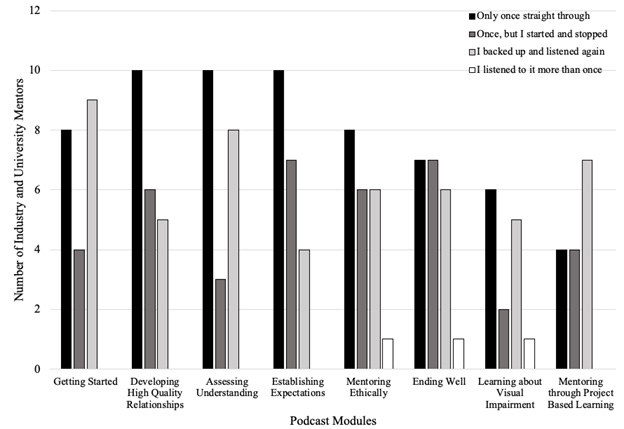
*Industry mentors were not required to complete two modules. However, two industry mentors completed the “Learning About Visual Impairments” module and three industry mentors completed the “Mentoring Through PBL” module. Their responses are included in the frequency counts.
The Journal of Blindness Innovation and Research is copyright (c) 2023 to the National Federation of the Blind.