


Welcome to the Voice’s newest feature, If Blindness Comes is
a special pull-out section on diabetes and vision loss, printed in a larger
font. If you know someone living with diabetes and vision loss, please pull
this section out and share it.
by Ed Bryant
A major aim of the Diabetes Action Network of the National Federation of the Blind is to provide support and information for blind diabetics, so they might better maintain or regain independence and productivity. Our national support and information network allows communication across a wide area, something important for blind or visually impaired diabetics and their families. With the trauma of sight loss, sometimes the newly blinded do not realize that most blind men and women with diabetes CAN self-manage safely and accurately, by use of alternative/adaptive techniques.
I became blind from diabetic retinopathy about 28 years ago. When I first lost my sight, I didn’t use insulin gauges to help draw my insulin, as I had never heard of such devices! Twenty-six years ago, I designed my own insulin gauge, and I used it for approximately three years, with no difficulties. However, I do not advocate the use of non-standard or homemade insulin-measuring devices, unless they have been checked for reliability by someone knowledgeable in insulin-measuring techniques.
 Members
of the health care community sometimes forget that although a diabetic may be
newly blinded, he or she has often been successfully self-managing the disease
for 15 years or more. Most long-term type 1 diabetics have had years of experience
drawing their own insulin. Veteran blind diabetics often have more experience
with adaptive insulin preparation devices than do many sighted health professionals.
The following observations are only a small sample.
Members
of the health care community sometimes forget that although a diabetic may be
newly blinded, he or she has often been successfully self-managing the disease
for 15 years or more. Most long-term type 1 diabetics have had years of experience
drawing their own insulin. Veteran blind diabetics often have more experience
with adaptive insulin preparation devices than do many sighted health professionals.
The following observations are only a small sample.
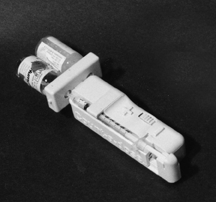
Because of my experience with diabetes and blindness and my editorship of Voice of the Diabetic, I am often asked to evaluate insulin-measuring gauges designed for the blind or visually impaired. I have tested numerous measuring devices, and in my opinion the Count-A-Dose, from Medicool, wins my blue ribbon. (Note: The Count-A-Dose is available from the National Federation of the Blind Materials Center: (410) 659-9314.) The device provides a very easy method of insulin dispensing. Designed for the B-D LoDose syringe, the Count-A-Dose holds two insulin vials and directs the syringe needle into the vials’ rubber stoppers. Using the thumb-wheel, which clicks for each unit measured (clicks can be both heard and felt), the blind diabetic can reliably draw and mix his or her own insulin.
How to Get Air Bubbles Out of an Insulin Syringe
There are techniques by which a blind diabetic may draw and mix insulin without drawing air into the syringe. Like many others, I have used them successfully for years. I first draw four or five units of regular insulin into the syringe and then inject all of it back into the vial. I then repeat the operation two more times. The fourth time, I draw the full amount of insulin needed from the first vial. Then, when I draw insulin from the second vial, I draw the exact amount needed. I have put this to the test; 100 repetitions without air bubbles. Diabetes Action Network former First Vice President Janet Lee twice performed the same test. In both cases the complete absence of air in the syringe was independently verified.
“Tapping the syringe to remove air bubbles,” a common technique used by the sighted, becomes unnecessary. The one to two units of air in the hub of the needle (where needle meets syringe) are expelled during the procedure used with the first vial of insulin. I demonstrate this technique to nurses, who are delighted to see that air bubbles are not present and the insulin measurement is accurate. Of course, long-term insulin users will be familiar with the need to inject as much air into the vial as the amount of insulin they withdraw, to facilitate getting the insulin into the syringe.
How to Know When an Insulin Vial is Getting Low
Each vial of insulin contains 10cc, 1000 units. The maximum number of units used per day, divided into the vial’s 10cc (1000 units) capacity, gives the maximum number of days the bottle can be used. When I open a new vial of Regular insulin, I divide its 1000 units by 20 units, the maximum I use daily, so one supply should last me 50 days, but as a safeguard, I assume that the new bottle contains only 940 units (9.4cc), which should last a maximum 47 days instead of 50. I measure my NPH insulin in a similar manner. As long as at least 60 units of insulin remain in the vial, the needle will remain submerged while filling, and there is no danger of drawing air. In drawing out the insulin, I keep the syringe vertical, needle straight up in the vial, so as not to inadvertently draw out air. Many blind consumers (and diabetes educators) are unaware of this point’s importance—that the natural tendency is to tilt or slant while drawing, which can lead to inaccurate filling, and air in the syringe.
Many methods exist to determine how long a supply will last. One way is to set aside the number of syringes needed for 940 units of insulin. Another might be to employ Braille, large print, tape recorders, or personal computers, to record how much insulin has been used each day. Blind consumers, who keep their blood glucose under tight control, follow regimes of insulin mixing and multiple injections, both of which increase the need for precision. I have found the more precise the record of insulin drawn, the easier to safely predict when it is time for a new supply.
The first of a two part series.