



by Jean Suren, KRN, BSC, CDE
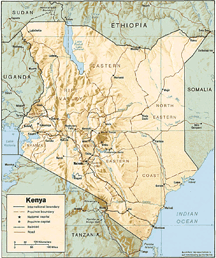
When I came to Kenya, East Africa, in 1991, I was only the second diabetes educator on the continent (there was one in South Africa). I knew I would face challenges getting diabetes education started here, but I didn’t know how very difficult it would be.
 As
the third president of the American Association of Diabetes Educators (AADE),
in the late 1970s, I battled to empower Americans with diabetes. Little did
I know that my work with AADE was preparing me for much larger battles ahead
in Africa.
As
the third president of the American Association of Diabetes Educators (AADE),
in the late 1970s, I battled to empower Americans with diabetes. Little did
I know that my work with AADE was preparing me for much larger battles ahead
in Africa.
At the age of 45, I was diagnosed with type 2 diabetes. This was no surprise to me; it was in the family—and I’d had reactive hypoglycemia (a precursor of type 2 diabetes) for 20 years. Of course I was angry—but I’d been an educator for more than a decade, so I knew what to do. It took a few months to find the right motivation to “do the doing.” My feet were my motivation—I didn’t want an amputation. I am addicted to African music, and love to dance—so I have managed my diabetes well for the past 20 years.
Life in Africa has challenged my diabetic control, but thankfully, I win almost every battle. Although Kenya grows a lot of vegetables for export, many Kenyan tribes consume few vegetables. As I traveled around Kenya, teaching health professionals in hospitals about updated diabetes care and patient education, I had a hard time getting my daily vegetables. Traditionally, Kenyans eat a high-starch diet, with occasional meat, and only small amounts of vegetables and fruits.
For five years, I traveled two weeks out of every month, via public transportation. Because of this, my stress level was usually very high. Roads here are in horrendous condition, accidents are common occurrences, drivers explain “rules are meant to be broken,” and our public transport system is very dangerous. Busses and matatus (Nissan vans) are always packed like sardines; until recently there were no seat belts or speed governors.
My experiences as a diabetic in Kenya taught me how to advise my patients living with the same challenges. It took two years to research the state of diabetes within the health care sector and to develop means of delivering quality care. Our health care providers’ knowledge of diabetes and patient care is nearly 20 years out of date. Half the nation is living below the poverty line—which makes getting any health care nearly impossible.
In 1993, I started the first hospital-based diabetes program in Sub-Saharan Africa, at Kikuyu Hospital, outside Nairobi, the capital. Gradually, I developed a motivated and dedicated team of health professionals. We learned a lot about how to give high-quality care at very low cost. We debunked the excuse: “We don’t have the money.” We proved that trained and motivated health professionals can deliver high-quality, cost-effective care.
The Diabetes Control and Complications Trial (the DCCT study), completed in 1993, was a great impetus to do a better job, for now we had proof there was payoff for good control. Then we defined clear targets for our patients based on that data.
In our own clinic, Diabetes Care and Training, about 75 percent of our patients can successfully hit the target and keep it (except during illness or times of stress). Of over 2,300 regular patients, 25 have received certificates of recognition for maintaining good control and stopping the progress of complications.
Over the past decade there have been three American diabetes educators who sent our clinic surplus supplies. These we used for our indigent diabetics who want good control but cannot afford it. My foster son Stephen, who I was blessed with 12 years ago, when he was diagnosed with type 1 diabetes, grew into a strong, healthy man on donated, often recently expired, insulin. (Unofficially, insulin, if stored properly, can be used for up to six months past the printed expiration date.) He is now a nurse/diabetes educator in a hospital on the outskirts of Nairobi, and is married with children.
We recently celebrated my 65th birthday—21 years with well-controlled diabetes, and 15 years of serving Kenyans with diabetes. In reflecting upon my contributions to this nation, 4,000 health professionals have been taught updated diabetes care, and over 5,000 people with diabetes have gotten the benefit of care under my guidance. Today, there are about 40 trained diabetes educators across Kenya, doing a good job under trying circumstances. At the end of our long, busy days, we draw strength and satisfaction knowing that we empowered thousands of interested diabetics to live full and healthy lives.
PARAMETERS FOR GOOD CONTROL
Fasting Blood Sugar
63 to 90 mg%
1 hour after meal
108 to 162 mg%
2 hours after meal
125 to 180 mg%
3 hours after meal
108 to 162 mg%
4 hours after meal
80 to 144 mg%
5 hours after meal
63 to 90 mg%
NOTE: If anyone wants to contact Jean, her staff, or other Kenyan diabetics, write to: Diabetes Care and Training, PO Box 35181, Nairobi, Kenya 00200, or (iffy) email: [email protected]