Maurer Devotes Career to Serving Blind Americans
by Josh Stowe
From the Editor: This article about Immediate Past President Marc Maurer is reprinted with the kind permission of the Notre Dame Alumni Association. A link to their newsletter can be found at <http://my.nd.edu/s/1210/myND/interior-2col.aspx?sid=1210&gid=1&sitebuilder=1&pgid =23642>. Here is the well-deserved tribute:
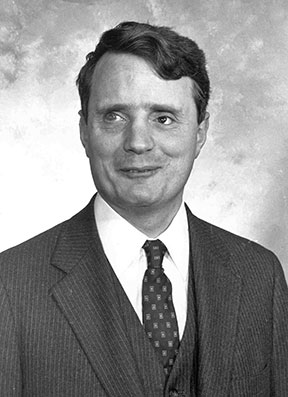 How on earth was a blind young man going to grill burgers for his new friends?
That’s the question Marc Maurer (class of 1974) pondered after he was asked to cook after a meeting for blind people. He’d dealt with his lack of sight since birth, but he was about to learn just how little it limited him.
Kenneth Jernigan, who would become his mentor, showed him how to grill. First, Maurer learned to pour lighter fluid and drop a match on the coals. After they were hot, he pulled on a pair of fireproof gloves and gently stirred them to distribute the fire. Now he was ready to cook dinner.
“I found out there’s lots to blindness I didn’t know. The limitations are much less if you know how to handle them,” Maurer says, recalling how that moment with Jernigan changed his life. “He told me, ‘Lots of people will tell you that you can’t do things, but you’ll find out that you can, if you’ll just learn the techniques.’”
That moment cemented Maurer’s relationship with Jernigan, who would lead him to Notre Dame and help him grow into a leader who offered hope and opportunity to countless others as president of the National Federation of the Blind.
A Sense of Possibility
Maurer, who was born prematurely, became blind shortly after birth when he was overexposed to oxygen. He grew up in Boone, Iowa, in a family of six children, where money was tight, and he and his siblings held odd jobs to help make ends meet. He began by baking bread and selling it around the neighborhood, then opened a business selling garter belts designed to help pregnant women wear stockings more comfortably.
He became involved with the Iowa Commission for the Blind, where members encouraged Maurer to think about further education, even arranging for him to take the college entrance exam in Braille.
Grilling burgers was just the start of his hands-on, can-do education. In a group-sponsored shop class, he learned how to overhaul a car engine. “I did it because the guys at the program told me, ‘if you want to do something, we’ll help you learn how to do it,’” Maurer says.
He first considered attending St. John’s University in Minnesota after a parish priest urged him to visit. But Jernigan suggested he consider Notre Dame and helped him find a scholarship when he was accepted.
Embracing the Power of Ideas
Maurer, who lived in Sorin Hall, was used to navigating city streets with a cane, but, after arriving on campus, he had to learn his way around all over again. “It was magnificent fun and also scary as all get-out,” he recalls. “I got some people to tell me where things were some of the time. I had to wander around quite a bit to figure out where I was going.”
Initially he planned to study mechanical engineering, but a talk with Jernigan after the first semester nudged him in another direction. “He told me, ‘You can be an engineer and you can build things and they’ll be good, but if you really want to change the course of society, you need to study the Great Books,’” Maurer says.
So Maurer enrolled in the General Program (now the Program of Liberal Studies), exploring a variety of academic fields with his classmates.
“The people in the program were fun, they were curious, they were challenging, many of them had read quite a bit,” he says, “and the books were of a wide enough range that you got the idea that one discipline isn’t enough, that you needed to develop a comprehensive view of the world.”
This perspective, he says, helped him believe that he could create change, paving the way for his work as a civil rights attorney and his role with the National Federation of the Blind.
Learning to Lead
After graduating from Notre Dame and earning a law degree at Indiana University, Maurer handled a variety of cases dealing with employment law, including some that dealt with discrimination based on blindness. The National Federation of the Blind sometimes hired him to handle cases, and Jernigan, who had become the organization’s leader, convinced him to join as legal counsel.
Over time Jernigan helped Maurer hone his leadership abilities and invited him to consider serving as president. He was elected in 1986 and set a record by leading the organization until 2014. During his tenure he oversaw construction of the Jernigan Institute, which offers education, services, and products for the blind. He tackled a variety of other initiatives such as putting a blind driver in a car on the Daytona Motor Speedway—memorable experiences in a long career of service. “When do you do something like that?” Maurer says. “You can’t try everything all at the same time, when do you need a new challenge, and how do you bring the resources together to make this challenge happen? These are the things you need to learn how to do if you’re going to run an organization.”
Beyond managing multiple projects and priorities, Maurer drew on the power of ideas to help drive change. “The president has to figure out how to put together dramatic, challenging texts that say to people, ‘there’s something you don’t know that we can do together to make the world a better place than it’s been so far, and here’s how we’ll get there,’” he says.
Now, as he reflects on his work to help the blind, Maurer credits Notre Dame with inspiring him to make a positive impact. “There were lots of us when we got to college who wanted to change the world. We wanted it to be different, we wanted it to be better,” he says. “In my life I’ve done that. The inspiration I got from the university was part of it. I learned not to give up on the notion that we can build a world that is more interesting and fun and accepting, and that includes a belief system that supports people.
“Blindness is often a hidden matter. People who become blind often don’t want to tell people. They don’t know what to do with their lives and what the future can be. Tell them to get in touch with us, because we can help them. We’re in the business of hope.”
---------------
Giving a Dream
One of the great satisfactions in life is having the opportunity to assist others. Consider making a gift to the National Federation of the Blind to continue turning our dreams into reality. A gift to the NFB is not merely a donation to an organization; it provides resources that will directly ensure a brighter future for all blind people.
Seize the Future
The National Federation of the Blind has special giving opportunities that will benefit the giver as well as the NFB. Of course the largest benefit to the donor is the satisfaction of knowing that the gift is leaving a legacy of opportunity. However, gifts may be structured to provide more:
- Helping the NFB fulfill its mission
- Realizing income tax savings through a charitable deduction
- Making capital gain tax savings on contributions of appreciated assets
- Providing retained payments for the life of a donor or beneficiary
- Eliminating or lowering the federal estate tax in certain situations
- Reducing estate settlement costs
NFB programs are dynamic:
- Providing hope and training for seniors losing vision
- Promoting state and local programs to help blind people become first-class citizens
- Educating the public about blind people’s true potential
- Advancing technology helpful to the blind
- Creating a state-of-the-art library on blindness
- Training and inspiring professionals working with the blind
- Providing critical information to parents of blind children
- Mentoring blind job seekers
Your gift makes you a partner in the NFB dream. For further information or assistance, contact the NFB planned giving officer.
Media Share
