Big Opportunities in a Small Town: Thinking Outside the Box
by Dennis Miller
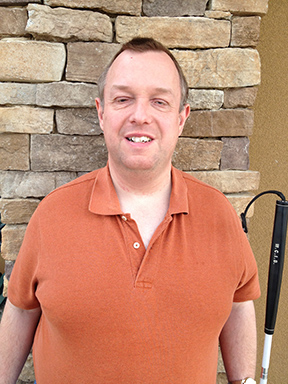 From the Editor: Missouri is a rural state with a lot of farmland and many small towns separated by a considerable distance. In most of these there is no bus service, no taxicabs, and though you can bring up the rideshare app of your choice, there simply are no rides to be had. It is a given for people who live in a small town that one will have a car or a pickup truck that they can drive, so many people who are blind take as an article of faith the idea that the only way for us to be independent is to move to a place large enough to meet our basic transportation needs.
Although for many this is a choice, for some it is not. Perhaps they are unwilling to part from the family support which is the primary focus of their lives. Some blind people are themselves the support for their loved ones as they take care of older parents or siblings who cannot take care of themselves. So what do you do when you’ve gone through school, have gotten rehabilitation money to get a college degree, and find yourself in a small town here in Missouri?
The answer to this question can be found in part in the presentation made to the convention of the National Federation of the Blind of Missouri on March 23, 2019, by Dennis Miller, a member of the Missouri affiliate who is blind and significantly hard of hearing. In these remarks he provides concrete examples of how he has managed to get work and some uncomfortable examples of why we sometimes fall short of the goal he has achieved. Push for what you want, but don’t just wait; do what you can until you can do what you want to do. The need to survive should make this clear, but sometimes programs that are intended as a safety net end up being a lifeboat. The problem is that a lifeboat is never intended to be a vessel on which someone lives permanently. It is way too small and has none of the necessities most of us require and take for granted. Over time that lifeboat is transformed from a safe refuge to a prison, and far too often we don’t realize that we are making a choice to stay in it. Staying in the lifeboat occurs when we decide to give up on seeking employment or pretend to ourselves that there are just so many choices out there that we can’t bring ourselves to make one. Here is what Dennis said about finding employment where he wants to live as a part of living the life he wants:
Thank you, President Wright. What an honor it is for me to be here among you folks today. This is only my second National Federation of the Blind convention, and I’m very much enjoying it.
I’ve known Shelia Wright for almost thirty years now, and when we first met it was at an agency called Blind Focus. While I was a student there, and I was going through a lot of difficult adjustments, this lady was kind enough to shepherd me through all of it. Ever since that point, when she has asked me to do something, I’ve asked three questions: when, where, and how much am I getting paid? After a few years I realized that the answer to the third question wasn’t going to change, so now I just ask when and where.
I want to talk briefly today about my experience living in a small town and being employed. The residents of my small town may not like some of the things I say, but so be it. Actually Kirksville is a very small community of 17,000 people. It’s ninety miles to the north of Columbia, and some of you in your lifetime have probably had the misfortune of traveling through it on your way to somewhere else. Kirksville is one of these towns where once you’ve gone to the Walmart supercenter, you’ve about seen everything.
But Kirksville is my home. It is where I was born and raised. It is where I went to school as a totally blind person and graduated from the university there. When I graduated from Truman State University, the district supervisor for Rehabilitation Services for the Blind (who has since been put out to pasture) told me that if I ever wanted to be employed, I had to leave Kirksville. He said there was absolutely nothing for me and Kirksville. For a while I thought he might be right.
I graduated with a degree in broadcast communications and minored in political science. I spent several years living out my dream in radio, but I left radio because there was very little money in it, and unfortunately there’s very little need for humans anymore. It’s become almost totally automated.
I worked several years in the independent living industry, and I wanted to do something different. I really liked the idea of thinking outside the box, maybe doing some things on my own. And I think this may be the major focus of my talk today.
Sometimes when you live in a small community, opportunities come down and hit you on the head. If you are there, and if you’re willing, you can take advantage of them. The first opportunity I was given was to spend six years as a contract Braille instructor for an entity over in Milan, Missouri, which is even smaller than our town of Kirksville. Milan is about thirty-five miles to the west. Some of you may remember the young man I helped, because he won an NFB scholarship and took that on to Northwest Missouri State University where he graduated with honors. He’s now married and very happy and very gainfully employed. So I was given an opportunity that required my being in the right place at the right time and being willing to think outside the box, being willing to do something that I couldn’t imagine myself doing. I never thought of being a teacher. I hated school. But being a teacher was what I’ve been in one form or another since 2000.
My experience with the Braille instructor position led to a contract with TAPI [the Telecommunications Program for Internet], a wonderful program operated by the Missouri Assistive Technology Project that provides equipment and instruction to help blind people get on the internet. But after you do so much training in a small town like Kirksville, you run out of people who need it.
The next question I asked myself was where am I going from here? In the summer of 2006 I happened to overhear a conversation among parents who had blind children who were being homeschooled. The state of Missouri had already passed a law that requires all graduating seniors to have a working knowledge of the state and the United States constitutions. That applies to everyone, whether you are in a public school or being educated in a private or homeschool. These parents were commiserating among themselves, saying, “We don’t think we know enough to be able to teach this. We don’t have the skills. What are we going to do? We barely understand the Constitution ourselves. How are we going to teach these crucial documents to our children?”
One of the parents said, “I think Dennis has a background in political science.”
That piqued their interest, and they turned to me and said, “Would you be interested in teaching a civics class for children who are homeschooled, both middle school and high school students?”
My first thought was that I had never taught a group before, but almost immediately my second was that I would certainly give it a try. They also said, “While you’re teaching that, would you mind teaching a public speaking course?” So that’s how my experience in teaching large groups of kids went, teaching civics and public speaking. I developed my own way of teaching civics because there was no set formula. I wasn’t in a public classroom; I was in a private setting where I could kind of do my own thing. I decided that instead of using a textbook, I would teach directly from the documents themselves. This means that I taught directly from the Declaration of Independence, the United States Constitution, and the Missouri Constitution. I had a lot of success with that. The kids seemed to like that it was very interactive. They were encouraged to ask questions and to venture answers.
We came to Jefferson City every year to meet with their senators and representatives. One year we had a particular representative who took a strong interest in our class. I can’t remember the issue (I suspect it was not a major one), but it was up for a vote. Our representative walked over to the kids and said, “How should I vote on this?” They listened to the debate, they told him, and then they were able to see him go vote in the way they had suggested. That may have been how he was going to vote anyway, but it was a different way of doing things that said to them that what they thought mattered.
This year is actually the first year I have not taught that civics class because, through my teaching of that, I have built a reputation as a good teacher. So when the city of Kirksville got a grant for this teaching of English as a second language, they turned to me, and I accepted. We have two manufacturing plants, one in Milan and one in Kirksville. Many of their employees are from African speaking nations as well as some Latin American nations. We have people from the Democratic Republic of the Congo, Togo, the Ivory Coast, Thailand, Indonesia, Mexico, South Korea, Venezuela, Panama, and Puerto Rico. There are a wide variety of people, but it works.
I happen to go to church with the lady who is responsible for that grant, and I asked her “How do you do that?” She said, “What we really need are volunteers who are willing to talk to the adults. Dennis, you would be perfect at that because you have such a strong curiosity and interest. I think it is something that you would really enjoy, and they would enjoy you.”
I promised her that I would give it a try. For those of you who don’t know, I do have some hearing difficulties. I have a cochlear implant which I got a couple years ago, but I wasn’t quite sure how it would work out. I said, “Okay, I’m not sure if I’m going to be able to do this, but I will give it a try.” I started the job in January of 2018, and they kept asking me to increase my hours. I started out doing this just one day a week, and that went until the end of the school year. They then wrote my position into the grant so that I could teach more hours and actually get paid. The request to increase my hours has continued, and it has been the most rewarding thing that I have ever done in my life. I love every second of it. I would not trade it for the world.
So why do I bring all this up? I bring it up because when I came to my first convention in 2006, I didn’t know I could’ve imagined my doing any of those things. I was not a teacher. I knew nothing about teaching. I didn’t even like books unless I was reading them for myself for pleasure. The point that I have come here to make is that we need to be willing to think outside the box. When an opportunity comes your way, don’t be afraid to say, hey, I’d like to try that. A lot of times what happens is that we go to school, we get a degree, and we don’t find a job within a certain amount of time in the area in which we got our degree. We then give up. Yes, the unemployment rate among blind people and people with disabilities in general is extremely high. Some of that is because we are not given the opportunities that we deserve, but, in my opinion, some of that is that we don’t take advantage of all the opportunities that are out there. [applause] You know, if someone said, “Dennis, do you want to collect trash out of the street?” I would have to admit that that is not a job that I would really want to do, but keep in mind that somebody has to do it.
When I started as a civics teacher, it was as a volunteer. The same is true for the ESL class. As I said, they then rolled me into the grant so that I can get paid. Now maybe I didn’t want to start out as a volunteer, but they needed the work done, and I wanted the challenge. Had I not taken that opportunity, someone else would’ve. That somebody else would now be written into their grant, and I would not be working every week.
So my real point in all of this is that when you are looking for a job, be willing to explore—be willing to explore, be willing to experiment, be willing to try something different. If I had an advanced bachelor’s degree in chemistry and I couldn’t find a job in chemistry, I’d probably be upset, but it really comes down to do you want to work or do you want to stay at home? Sometimes I think we limit ourselves because we’re not willing to think outside the box. We too often tell ourselves that we are above this job, or this job isn’t what I want. I know that when I graduated from college, if you would have come to me and asked if I wanted to teach immigrants English, I would’ve said absolutely not. No way! But as I said, this has become the most rewarding thing I’ve ever done in my life, and it is now something I would not trade for the world.
I leave you with this plea and challenge: be willing to try, be willing to expand your horizons, be willing to dream, be willing to go into an area that is outside your comfort zone. I had never been around immigrants before; I told you I live in Kirksville, Missouri. I didn’t even know we had immigrants. I just assumed somebody else did all of those factory jobs. But these people have become some of my best friends. I am extremely comfortable around them, and they are very comfortable around me. They look at me outside of the classroom as somebody they can rely on to help them if they get in a difficult position. But again that is an opportunity that, had I not been willing to take that chance and take that risk, would’ve gone to somebody else. Don’t limit yourself. Never think that something isn’t right for you until you have taken the opportunity to try it. It’s okay to try it and not like it. I did not particularly enjoy working in the independent living center—it wasn’t my thing. I did it because it was a job, and I needed to work. How do you know if you don’t like something until you try it?
Some of you in here may remember a man named Casey Kasem. He’s probably too old for some of you. Back when I was a small boy, Casey Kasem had a weekly show on the radio called America’s Top Forty. He always ended the show with the same signature line, and I’m going to end my presentation in the same way. “Keep your feet on the ground and keep reaching for the stars.”Media Share
