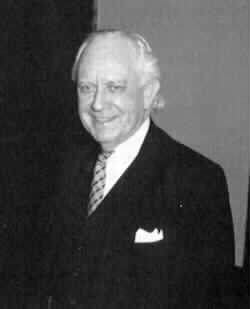
 Judge Richard C. Casey
     A Jurist Who Happens to Be Blind

		in the Federal Courts

                       by Richard C. Casey
                           **********

     From the Editor: Tuesday afternoon, July 7, delegates to the

1998 convention of the National Federation of the Blind heard a

stirring address by the Hon. Richard Casey, District Judge in the

United States District Court for the Southern District of New

York. He spent several days at the convention, and his fine mind

and probity were evident. But those who met him were particularly

impressed with both his dedication and his humanity. This is what

he said:

                           **********

     Dr. Maurer, Dr. Jernigan, Congresswoman Johnson, and members

of the National Federation of the Blind: I'm extremely honored to

be asked to speak to you this afternoon. I must say, however, I

do it, as I told the National Association of Blind Lawyers

yesterday afternoon, with a bit of anxiety because I only lost my

sight eleven years ago. I stand before you feeling somewhat

inadequate realizing all that you have accomplished and all that

you have done. It makes me feel like I am just beginning.
     I'd like to start my talk this afternoon by telling you a

little story. Eleven years ago, right after I lost my sight, I

was traveling in Europe, and some friends of mine took me to a

religious shrine in southwest France called Lourdes. I was

walking across the esplanade in front of the Basilica, and a man

approached me and started to speak to me. I couldn't understand a

word that he was saying. Fortunately a friend was with me who was

from Rome, and he listened intently and finally said: "Well I'm

not doing much better. He's speaking Italian, but he lives in Sao

Paulo, Brazil, and he's Mexican and Portuguese, and we're having

a hell of a time. He said however, the best I could make out of

it is that he admires your guide dog, but he would like to take

the two of us up the hill and show us something, I'm not quite

sure what." In any event, we accompanied him up the hill, and he

took us to a little tiny grave yard. We entered the graveyard,

and he took us over to a tombstone and said: "I'd like to tell

you the story behind the woman who is buried here. Many years ago

a young Italian blind girl was brought to Lourdes by her parents.

She resisted because she was an atheist, and this was a religious

shrine. But she acquiesced, and, of course, her parents brought

her there in hopes that through prayer she might receive the

miracle of sight." He told me that she never received that

miracle, but she did receive the miracle of faith in God.
     She went back home to Italy, and many years later, when she

was an old, old woman and was dying, she asked that her body be

brought back to Lourdes and buried there. A tombstone was erected

with an inscription which we were standing before. The words on

the tombstone were, "What is important is not to see but to

understand."
     For me, who am very new, I feel, to your world, these are

words that have lived with me ever since. They are words that are

very profound; they contain many layers. They make you think: why

was I born, why am I here, where am I going, and how am I going

to get there? It encompasses, I think, the philosophy of the NFB-

-that, if you have that understanding, if you have the attitude,

if you have the talent, there is almost nothing you cannot

accomplish.
     Now I don't know if the story of the little Italian girl is

true. I know the tombstone is there, and as they say in Italian,

"Si non e vero, e ben trovato." [literally, "If it is not true,

it is well discovered."] I like that. I think I'll give the rest

of the speech in Italian. (In all seriousness, don't worry; I

have difficulty ordering dinner in an Italian restaurant.)
     Every day since 1987 I think about those words. It's been a

long road from my early education to this point. I graduated from

Holy Cross in 1955, before most of you were born, and I graduated

from the Georgetown University Law School in 1958. After that I

went on and was appointed Assistant United States Attorney in New

York and was assigned the criminal division, where I tried many

different cases from narcotics to mail fraud to securities fraud

to tax evasion. In 1960 I was appointed the head of the internal

security unit, and again, for you younger people in the audience,

that was a period known as the Cold War. I had the privilege of

representing the United States in prosecuting three Soviet spies:

two for espionage and one for perjury. After that I went on and

was counsel to a state commission investigating public

corruption. Then I went on to private practice, where I engaged

in commercial litigation, mostly securities litigation on the

civil side with a touch of criminal work--you never seem to get

away from it.[laughter] Not that I committed it myself, but

represented people, for those in the audience who are laughing. I

often have to admonish my law clerks these days that when they

answer the phone, please don't tell people that the judge is on

trial; he's in trial.
     In any event, after a long career in private practice, in

1991 I was approached by one of the judges on the United States

District Court in New York who asked me if I would like to join

them on the court. Of course I was very honored; however, I

really didn't feel quite adequate to assume the job. I had

recently lost my eyesight. But after much conversation he

convinced me to make a stab at it. He, together with a bipartisan

group of judges, recommended me to both Senator D'Amato and

Senator Moynihan of New York, and I was recommended to the White

House and nominated in 1992 to the District Court. The nomination

was sent to the White House, and President Bush acted on it and

sent it to the Senate. But unfortunately I learned my first

lesson in judicial process. It was election year, they cut off

confirmation hearings, and my nomination lapsed with fifty-four

others. We were left at the judicial altar so to speak.
     In any event, time went by, and last year I was invited by

the Moynihan judicial selection committee as well as the D'Amato

judicial selection committee to appear before them to be

considered again for the United States District Court. In May of

last year Senator D'Amato sent my name to the White House for

nomination, and Senator Moynihan joined in the nomination. In

July I was nominated and confirmed by the Senate in October. I

was sworn in in November of last year.

     I am very pleased and honored with the job I have, but,

although Dr. Maurer was quite laudatory in his introduction, I am

going to confess to you that my real ambition is to be the first

blind nose tackle in the National Football League. [laughter]

Since I told you when I graduated from college, I think it is

unlikely.
     As I told the National Association of Blind Lawyers, with

the appointment of David Tatel to the United States Circuit Court

of Appeals for the D.C. Circuit (I'm sure many of you heard him

when he spoke at your convention last year) and with my

appointment to the United States District Court, we have come a

long way in the federal judiciary. For those of you who may not

be familiar with the federal court system, basically the federal

system has three courts: the basic trial court is the United

States District Court, of which I am a member; the intermediate

court, the appellate court, is the Circuit Court of Appeals,

where Judge Tatel serves; and the Supreme Court of the United

States. As I told the lawyers yesterday afternoon, we have made

inroads; we have members on both courts; the door is wide open.

[applause] I assure you that, sometime in your lifetime, a blind

lawyer will be appointed to the United States Supreme Court.

[applause]
     I think we have made great strides in my profession and in

the judiciary, primarily due to two reasons. One is developments

in technology, and the other is the change in attitudes in

society. I will always be grateful to the Federation for the help

they gave me last summer when I was trying to assemble the

package of technology we would use in my chambers. I went to

Baltimore, and the staff couldn't have been nicer--Dr. Maurer,

Richard Ring, all the wonderful people who helped me and the

blind engineer who was working with me, who adapted all this

material for me. Today I am using things that many of you use, an

optical scanner with synthetic voice, a computer with synthetic

voice, steno masks, and tape recorders. By September we will have

real-time reporting with synthetic voice in my courtroom. It will

allow us simultaneously to record, search, and call up testimony.

Moreover, it can be remotely transmitted into my chambers. When

we have non-jury cases, my law clerks can almost simultaneously

with testimony prepare findings of fact and issues of law.
     I would be remiss if I didn't mention the second point that

allows us to succeed and achieve in my profession and in others--

the changes in society. Much of this you have brought about. In

touching on this point, I have to commend Senators D'Amato and

Moynihan. Not just because of me, but they were the first

Senators who had the guts to nominate a blind lawyer to a federal

court in over two hundred and eight years. [applause] There is no

longer an excuse for any politician; they no longer have to ask

"Can it be done?" "Has it ever been done?" It has been done, and

they should do it.
     There is still a lot that can be done to change society even

more. I listened to the Congresswoman speak and the way you

brought up issues. Yes, there is much to be done. I think,

frankly, that we should all work at it. We can bring it about by

example; we can help society change.
     At lunch Peggy Elliott asked me to mention that, when I was

called before those committees last year, I thought long and hard

about it. (I listened to lots of discussion yesterday about how

to approach the question of blindness in job interviews. I don't

have a patent on it because I am still new at blindness. But I

pass along a little story for your consideration.)
     I approached my interview just as I used to prepare for

trial. I would ask myself, "What are the weaknesses of my

witnesses?" Thinking about the committee, I asked myself what my

weaknesses--even my perceived--weaknesses were. The answer seemed

obvious. I was talking to a group of sighted people, half lawyers

and half laymen. When I became blind, I didn't know a single

blind person; there's a good chance they don't know one either.

So when I walked in the door and sat down, I said, "Before you

start, may I say a word? The word is `blind.'" [applause] I said,

"Let's not pussyfoot around it; let's put it on the table. What

you are all thinking is `Can he do it?'" I then said, "I love

this profession; I have great admiration for this court. I would

not do anything to damage either one. I am here because I know in

my heart that I can do the job." I told them that I did not wish

to be recommended to the Senators because I was blind; I wished

to be recommended because I was a lawyer who could do the job who

happened to be blind. [applause and cheers]
     I told Peggy at lunch that at my swearing-in last November a

woman who was on the committee but not a lawyer came up to me.

She said, "I had to come today because I wanted to tell you that,

when I came to the interview nine months ago, I came with the

pre-disposition to vote against you because I thought it was

impossible. We were not mean-spirited people, but you explained

to us how it could be done. I wanted to tell you that, had you

not taken the bull by the horns and made it comfortable for all

of us, it wouldn't have mattered that you had the credentials.

But once we understood, we were happy to give you the highest

rating we have ever given a candidate." [applause]
     So I humbly suggest that, although we have come a long way

and the door is wide open, there is still more to be done. I

suggest that you continue to keep that door open by example. Show

the world that you can do things that heretofore were never

dreamed possible. Show the world that you as a blind person are

not solely on the receiving end; give of yourself. The greatest

givers, as the Biblical story has it, are those who give from

their want to those who have even greater need. You will destroy

erroneous stereotypes by showing how much you can give.

[applause]
     This was beautifully expressed a couple of months ago when I

was listening to a broadcast of the Masters Golf Tournament, they

did a tribute to the late, great golfer Bobby Jones. To many

Bobby Jones was the greatest golfer ever to play the game. Kids,

he was the Tiger Woods of his era. He won every golf tournament

there was, and he never turned pro. He was also a lawyer--

probably why I like him. But perhaps the thing he did better than

anything else was that he devoted a lot of time to teaching young

boys to play the game. Even when illness confined him to a

wheelchair, he continued to teach young people to play. The

commentator said that Bobby never stood as tall as when he

stooped to help a boy.
     I suggest and humbly urge that you who have done so much and

inspire me so much, as you climb the hill and step over the

obstacles on your way to the top, look over your shoulder and

help the one behind you to get over the fences. [applause] If you

do that, I promise you real success. Be good; stay well; God

bless.

                           **********