American Action Fund for Blind Children and Adults
Future Reflections Convention 2018 NOPBC CONFERENCE
Tools for Success: Student Perspectives
by Sal Villa, Ahbee Orton, and Abby Duffy
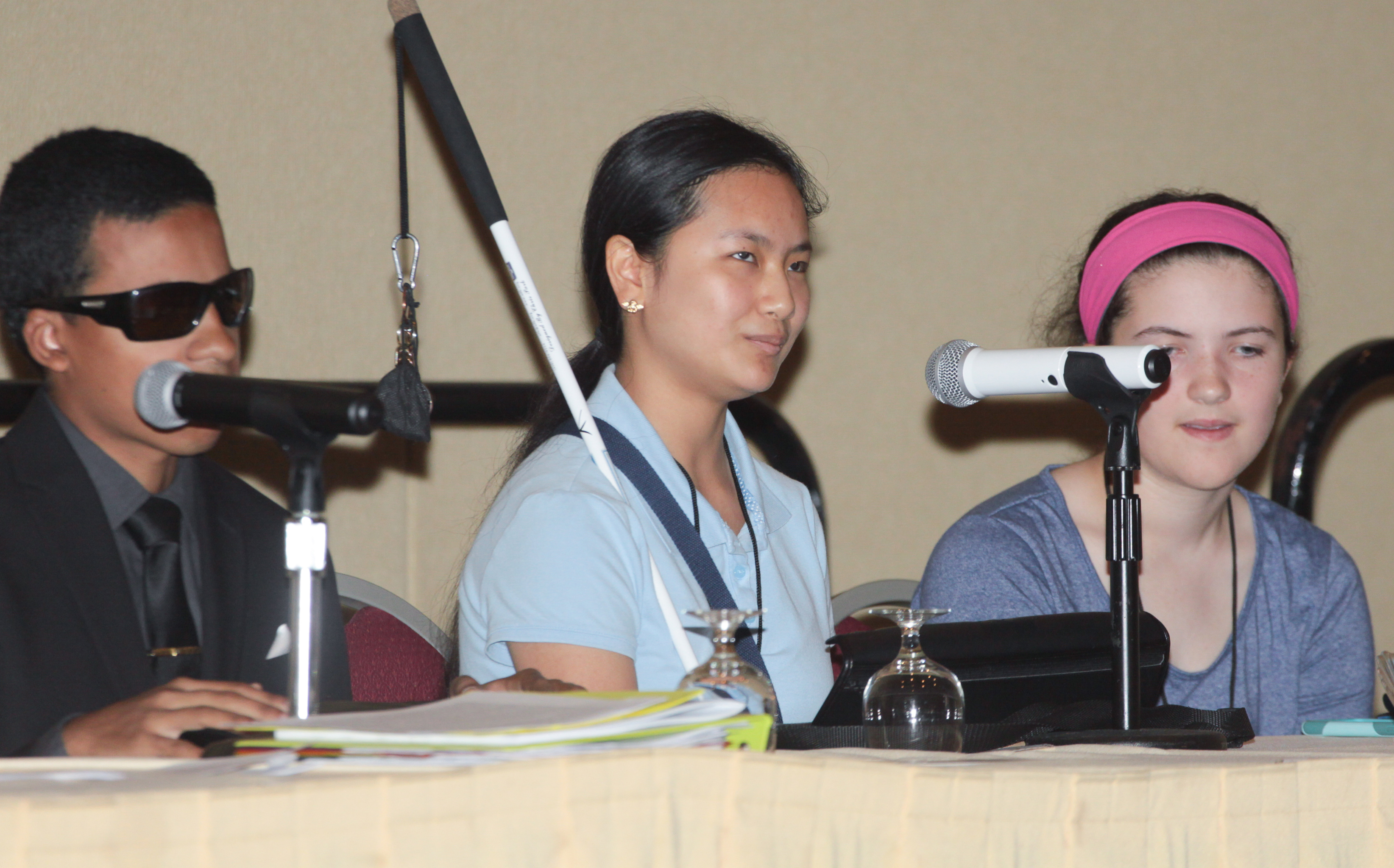 Introduction by Kim Cunningham: Now it's time to hear from some of our young people. After all, they're the reason we're all here! First I'd like to introduce you to Sal Villa. Sal is nineteen, and he's from Texas. He's currently attending the rehab program at the Louisiana Center for the Blind.
Sal Villa: The Dallas-Fort Worth International Airport resembles a figure 8 with an extra half-circle attached. Navigating the airport requires the use of the Skyline, a train that travels from terminal to terminal. The Skyline consists of two trains, each of which stops at different sets of terminals. I traveled through DFW on my way back home from San Antonio after working in this year's NFB of Texas BELL Academy, making it to the gate with just enough time to find dinner.
How can a blind person travel through the fourth largest airport in the country without missing the flight? It all boils down to holding blind people to the same standard as others. The soft bigotry of low expectations prevents society from allowing blind people to use the tools and methods that are required for our success.
Though our tool kit may be different from that which people generally conceive as "normal," it can produce the same results nonetheless. These instruments allow one like me not only to catch my flight, but to take classes, go grocery shopping, prepare meals, and cross interstate highways.
As parents of blind children, it is crucial that you hold the conviction that sight is not a requirement for success in life. When you deeply take in that realization, you will allow your children to flourish and reach their full potential.
A basic tool in my toolbox is a positive philosophy toward blindness. To me lack of vision is an arbitrary characteristic akin to the color of my hair and the shade of my skin. It doesn't affect the degree to which I pursue my goals any more than race and gender. Individuals must develop a sense of self-worth and should believe in themselves as blind people. The earlier this process begins, the better. In his speech "Blindness: Handicap or Characteristic?" Dr. Kenneth Jernigan states, "It has been wisely observed that philosophy bakes no bread. It has, with equal wisdom, been observed that without a philosophy, no bread is baked."
Positive philosophy plays a critical role in my tool kit, but skills are equally important. These skills include nonvisual independent cane travel and home management. Cane travel is the ticket to my freedom and independence. After all, what is the use of having skills if you lack the ability to navigate true environments where said skills might be applied? Cane travel does not merely involve the use of the long white cane. Rather it is a comprehensive system of orienting to the environment by means other than sight. Cardinal directions, sound cues, traffic patterns, and texture changes all contribute to my thorough understanding of my surroundings.
Frederick Douglass taught that literacy is the path from slavery to freedom. There are many kinds of slavery and many kinds of freedom, but reading is still the path. For centuries knowledge has been brought to people through visual means. This circumstance naturally excluded the blind from participating in significant parts of culture, literature, communication, and business. However, in the nineteenth century a system was created that allowed the blind to access the formerly trapped information through touch rather than sight. This system is equivalent in all respects to print except for the method of transmission. Just as a sighted child is taught to read print from an early age, so the blind child should be taught to read Braille.
Braille serves many purposes in my day-to-day life, from allowing me to access schoolbooks to labeling items in the kitchen. We know that 90 percent of employed blind people are active Braille users. Unfortunately, only 10 percent of the nation's blind are learning the code. In order for your child to compete on an equal footing with his or her peers as an adult, it is self-evident to me, through my own experiences and the data, that Braille is the way to go. Without it I would not have been able to complete my high school education, read my favorite book of all time, The Grapes of Wrath by John Steinbeck, or navigate efficiently through buildings.
While skills and philosophy are important, they are by no means the full picture. The people I associate with, my support system, serve a role that is just as important. No one can go it alone.
I attended my first NFB national convention when I was fifteen. I met and bonded with people who have shaped my destiny and helped make me the person I am. My mom, the people in the Texas NFB affiliate, and the staff at the Louisiana Center for the Blind all encouraged me to accept my blindness as a characteristic and never to let it get in the way of my dreams.
Your children will look to you when it comes to shaping their outlook on blindness. Keep in mind that the attitude you hold, the standards you apply, and the expectations you enforce could determine whether your child's blindness is a handicap or a nuisance.
Ahbee Orton: My name is Ahbee Orton. I am a senior at Florence High School, and I am a member of the band. I play the flute during concert season and the piano keyboard during marching season. I also enjoy reading and singing. I play the piano sometimes when I'm asked and sometimes just at home. I also like to hang out with people. I have two younger sisters. One of them is only twelve, but she can be mistaken for being older than I am because of her tallness.
That's a lot about me, but I'll go on to the tools in my toolbox that I use daily or frequently. At school I carry around a rolling backpack. I usually have a lot of technology in it, and sometimes books that are in paper Braille and folders with all my handouts. I use a laptop with JAWS on it and a Bluetooth keyboard, an iPad, some talking calculators, and two Braille displays. I also use a Sensational BlackBoard®, which is a rubber sheet stuck onto a plastic backing. You can stick a piece of paper on it and draw on it with a pen, and I can feel the drawing with my fingers. I use it for math and science mostly. It's better when the teacher can make drawings for me before class so I can use them all during class time. I email my assignments to my teachers; that way I don't have to deal with a middleman who transcribes my work for my teachers to understand.
I use a Braillewriter in my AP classes. In AP classes there is a rule that you can't go on the Internet, and I have to follow the AP standards.
At home I use some low-tech things as well. My mom has come up with some great ideas, and I'm very grateful for that. One low-tech method I use is the rubber-band-Scotch-tape method. When I go to the store, I might come back with a bunch of cans. I take a card and write on it what it is in print and Braille, since I live with my family right now. I punch a hole in the index card and put a rubber band around it and stick it on the can. It helps me be faster in picking out which can is which for cooking. That way I don't have to take out my phone and use Seeing AI every single time, although I use it in the very beginning when I bring the cans home. Seeing AI is a free app that I have on my phone. It will look at a product and scan the label. I do that, and then I put the label on.
In some situations you can just use regular tape. If I have soy milk and almond milk, I can put a piece of tape on one of them, and then I'll know which one it is.
When I was going to camp many years ago, my mom came up with a very cool idea. We had to label my things, and I had to know the colors so I could dress nicely. Mom used a kind of paint called dimensional paint. It's by Tulip Brand. She takes a shirt or some other piece of clothing and puts dots on it like the Braille cell. She might put the letter p for pink. You can put it out to dry for forty-eight hours. Then you can wash it, and the paint stays on for a really long time. I don't know if it ever comes off.
Then there's Dymo tape. That's a very easy tool, and it's quick. You just write on the tape with a Braille labeler. You stick the Dymo tape on the item that you want to label.
These are just a few of the items I use. I wanted to tell you about them because they might be helpful to you and your child. Thank you for letting me speak to you.
Abby Duffy: My name is Abby Duffy. I'm from Concord, New Hampshire. I am fourteen right now. I just left eighth grade, and I'm moving into high school. I do two sports. I am an Alpine skier, and I am a varsity rower on my high school crew team. Rowing is a really adaptable sport for blind people because everyone's facing backwards and nobody can see where they're going. [Laughter]
I have a great TVI, teacher of the visually impaired. I've had her since first grade, and she's just become my O&M instructor as well. She's doing great. I love her! She helps me get all my materials.
I have two Braille displays. I have a Focus 14 at home, and at school I have a forty-cell Braille display, which makes it easier to read long stuff. I used to try to use a Chromebook, but it wasn't accessible with a Braille display. They have a program called ChromeVox, which is their attempt at JAWS, but it's not that great. This year I'm going to learn to use the PC with a Braille display. I think it'll be great.
Those are just some of my tools. They're all very important. Thanks!
Media Share
