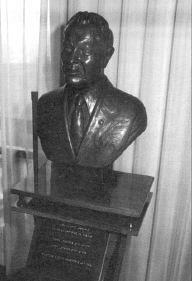
Dr. Kenneth Jernigan
Pictured here is the bronze bust of Kenneth Jernigan unveiled during the
convention and now on display in the reception area at the National Center for the Blind.
THE MEMBERS OF THE NATIONAL FEDERATION OF THE BLIND
DEDICATE THIS CONVENTION
TO
DR. KENNETH JERNIGAN
The man who carried our burdens,
Cherished our spirits,
Challenged our minds,
Demanded excellence,
Taught us, loved us,
And set us free!
These words appeared at the beginning of this year's convention agenda. They
captured the spirit of a convention filled with love and respect for our deeply revered
leader and sorrow in his passing, but also
with joy in the promise for the future that his life and work made possible.
by Barbara Pierce
**********
How does an organization mark the change of an era? That was the question the
National Federation of the Blind resolved June 30 to July 6 in Atlanta. At the time of the
1998 convention in Dallas, Dr. Kenneth Jernigan was still able to take an active part in
planning and conducting the convention, despite nearly a year of serious illness, and to
call forth from us the same courage and hope for the future that he himself was
demonstrating. But since his death on October 12, 1998, we have been mourning, working to
incorporate his teachings into our daily activities, consolidating our strength, and
preparing to move into the new millennium.
More than three thousand Federationists gathered in Atlanta from every state,
Puerto Rico, the Virgin Islands, and sixteen other countries from around the world. Almost
inevitably it was a convention of contrasts: celebration and solemnity, intense focus and
remarkable diversity. The Marriott Marquis's architecture probably contributed to the
feeling that convention delegates were comfortably spread out to engage with those of like
interests in their own part of the facility. Yet we have never had a convention in which
more delegates gathered together to take an active part in general convention sessions.
With four floors of public meeting areas, the Marriott Marquis provided magnificent
space for a convention. Hotel staff assured us that all their guests struggle to master
the hotel layout. Security personnel told Debbie Baker of Utah that they were frankly
astonished to note how well NFB convention traffic moved and how quickly delegates learned
how to get where they were going. From front-desk and concierge staff to bellmen and
security personnel, hotel employees were courteous, helpful, and efficient. The Hilton
staff were equally impressive; and, though many of us spent time hunting in vain for the
right elevator bank, the consensus was that we have never been in more beautiful or
pleasant hotels.
A word should be said in passing about the corps of Atlanta Ambassadors, who roamed
the streets in the downtown area providing advice, directions, and simple security. These
folks were helpful without being overbearing. They made it clear that they knew we are
coming back to Atlanta next year and they plan to be ready to welcome us.
About fifty volunteers from the United Parcel Service also participated in the
convention. UPS continues to be a wonderful corporate sponsor of NFB programs. They
contributed $5,000 to support our 1999 scholarship program, and UPS volunteers were on
duty, particularly at the beginning of the week, to show delegates where out-of-the-way
rooms were located and, as one frustrated Federationist put it, "Where they've put
the elevators this time."
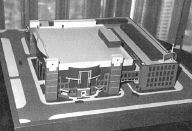
The architect's model of the new building, on display in the Jernigan
suite.
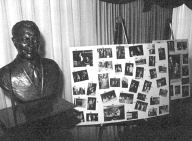
The bust of Dr. Jernigan and the picture boards on display in the Jernigan suite.
The model was a sturdy floor-by-floor representation of the proposed National
Research and Training Institute for the Blind, for which we are beginning a capital
campaign to raise eighteen million dollars. That campaign was kicked off during the
convention, so more will be said about it later.
The bronze bust of Dr. Jernigan was commissioned before his death, and in the late
summer he actually sat for the sculptor, Joseph Moss, who worked primarily from
photographs and video. For many of us, examining this bust was our first opportunity to
appreciate the strength and character of Dr. Jernigan's chiseled features. We found a new
kind of intimacy with a man whom we have loved and respected for years.
As soon as people arrived, they could study the pre-convention agenda in print or
Braille, but some of the really interesting sites were not listed. Most people made a
beeline for the Peachtree Center Mall and the food court. Excellent bagels, sandwiches,
salads, and other quick fare were available at reasonable prices. Shops of all kinds just
waited to be explored. Meantime in the hotel, Braille labels prepared by the Georgia
affiliate for ninety soda machines waited for volunteers to put them where they belonged.
Ramona Walhof recruited Barry Hond of Maryland, who in turn snagged Warren Figueiredo of
Louisiana, and off they went. Hours passed, and still they did not return. It takes a long
time to label ninety soda machines completely, but Barry and Warren stayed with the job
till it was done; that's the way Federationists approach an assignment.
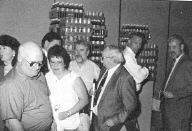
A group of Federationists at the Coca-Cola display during the food fair
By the time June 30 dawned, plenty of folks were acclimated, oriented, and ready to
roll. The National Buyers Group organized an excellent food fair that attracted hundreds
of people interested in food and food service. Convention exhibitors were scurrying to set
up their displays in the huge exhibit hall. Federationists were checking out NEWSLINE(R)
and Jobline, Myna products and Blazie notetakers, and Windows and Internet access. Several
divisions got an early start by conducting meetings and seminars as well.
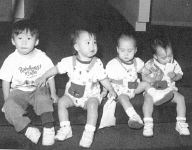
Big brother Mickey sits on the stairs
with his little sisters Melinda,
Melissa, and Melody Salisbury,
triplets from Utah.
The Job Opportunities for the Blind national seminar also took place Wednesday
afternoon. The JOB Program is markedly different this year, but the goal of helping blind
people prepare for and get good jobs remains the same, and the seminar was again filled
with lively and information-filled presentations. Peggy Chong, who emceed the seminar, saw
to it that there was plenty of time for questions and thoughtful answers as well.
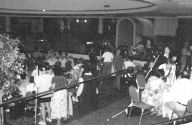
Lots of people had fun at the Braille Carnival.
As always, one of the highlights of the day was the array of activities sponsored
by the National Organization of Parents of Blind Children (NOPBC). About a hundred
families took part in NOPBC activities, including three families with triplets. Dr. Maurer
keynoted the morning-long seminar for parents and teachers while the kids from NFB Camp
enjoyed the Kenneth Jernigan Braille Carnival. Chaired by Melody Lindsey, now of Michigan,
the carnival was a group of Braille-centered activities for both blind and sighted kids.
Judging from the noise level, everyone had a great time, and people are already making
plans for how to improve the games for next year.
Meantime blind and sighted teens were exploring what they have in common by putting
parents on trial. This was not an exercise in blaming parents for all adolescent problems
but an opportunity to discover that all kids share the struggle for independence,
understanding, and self-confidence. In the afternoon male and female blind teens divided
up for "Guy Stuff" and "What Your Mother Couldn't Tell You." These
were guided discussion groups in which teens could explore gender-specific issues
associated with blindness and growing up.
Parents spent the afternoon attending several workshops and activities:
"Resource Materials," "Computers for Tots," "Technology in the
Classroom," "Writing IEP Goals and Objectives," "Placement: How to
Find the Right Program for Your Child," and "Blind Mentors, Models, and Peers:
Why and How."
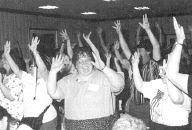
People dancing at family hospitality
That evening families could meet, get to know each other, and play at family
hospitality. Kids and teens each had a scavenger hunt, and teens found the hang-out room,
which was supervised space intended for teens only.
Convention hospitality that evening gave everybody a chance to catch up with old
friends and enjoy good music and dancing. The Lew's Blues Review was the name of the band,
and dynamite describes their sound.
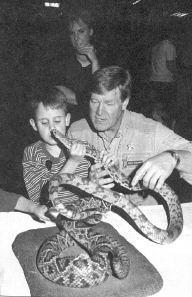
A Sensory Safari guide shows a snake to Kirt Manwaring of Utah.
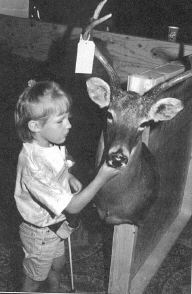
Hannah Weatherd of Montana explores the neck of a deer.
Thursday morning started with a bang as Convention Registration kicked off at nine
with the usual long line that evaporated like magic once the doors opened. As always the
process was amazingly fast and efficient. For the first time agendas were available on
cassette and computer disk, suitable for loading into portable Braille notetakers, as well
as in the usual print and Braille formats. By 9:30 both the Sensory Safari and the exhibit
hall were open for business. The Georgia chapter of Safari Club International set up the
displays and conducted the individual safaris, which were a big hit with kids and adults
alike.
The exhibit hall provided the usual panoply of technology and products of all kinds
for conventioneers to examine and try. Fifty-two outside exhibitors and thirty-two
Federation groups took part in the extravaganza. Lists of exhibitors and their table
locations, as well as several tactile maps, were available this year, which made it easier
to find what one was looking for; but a large part of the fun of prowling the hall is
always discovering things by accident. Of course the NFB Store did a land office business
all week in aids, appliances, and literature.
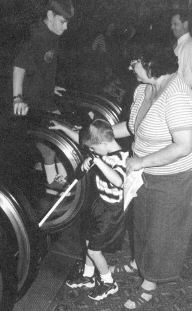
Diane Foster and her son Peter from Kentucky work on escalators during the cane travel workshop.
Again this year children and youth who were just beginning to use the white cane
had an opportunity to work with orientation and mobility professionals and experienced
blind adults on their skills. Parents, too, were welcome to try the cane and talk with
those who use and trust it every day. Two sessions of this popular workshop took place
Thursday morning. That afternoon Dr. Lilli Neilsen met with parents of multiply disabled
children and others interested in her Little Room and philosophy of working with these
children.
The Resolutions Committee met Thursday afternoon under the leadership of Sharon
Maneki, who chaired the committee this year. Nineteen resolutions were presented and
discussed; seventeen of them were eventually passed by the Convention. A discussion of all
the resolutions and the texts of those adopted appears elsewhere in this issue. A number
of people have chaired the Resolutions Committee over the years, but Sheryl Pickering has
now served faithfully as Resolutions Committee secretary for twenty-one years.
As soon as the Resolutions Committee adjourned, folks poured into the ballroom next
door to enjoy and learn from the second annual mock trial, presented by the National
Association of Blind Lawyers. In the court room of Judge Charles Brown and with Bailiff
and Clerk of Court Peggy Elliott, NABL lawyers re-enacted the 1986 Kevan Worley case, in
which Mr. Worley was arrested and manhandled by the police for the crime of trying to buy
full-fare bus tickets for himself and his blind wife. Scott LaBarre and Anthony Thomas
served as counsel for the defense, and Bennett Prows and Ray Wayne prosecuted the case.
Kevan Worley of course played himself, and Kallie Smith, thirteen, of Iowa played Kevan's
daughter. Pam Dubel made an unforgettable little old lady, and Ever Lee Hairston was a
delightfully officious and condescending expert witness. Doug Elliott played the kind of
cop that gives the police a bad name, and Jim Gashel was the ticket agent who caused all
the trouble to begin with. An audience of almost 500 happily took its place as the
admittedly biased jury, cheering for the good guys and scoffing at the bad.
Kevan Worley captured the feelings of everyone when at the conclusion of the trial
he described the conversation he had with Dr. Jernigan after he was finally released from
jail. He said that he knew the NFB was pulling out all the stops to get him released when
an attorney turned up early on to assist and advise him. But when he actually got home and
called the National Center and then heard Dr. Jernigan's calm and resonant voice inquiring
about how he and his family were doing, he realized just how much he had been depending on
the sustaining power of the Federation to keep him afloat. Then Dr. Jernigan said,
"Mr. Maurer is here as well." In that moment Kevan said that he felt and
understood in a new way the continuity and strength of the NFB.
Thursday evening and Friday afternoon and evening dozens of committee and division
activities took place. Here are some of the highlights. On Friday afternoon Federationists
interested in exploring the possibility of forming a division for those in medical
professions gathered to make plans. Those in rehabilitation also met with an eye to
forming a division. The managing editor of the Atlanta
Journal-Constitution addressed the Professional Blind Journalists group. This year's
play, written by Jerry Whittle and performed by the Louisiana Center Players on Friday
evening, was titled Long Ago When Freedom Rang.
It's about a Vietnam veteran who loses everything and finds himself. The tenBroek Fund
auction Friday evening offered a number of items of value, including a wall hanging of the
NFB logo that had previously hung in the Jernigan home and the bow tie that Dr. Maurer has
worn at every convention banquet since he became President of the NFB.
Kids wait to begin their tour of the Coca-Cola Museum.
A number of kids from NFB Camp toured the Coca-Cola Museum Friday afternoon, but
that was only the beginning of kids' fun for the week. NFB Camp is always filled with
books, games, and special activities, and this year was no exception. Carla McQuillan and
her staff saw to it that blind and sighted kids alike had fun and learned about the
abilities of blind people.
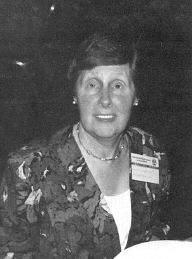
Betty Niceley
Friday morning, July 2, at 9:00 a.m. the first official session of the 1999
convention came to order when President Maurer pounded the gavel to begin the annual Board
of Directors meeting. After a moment of silence to remember Federationists who were no
longer with us, the meeting opened with the pledge to the American flag and recitation of
the NFB pledge. President Maurer then announced the Board positions that would be open for
election this year. Betty Niceley sought the floor to make the following announcement:
**********
Dr. Maurer, I would like to say that I am not seeking reelection to the Board this
time. I want to say first of all that this decision in no way indicates a lessening of my
commitment to this organization. I have served on the Board for fourteen years, and I have
been deeply touched by the trust that has been placed in me in electing me to this
position. I feel the need to spend a lot more time in affiliate building in my own state
and attending to the Braille concerns of the Federation. I am grateful for the wisdom of
our beloved Dr. Jernigan, who put his confidence in you, Dr. Maurer, as our leader. I want
to pledge to you and to future leaders of this organization my willingness to do whatever
I can as you lead this organization to greater heights of success, which I know you will
do.
**********
Dr. Maurer thanked Betty for her many years of loyal service.
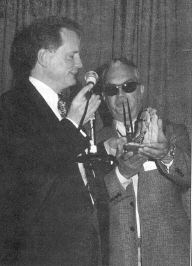
Toby Longface presents a sandstone desk set to President Maurer.
He then called Bruce Gardner to the podium for a presentation. It was an Arizona
sandstone desk set made by artist and NFB of Arizona leader Toby Longface for Dr. Maurer.
The base is eight inches across with an arch rising from it. Hanging from the arch is a
silver commemorative coin from the 1990 golden anniversary celebration. The stand holds a
slate and stylus and a silver pen. President Maurer accepted the gift with gratitude and
has displayed it in his office.
Mr. Prayat Punong-Ong, President of
the Thailand Association of the Blind, then came to the microphone to bring greetings from
his country and organization and to hope that the NFB will continue to flourish and reach
out to the rest of the world.
Sabriye Tenberten, a German woman working in Tibet, described her project to the
audience. Blind herself, she invented a Braille system in order to conduct her personal
scholarship in the language of Tibet, for which there was no Braille code. She was then
invited to travel to Tibet to teach her system to the people who need it and establish a
school to educate and train blind people there for the first time in history. A German
television crew was working on a story about her and her work while she was attending the
convention.
President Maurer next introduced the newest of the Kernel Books, Remember to Feed the Kittens. He read his
introduction and a bit of his story from the book. He also announced that the seventeenth
Kernel Book, Reflecting the Flame, will be
released later this year. We have a number of new products, including light-weight
monaural and stereo headphones and an indoor/outdoor thermometer.
Dr. Maurer announced that in the exhibit hall delegates would be able to stop by a
table and get help in writing to their Senators and Members of Congress to encourage them
to co-sponsor the linkage bill or to thank them for doing so. By the close of the
convention almost 2,000 letters had been generated.
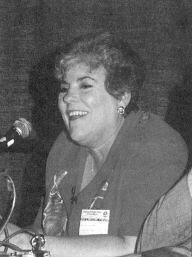
Ellen Bomer
President Maurer then introduced a remarkable woman. Until August 7, 1998, Ellen
Bomer was the administrative director of the U.S. Trade Office at the American Embassy in
Nairobi, Kenya. She was there on temporary assignment from the same position in Jeddah,
Saudi Arabia. On that day life changed forever for Ellen. Shortly after 10:00 A.M. a
co-worker several feet away from Ellen looked out the window after hearing a small
explosion. At that moment a massive truck bomb exploded, which killed her co-worker
instantly and severely injured Ellen. After four and a half hours of searching, Ellen was
found unconscious under a wall. She had been critically injured, with thousands of pieces
of glass and shrapnel imbedded in her face and body. After emergency, lifesaving surgery
in Nairobi, she was airlifted by medivac to Germany. There her husband Don, who had been
flown in from Saudi Arabia, joined her. From there she was flown on to Walter Reed Army
Hospital in Washington, D.C.
By October Ellen was ready to start rehabilitation--she wanted her life back. At
this point Harold Snider, a long-time leader in the Federation, and his wife Linda first
began working with Ellen. She is now a student at the Louisiana Center for the Blind, and
she and Don attended the entire convention. A film crew working for the ABC News program
"Nightline" followed Ellen in Atlanta and recorded her experience during the
week. The result of this project was two full-length programs on Ted Koppel's show. They
were aired August 5 and 6 in commemoration of the August 7, 1998, bombings.
Ellen spoke movingly to the Board of her experience during the past year. She said
that she never doubted that she would survive and that God still had work for her to do.
But she had had no previous experience of blindness, so she did not know how to proceed
until Harold Snider introduced her to the NFB and our philosophy. In closing she said that
she had been floundering in an unknown ocean, when Harold Snider threw her the NFB
lifeline. She now wants and expects to find ways to pass along to others what she has
received.
Peggy Elliott, Chairman of the Scholarship Committee, then presented this year's
scholarship class. A full report of the students and the scholarships they won appears
elsewhere in this issue.
Several state presidents came to the podium to make gifts to President Maurer on
behalf of the organization. Arthur Schreiber, President of the NFB of New Mexico,
presented $53,000 from a recent bequest. Jim Willows, NFB of California President,
announced that in the past year his affiliate has given $233,000 to the national
organization from bequests. Ron Gardner, the new President of the NFB of Utah, then
announced that from a very generous bequest, the Utah affiliate had contributed to the NFB
$1,077,000 during the past year. He went on to say that the affiliate has decided to make
an additional gift of a half million dollars to the capital campaign in the form of a
matching gift. As soon as the NFB has raised $1,500,000 from other sources, the Utah gift
will be presented to make a total package of two million. He then removed his Stetson in
memory and gratitude to Helen Colby, the benefactor who made all this possible.
President Maurer next announced that Ted Henter, President of Henter Joyce, Inc.,
had made a quiet gift to the NFB of $15,000 because he believes in what we are doing and
wanted to help with more than words. Betsy Zaborowski, NFB Director of Special Programs,
then thanked the UPS volunteers for their help during the convention. She announced that
UPS and the Kaman Corporation have both made significant gifts to our scholarship program
this year.
Sharon Maneki, Chairwoman of the Distinguished Educator of Blind Children Award
Committee, came to the platform to present a plaque and check to Deborah Baker of
Springfield, Ohio, as the 1999 NFB Distinguished Educator. A full report of this
presentation appears elsewhere in this issue.
Brief reports were made about the Shares Unlimited in NFB (SUN) and Pre-Authorized
Check Plan programs and the Jacobus tenBroek Fund activities during the convention.
President Maurer then read the top ten in number and in contributions in the 1999
Associates contest. Those recruited to become Members-at-large (Associates) not only make
contributions to the NFB but also become full-fledged members of the organization. The top
ten recruiters this year by number of Associates and by dollar amount are as follows:
**********
Top Ten in Number
of Associates Recruited
**********
10.
Jim Salas (New Mexico), 48
9. Gary Thompson (Missouri), 50
8. Bill Isaacs (Illinois), 55
7. Karen Mayry (South Dakota), 58
6. James Omvig (Arizona), 58
5. Joe Ruffalo (New Jersey), 66
4. Laura Biro (Michigan), 83
3. Mary Ellen Jernigan (Maryland), 115
2. Tom Stevens (Missouri), 162
1. Arthur Schreiber (New Mexico), 168
**********
Top Ten in Dollar Amount Raised
**********
10.
James Omvig (Arizona), $1,388
9. Ed Vaughan (Missouri), $1,450
8. Jim Salas (New Mexico), $1,570
7. Marc Maurer (Maryland), $1,746
6. Tom Stevens (Missouri), $1,774
5. Joe Ruffalo (New Jersey), $1,904
4. Arthur Schreiber (New Mexico), $2,280
3. Unknown (Delaware), $2,510
2. Kenneth Jernigan (Maryland), $5,150
1. Mary Ellen Jernigan (Maryland), $6,095
**********
After several prize drawings the Board voted to conduct an Associates contest
during the coming year, and President Maurer then adjourned the meeting.
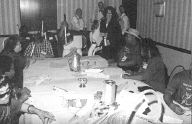
Members of the NFB of Georgia fold paper airplanes in preparation for the opening general session.
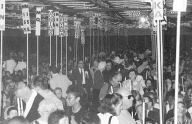
The convention ballroom shortly before the opening convention session.
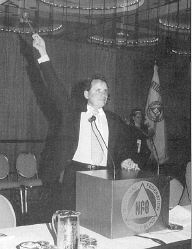
President Maurer gavels the 1999 Convention to order.
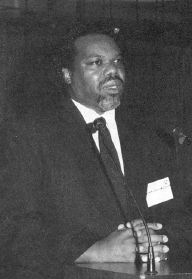
Wayne High, President of the NFB of Georgia, greets convention delegates from the podium.
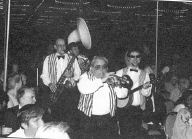
The Dixieland Band marched in playing "Georgia on my Mind."
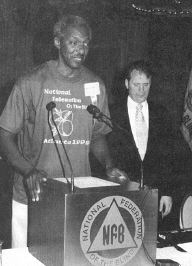
Al Falligan, NFB of Georgia Convention Coordinator, prepares to
introduce
Representative Randy Sauder. President Maurer looks on.
An hour before the opening of the first general session of the 1999 Convention of
the National Federation of the Blind, the crowd was already beginning to gather, and by
the time the gavel fell, the press of delegates was remarkable, even for the first-day
festivities.
Following the invocation and initial door prizes, Wayne High, President of the NFB
of Georgia, welcomed delegates and thanked all those who had helped to make this
convention memorable. He reminded us that this year's gathering was dedicated to the
memory of Dr. Jernigan. With that a Dixieland band playing an energetic version of
"Georgia on my Mind" marched into the ballroom followed by the Georgians
throwing paper airplanes into the audience. Then
Al Falligan, Georgia's Convention Coordinator, introduced Representative Randy Sauder, who
has been a true friend to the blind of Georgia. Representative Sauder welcomed the
convention with true southern hospitality.
The remainder of the morning session was devoted to the roll call of states.
Several states announced that in the past year they had fought the battle to preserve a
separate agency to serve blind consumers. Several states also announced that they had seen
the establishment of NEWSLINE(R) local service centers in cities across their states.
Arkansas and Virginia announced that the model technology bill became law this year, and
West Virginia boasted that with affiliate help and encouragement the University of West
Virginia will begin a training program for teachers of the visually impaired. Five
states--California, Delaware, Minnesota, New Jersey, and Pennsylvania--have new Jobline
sites. The roll call of states concluded with a mighty Federation cheer, and the
convention session recessed.
The afternoon session came to order precisely at 2:00 p.m. with Dr. Maurer's
Presidential Report, which appears in full elsewhere in this issue. As always it was
thrilling to listen to the review of what we have accomplished in the past year and Dr.
Maurer's assessment of where we are heading in the future.
Following the report, President Maurer made the official announcement for which we
had all been waiting. In his report he had talked about the need for the National Research
and Training Institute for the Blind to be built on the southwest quadrant of our property
in Baltimore. Dr. Maurer announced formal plans for the opening of our Capital Campaign.
He said that everyone will be asked to participate but stressed that no one should decide
how large his or her personal gift should be on the spur of the moment. Gifts that are
thoughtfully considered in the light of the need we face and the possibilities for future
development will be more generous. The Maurers, Mrs. Jernigan, and Don and Betty Capps had
all been considering their personal gifts for several weeks. In turn each of them came to
the podium to announce gifts of $25,000 to be given over a five-year period.
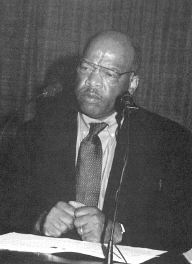
Congressman John Lewis
"Equal Rights and Equal Opportunity for Everybody: The View from
Congress" was the title of a soul-stirring address by Congressman John Lewis, Fifth
Congressional District of Georgia. Mr. Lewis had expected to find an audience of a few
hundred blind people. When he walked onto the platform to greet the National Federation of
the Blind in its thousands, he pulled out all the stops, and together we raised the roof.
As Mr. Lewis was leaving the platform, Dr. Maurer made two interesting comments: Mr.
Lewis's autobiography would be released on Talking Book in November, and Congressman Lewis
is a member of the Ways and Means Committee and is one of the 243 co-sponsors of the
linkage bill.
The next agenda item was a panel presentation titled "Separate Programs for
the Blind: How Important Are They?" The presenters were Suzanne Mitchell, President
of the National Council of State Agencies for the Blind and Executive Director of Blind
Services of Louisiana Rehabilitation Services; Jamie Hilton, Director of the New Jersey
Commission for the Blind; and Tom Robertson, Associate Commissioner of the New York
Commission for the Blind and Visually Handicapped. Even though time was growing short, all
three advocated for close working relationships with consumer groups and leadership from
all sources to create innovative programs for the new century. They expressed their need
for qualified blind professionals to staff their programs and counselors who believe in
the abilities of blind people. In concluding this segment, Dr. Maurer urged the speakers
to spread the word among their colleagues that strong and independent state agencies must
have strong and independent consumer organizations with whom to work in partnership. It is
in everyone's best interests to encourage the development of vibrant consumer
organizations.
James Gibbons was the first blind graduate of the Harvard Business School. Last
November he became president of National Industries for the Blind. He gave Convention
delegates a brief summary of his experience and urged closer ties between NIB and the NFB
in order to improve conditions for blind workers and the range and quality of jobs they
have access to. He announced that NIB has set a goal of 600 new jobs for next year, and
Mr. Gibbons intends to keep that goal expanding by working faster and smarter. When asked
about joining the NFB in working for legislation to prohibit less than the minimum wage
for workers whose only disability is blindness, he admitted that he did not know the
history but certainly would work toward that goal as rapidly as he could. President Maurer
thanked him for coming with an open mind and a willingness to think and talk about
difficult issues. He ended by inviting Mr. Gibbons to return to the Convention in future
years.
Dr. Maurer then recessed the session, and Federationists raced off to meetings,
workshops, seminars, the Showcase of Talent, and Dancing--Swing, Soul, and Rock and Roll.
This last was the annual reception and dance, and dance we did.
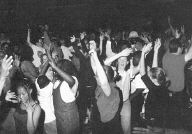
Federationists crowded the dance floor at the Saturday night party.
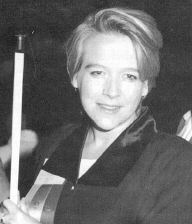
Noel Nightingale
Following the opening exercises on Sunday morning, the first order of business was
the annual election. Six positions on the Board of Directors were open for election.
Ramona Walhof, Chairwoman of the Nominating Committee, placed the following names in
nomination: Donald Capps, South Carolina; Wayne Davis, Florida; Priscilla Ferris,
Massachusetts; Bruce Gardner, Arizona; Noel Nightingale, Washington; and Joanne Wilson,
Louisiana. All were elected by acclamation and responded with thanks and a promise to
continue to do their best to further the goals of the Federation. This is what Noel
Nightingale said as she was elected for the first time to the Board:
**********
When I was a student at the Louisiana Center for the Blind, I met a woman who
worked at a residential facility for people who are mentally retarded. She told me about
two brothers who are now in their sixties and who had recently come to live at the
facility. She told me that, when they were born blind, their parents didn't know the truth
about blindness. Even worse than that, they put the brothers into a room with a cement
floor and cinder block walls. They just left them there; they didn't teach them to feed
themselves properly--didn't even teach them to use the bathroom properly. As a result of
the lack of stimulation in their lives, they became retarded. Eventually, after their
parents passed away, they ended up in this institution. This woman told me that, shortly
after they arrived, she gave them each an orange. They had apparently never seen an orange
in their lives. They held it and smelled it and marveled at the texture and roundness of
it and they tasted it. They were overjoyed at the beauty of this simple orange.
The National Federation of the Blind was founded at about the same time these
brothers were born. And, like the orange to those brothers, it brought to the lives of
blind people the fragrance of hope and the taste of freedom. While the founding of the
National Federation of the Blind came too late for those two brothers, it didn't come too
late for me. It saved me from a life of low expectations and mediocrity. I cannot imagine
a greater honor than I am receiving right now--than receiving your trust and love. I thank
you very much.
**********
The remainder of the morning session was devoted to the memorial for Dr. Jernigan.
The bronze bust was officially unveiled, and ten Federation colleagues spoke of what their
dear friend and mentor had meant to them. The text of what was said appears elsewhere in
this issue.
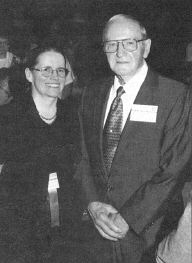
Mary Ellen Jernigan and Dr. Jernigan's brother, Lloyd
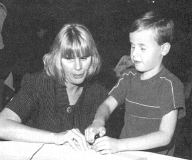
Joy Harris demonstrates proper use of the slate and stylus to Kirt Manwaring of Utah.
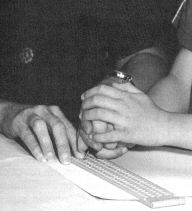
Working hand over hand, Joy teaches Kirt how to control the stylus.
Independence Day happened to be our half day this year, so, when the gavel fell at
the close of the morning session, Federationists scattered far and wide to work and play.
Parents had to decide between learning Braille from Claudell Stocker, a teacher and
certified transcriber, and Julie Hunter, a certified transcriber, and a drop-in session to
discuss kids and canes with Joe Cutter, a Pediatric Orientation and Mobility Specialist.
Several other workshops and committee meetings also took place that afternoon and evening.
Of course tours had been scheduled that carried Federationists all over greater
Atlanta, and the fireworks display was spectacular. In fact, it was a little hard to miss
the fireworks, whatever else one happened to be doing. The student division wound up the
evening with its Monte Carlo night for anyone who was interested in playing games. For
those who wanted a taste of our adult rehabilitation training centers, the Colorado Center
for the Blind brought their program to Atlanta for the evening.
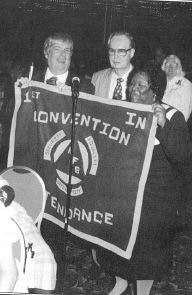
The attendance banner moved from Texas to South Carolina this year.
Tommy Craig (left) of Texas and Dorothy Barksdale (right) of South Carolina display the
attendance banner as Don Capps looks on.
Despite the partying, the Monday morning session arrived at the usual time, and
Federationists were on hand for the opening gavel at 9:00 a.m. Before beginning actual
program items, Dr. Maurer told the audience that he had spoken with Mrs. tenBroek the
afternoon before to tell her how much her presence was missed at the convention. Peggy
Elliott then suggested that we send her the following letter:
**********
July
6, 1999
Dear
Mrs. tenBroek,
We, the members of the National Federation of the Blind, assembled at the second
largest convention in our history, send to you our greetings on this, the anniversary of
our founder Dr. tenBroek's birth. You walked with us every step of the way, through the
long years of initial organization and the proud years of growth and success. On Dr.
tenBroek's birthday we pause to say to you, you are the first of the first ladies. We
salute you and know that, though you are not in Atlanta in person, your strength and your
commitment are joined with ours today and into the future of blind people.
**********
The members of the National Federation of the Blind
**********
Peggy invited those who wished to do so to add individual notes of greeting to the
packet going to Mrs. tenBroek, which would include this letter and copies of the book and
video presented to attendees the day before. The intent was to have this package arrive at
Mrs. tenBroek's home the following day, Dr. tenBroek's birthday, but the Independence Day
holiday prevented that from occurring. Mrs. tenBroek did, however, receive the remembrance
a few days later.
Much of the morning's program was devoted to presentations by representatives from
around the world. The first was Dr. Euclid Herie, President of the World Blind Union and
President of the Canadian National Institute for the Blind. He acknowledged Dr. Jernigan's
contribution to the World Blind Union and reported on the work still to be done around the
world. He talked about a little girl he met in a small Chinese village, the first blind
child to be educated in her tiny, two-room village school. She is one of one million
Braille readers in China. Her school has now received some Braille materials for her
education. He reminded his audience that we will change what it means to be blind one
person at a time, the way we have always done it.
Kua Cheng Hock, President of the Asian Blind Union and President of the Singapore
Association for the Blind, spoke to the convention about the situation in Asia and
recalled his friendship over the years with Dr. Jernigan. In the eighties, when Mr. Kua
was trying to achieve World Blind Union membership for the consumer organization of blind
people in Singapore, he turned to Dr. Jernigan for advice. Twice he visited the National
Center for the Blind, and only two weeks before his death, Dr. Jernigan spent time with
Mr. Kua advising him in his work for blind people in all of Asia. Mr. Kua urged the NFB to
continue its outreach to Asia as Dr. Jernigan did and promised that his organization was
ready to work with us to achieve freedom and equality for the blind. Before leaving the
platform, Mr. Kua presented Dr. Maurer with a commemorative pewter plate from the blind
people of Singapore to the members of the National Federation of the Blind.
Next William Rowland, Second Vice President of the World Blind Union and Executive
Director of the South Africa National Council for the Blind, addressed the Convention. In
introducing Mr. Rowland, President Maurer commented that, when he and Mrs. Jernigan
visited the South Africa National Council for the Blind last winter, they recognized and
rejoiced in the spirit and the philosophy of the organization.
Mr. Rowland began by comparing Dr. Jernigan to the great South African statesman,
Dr. Nelson Mandela. He went on to say that the disability movement in South Africa joined
with the ANC two years before the change of power. In the new organization of South
African society and government, 2 percent of jobs in both the public and private sectors
are to be held by disabled people by 2005. There are prospects for broad-based funding
sources for the blind similar to the Spanish organization ONCE's nationwide lottery. He
acknowledged that international programs must benefit both developing and developed
countries. He concluded by urging the NFB to establish an Africa policy, saying that the
South Africa Council for the Blind would eagerly become our partner in such an effort.
President Maurer commented that we receive thousands of letters every year saying,
in effect, "We don't have enough money, and we would like some of yours."
Because we don't have enough money to meet this great need, we grieve over the letters and
mostly just file them. But when we find individuals and groups who show indication of
wanting and working to increase the ability of blind people to improve their own lot and
increase their voice in the programs that affect their lives, we are far more enthusiastic
about finding the resources to help.
Chuji Sashida, Senior Researcher with the National Institute for Vocational
Rehabilitation in Japan, was the next speaker. He reviewed employment opportunities and
problems in Japan and what his organization is doing to help.
Bekele Haile-Selassie, Professor of Law at the Law School of Addis Ababa University
in Ethiopia, then spoke about the work of the Ethiopian National Association of the Blind,
which at one time he served as Secretary General. The Association trains people in the
skills of blindness, conducts a recording studio, and engages in production of merchandise
for sale as a demonstration of the capacity of blind workers.
Frank Kurt Cylke, Director of the National Library Service for the Blind and
Physically Handicapped of the Library of Congress, next addressed the Convention on
"Recent Technological Developments: Progress in Braille and Audio Delivery
Systems." He reviewed the five principles on which the NLS program is based and
explained that current plans are for a digital system for Braille and audio production
within the next ten years. Mr. Cylke attended his twenty-sixth convention this year and,
as usual, brought four staffers with him.
The next speaker was Adam Linn, a securities trader for Charles Schwab. In recent
months Adam has been featured in television advertisements for Charles Schwab, in which he
talks about his dedication to giving his clients good service. Never is the fact of his
blindness mentioned. It merely becomes clear that he is using Braille. Adam described how
he got to Harvard and then to the Louisiana Center for the Blind to enhance his blindness
skills. Everyone enjoyed his stories and his enthusiastic attitude.
Cheryl Fischer, President of the NFB of Cuyahoga County, then discussed her work as
NEWSLINE (R) Cleveland Coordinator for the NFB of Ohio. She described her search for
people to sign up for NEWSLINE (R) even before the service center opened on November 1,
1998. On that date she had 200 Clevelanders ready to begin using the service. Now that
number has risen to 600. Census figures suggest that 9,000 people in the area qualify to
use NEWSLINE(R), so Cheryl is still hard at work. But she does more than help them fill
out their enrollment forms; Cheryl checks to make sure that seniors know how to use the
service and works with them on the phone to press the correct buttons for what they want
to read. Cheryl and her chapter work hard to find and serve NEWSLINE(R) readers, and they
are continuing to do so.
The final speaker of the morning was Dr. Leonard Hjelmeland, Professor of
Ophthalmology and Molecular and Cellular Biology at the University of California at Davis.
Professor Hjelmeland began by introducing himself as the other blind scientist at UC
Davis, referring to Dr. Geerat Vermeij, the noted marine biologist who addressed the NFB
Convention some years ago. He admitted that others have done a better job of breaking new
ground for blind people, but he does face ophthalmologists and confronts their prejudices
as a blind colleague working alongside them to do necessary research, and that effort has
real value. Dr. Hjelmeland explained that, when he first lost his sight, he got to know
several Federationists, Lloyd and Judy Rasmussen and Harold and Gail Snider. But he had no
interest in being other than a loner. He has now come to recognize his mistake. He ended
his remarks by saying that he wanted to join with us.
The afternoon's agenda was so crowded that we frankly couldn't fit everything in,
considering that we absolutely had to clear the room at five. The first agenda item was an
address by Dr. Fred Schroeder, Commissioner of the U.S. Rehabilitation Services
Administration, titled, "Politics and Rehabilitation: Serving the Customer, Serving
the Agency, Serving the Public." Dr. Schroeder is a long-time advocate of effective
rehabilitation and a man who knows how to deliver it. The entire text of his address
appears elsewhere in this issue.
Lawrence W. Roffee, Executive Director of the U.S. Architectural and Transportation
Barriers Compliance Board, then spoke on "Equal Access for the Blind to Electronic
Media." His report focused on the standards now being promulgated to give more force
to Section 508 of the Rehabilitation Act as amended in 1998. He reviewed the history of
this legislation to insure that technology used by federal agencies is accessible to all
those whose jobs or inquiries require them to use it. The provisions of Section 508 have
been strengthened, and in the future enforcement, he assured the audience, would be far
more effective. In answer to questions from the audience, he said that government Web
sites will be included under 508, as will equipment other than computers such as copy
machines that no longer have discernible buttons to push. Public comment on these new
standards will soon be in order.
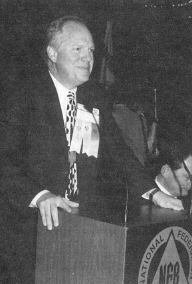
Ron Gardner
"The Blind at Work" was the title of a panel presentation which was
interrupted and rearranged because of time pressure. The first speaker was Ron Gardner,
President of the NFB of Utah and the attorney who serves as Director of the Disability Law
Center in Salt Lake City. It was a delightful and inspiring tale of his work and the
difference the National Federation of the Blind has made in his life and his contribution
to his community.
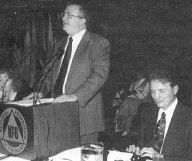
Tom Johnson addresses the Convention while Dr. Maurer sits listening.
**********
I want to thank you, Ms. Rolland and Mr. Johnson, and I am pleased that you brought
the matter up because we believe certain things about what we are doing. And we think it
is worth while to tell you what we believe. We like you, so don't take this personally or
anything. However, blindness is not a health issue. [prolonged applause] If you are
becoming blind, of course it is a health issue. If you are dealing with a doctor and
trying to avoid becoming blind, it's a health issue. I am blind; I have been blind for
thirty years, [jeers and laughter] forty years--fifty years--something.... I am going to
be blind; I never visit the doctor; I don't care what the doctor says because I know what
the doctor believes about my blindness, which is there is nothing whatever he's going to
do about it. From my point of view I may have other health issues, but blindness is not
one of them; that's stable.
The National Federation of the Blind as an organization--I would like to
characterize us for you. (It's dangerous to do that, I know, because if you characterize
us, maybe we'll never be looked at except from that characterization, and we would hope
not to be stuck into a box in the same way that we hope you don't get stuck into a box. We
don't think you will be, by the way, and we don't think we will be.) If you had to pick
one phrase to describe us, it would have more to do with being a civil rights organization
than anything to do with health [cheers and applause] because the problems we face are the
ones of getting in and getting opportunity, of winning the right to work and having the
right to participate in society, of having the right to get an education, of finding a way
to get the books, of finding a way to learn something, and not being told that, because we
are blind, we can't. [applause]
I very much appreciate your coming. I very much appreciate your bringing top
people, and I hope that the next time you send a reporter it isn't a health reporter.
[cheers]
Mr. Johnson: I think that one of the great benefits of an afternoon like this is
that we too have much to learn, [laughter and applause] and I cannot think of a more
wonderful place for a civil rights organization to meet than the home of Dr. Martin Luther
King. [prolonged cheering and applause]
President Maurer: Now that, Mr. Johnson, is why CNN is on top.
**********
When things calmed down after that lively interchange, Dr. Raymond Kurzweil,
"The Inventor Who Broadened the Landscape for the Blind," addressed the
Convention for a few minutes. He recollected his years of friendship with Dr. Jernigan and
reviewed recent progress and provided a glimpse into the future of technology for the
blind.
Sharon Gold, President of Sharon Gold Enterprises and a long-time leader of the
National Federation of the Blind, outlined some of the principles that have guided her in
her business success, and she tied them to the success of the National Federation of the
Blind and the lessons it teaches us.
The final speaker of the afternoon was Erik Weihenmayer, an experienced blind
mountain climber. His title was "`To Climb Every Mountain': The Blind Climber
Planning to Stand on Top of the World." This was a delightful and energetic
presentation from a young man who climbs serious peaks and insists on carrying his share
of the responsibility. His attitude is grounded in pure Federation philosophy, and the NFB
is supporting his effort to scale Mount Everest in 2002.
That evening's banquet was the largest in Federation history. An overflow crowd of
500 gathered across the Convention Level from the main ballroom. This second banquet room
was equipped with a large-screen video system and spotters with two-way radios to identify
door prize winners.
Diners discovered that this year's souvenir mug contained a small replica of the
bust of Dr. Jernigan, a votive candle, and a small book of matches. As soon as we were all
seated, Master of ceremonies Allen Harris instructed everyone to light our candles and
hold them aloft in the darkened room. He reminded us that Dr. Jernigan had always exhorted
blind people not to hide our lights under bushels but to show the world what we could do.
During this moment of illumination from the thousands of candles held by all of us, we
remembered our beloved leader and vowed to insure that his dreams and our own will never
flicker out and that the darkness of ignorance will never snuff out the light that the
National Federation of the Blind has set burning in the hearts and souls of blind people
everywhere.
Two awards were presented during the banquet. The first was the Golden Keys Award
given to Michael Romeo, and the other was the Jacobus tenBroek Award presented to Allen
Harris. The full report of these presentations appears elsewhere in this issue.
The 1999 scholarship awards were also made at the banquet. That report also appears
elsewhere in this issue. The American Action Fund scholarship, worth $11,000 this year,
went to tenBroek Fellow Marie Kouthoofd, First Vice President of the NFB of New York.
As always, the highlight of the evening was President Maurer's banquet address. His
title was "The Mental Discipline of the Movement," and it was a thoughtful call
to redouble our efforts to reject misconception and teach the world what is possible. Here
is the way it began:
**********
William Shakespeare thought that knowing what to do was easy. It was the doing of
it that was so hard. As he said, "If to do were as easy as to know what were good to
do, chapels had been churches, and poor men's cottages princes' palaces."
However, there are others who have a totally different point of view. They believe
that knowing what to do is the hard part. Remarkable achievement is attained (according to
these scholars) by thought--by exercising the ability to distinguish between the
significant and the mundane. As the American bacteriologist Hans Zinsser said, "The
scientist takes off from the manifold observations of predecessors and shows his
intelligence, if any, by his ability to discriminate between the important and the
negligible, by selecting here and there the significant steppingstones that will lead
across the difficulties to new understanding."
Just as it is for an individual, so it is for a culture, a nation, or an
organization. Each of these must attempt to identify the steppingstones of progress. To
the extent that they achieve this difficult task and are committed to implementing what
they learn, growth and advancement occur. To the extent that they fail, there are
stagnation, deterioration, and aimlessness.
**********
The banquet was unforgettable, and the parties afterward went on for hours, but the
next morning Federationists were in their seats when the gavel fell at 9:00 a.m. The
morning session was filled with reports and the Honor Roll Call of States making
contributions to the tenBroek Fund and the White Cane Fund. The afternoon session was
devoted almost entirely to the debate and passage of the 1999 resolutions. See the full
report of these actions later in this issue.
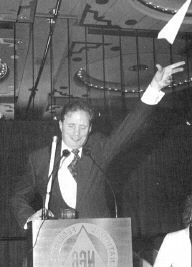
President Maurer flies a paper airplane into the convention hall.
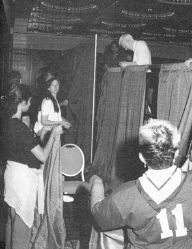
NFB staff members take down the platform curtains at the close of the
convention.
When Dr. Maurer brought his gavel down signaling the close of the 1999 convention,
it seemed a bit hard to believe that our first NFB convention in forty-nine years without
Dr. Jernigan was now history. With every ovation for Mrs. Jernigan during the convention,
delegates demonstrated that our love for her husband and our respect for her and the way
she has conducted herself and continued to work for our cause during this difficult and
lonely year knew no bounds. But the spirit of rededication and determination with which we
all left Atlanta also illustrated our unwavering conviction that the best is still ahead.
Newly blind people must learn what we have to teach. Blind children must be given hope and
tools for tomorrow. The public must still be freed from the chains of ignorance about
blindness. All these jobs and more lie before us. We have a capital campaign to conduct
and dreams to bring to fruition. In less than a year now we will return to Atlanta to take
the measure of our progress and inspire ourselves and one another once again with the
promise of tomorrow. In the meantime we will keep faith with the man who taught us to
dream and to make those dreams come true.
**********
**********
**********
*****************************************************************
Life Insurance
**********
Life insurance constitutes a very special gift to the National Federation of the
Blind. A relatively easy and direct form of planned giving is a new life insurance policy.
You can make the NFB the beneficiary and owner of a life insurance policy and receive a
tax deduction on the premium you pay.
For example, at age fifty you purchase a $10,000 whole life insurance policy on
yourself and designate the NFB as beneficiary and owner of the policy. The premium cost to
you is fully tax-deductible each year. You may even decide to pay for the entire policy
over a specific period of time, perhaps ten years. This increases your tax deduction each
year over the ten-year period and fully pays up your policy.
You may, however, already have a life insurance policy in existence and wish to
contribute it to the NFB. By changing the beneficiary and owner to the National Federation
of the Blind, you can receive tax savings, depending on the cash value of the policy. Your
attorney, insurance agent, or the National Federation of the Blind will be able to assist
you if you decide to include the NFB in your planned-giving program through life
insurance. For more information contact the National Federation of the Blind, Special
Gifts, 1800 Johnson Street, Baltimore, Maryland 21230-4998, phone (410) 659-9314, fax
(410) 685-5653.
*************************************************************