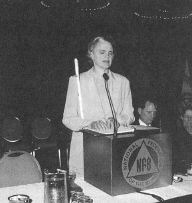
Barbara Pierce speaks during the memorial service. To her right can be
seen Dr. Jernigan's empty chair.
Lessons from a Master
by Barbara Pierce
**********
I consider that I knew Dr. Jernigan from January of 1974 until his death. That
January was the first time I listened to recordings of his speeches, and doing so gave me
the feeling that I had met the mind and spirit of this remarkable man. It was not until
that June that I actually had direct contact with him. I had written him a letter. I am
not sure how I expected him to respond, but it was certainly not the long, thoughtful,
prompt letter I received. I could not have been more surprised or delighted if the letter
had come from the President of the United States or the Queen of England. That was always
my experience of Dr. Jernigan--a man who gave and expected more of himself and me than I
did.
Part of his genius was challenging the people around him to do more than they
thought themselves capable of. For example, he told me fairly early in my life as a
Federationist that he wanted me to begin representing the NFB in media interviews. This
was unsettling news, but, since he had assigned me the job, I began reading the Braille Monitor even more carefully and listening
to Presidential releases with great attention. Then I went out and did my best. You always
wanted to do your best for him because he always gave his best to all of us, and that best
was very good indeed.
I was sitting in a 1987 convention session when Dr. Jernigan called me to the
platform to speak to him. To my astonishment and dismay he asked me to try my hand at
writing that year's convention round-up. He told me to study what he had written the year
before and then give it a try. I was dubious about my ability to produce anything that
would save him time, but again I did my best, and with a bit of first-aid he was able to
use it.
At the 1988 convention he asked me to come to work for the Federation to see if I
could learn to edit the Monitor. Agreeing to do
so was one of the most courageous things I have ever done. But it was just one more
example of Dr. Jernigan's challenge to reach further and do more than one thought
possible.
For almost ten years I had the privilege of working closely with Dr. Jernigan.
Watching him write was fascinating. He usually began an article seated at his desk, his
secretary in the chair across from him with a steno pad on her knee. After thinking a
moment, he would dictate a title. He might throw out two or three suggestions before he
got it right, but he never began writing without at least a working title. Then the
sentences began coming, word by word, complete with correct punctuation. Soon the phone
would ring. He would stop and deal with whatever the call brought; then he would ask to
hear the last paragraph or, more often, everything he had written so far. He might well
make changes or even rewrite or insert an entire sentence or paragraph. Eventually he
might get up to pace around his office as he dictated or corrected text. I often marveled
that his secretaries could decipher the layers of correction. So it went, interruption
after interruption, hour after hour. Sometime late in that first day of observation he
turned to me and said: "People think that those who write well throw long touchdown
passes; they don't realize that we have to grind out our progress yard by yard on the
ground, just like everybody else."
When he completed a draft or a day's work on a draft, he would ask for the text in
Braille. That's what he took home to read over. The next day he was back, draft in hand,
to read the text aloud and make the changes he had decided upon so his secretary could
pencil them in on a print copy. He would listen carefully to his own voice as he read. His
ear told him when a subtle alteration in the text would improve the work. "That will
have a better ring," he would comment as he substituted a word, and when you thought
about it, he was right.
That was how he began teaching me to shape my own writing. Gradually I learned to
avoid word repetition, the passive voice, and jargon words like "utilize" or
"usage" instead of short, vigorous words like "use." Having seen the
merciless rigor with which he edited his own writing, I found it exciting rather than
depressing to watch him tinker with and rework my text. The process was always
instructive.
Then there were the Braille lessons. As many of you know, I mastered the Braille
code as a teenager, but I never bothered to work on reading speed. Decoding those little
dots was slow and hard, and I never saw anyone read quickly. Not until I listened to those
speeches in 1974 did I realize that it was possible to read Braille at speaking speed. And
not until I began working closely with Dr. Jernigan did anyone suggest that there was any
point in my trying to make up the deficit in my education rather than complaining about
it.
As usual, Dr. Jernigan didn't just suggest that I do something about it. When I
hesitantly asked whether he thought I could increase my speed, he offered to help. That
was the beginning of a remarkable period of investigation and discovery. Dr. Jernigan
undertook to analyze how he used his hands when he read. He taught me to anchor my left
hand and read the first few words of each line with that index finger while the rest of
the hand marked the place and held on to the page--a handy skill when reading standing up.
Meanwhile he explained that the right index finger reads the right two thirds of the line,
and the middle and ring fingers travel lightly across the space at the top of the line,
keeping place and gathering information about the tops of the letters. He would often
interrupt his own proofreading to point out some detail his ring finger had discovered.
Unfortunately I don't think I increased speed as rapidly as Dr. Jernigan expected,
but he was always optimistic and encouraging. Despite the important matters constantly
demanding his attention, he regularly inquired whether I was continuing to read every day
and how my speed was coming.
History will remember that Kenneth Jernigan harnessed his tremendous intelligence
and compassion to tackle the job of setting all blind people free. But we who knew him
will remember his ability and willingness to use his talents to help his friends, and all
of us were his friends. It is easier for most of us to grasp his individual acts of
humanity, for they defined the man in ways we could understand. In the larger world Dr.
Jernigan made significant strides in redefining the way society sees blind people. I am
deeply grateful for his contribution to improving the quality of my life and the lives of
my blind brothers and sisters. But he was also my friend and mentor. He taught me to read
and to write. He also taught me to stand on my head, but that's another story.