**********
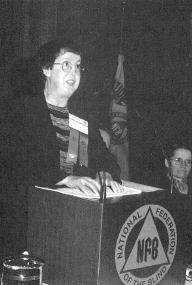
Joyce Scanlan
Of Gates and Good Intentions
by Joyce Scanlan
**********
"Lift up your heads, O ye gates; and be lifted up, ye everlasting doors."
These are lines from the Twenty-fourth Psalm, which for many years were code words between
Dr. Jernigan and me to signal our memories of an incident in which he, the consummate
teacher, helped me to understand more fully how to be a leader in the organized blind
movement.
In 1973, when I was a fairly new member of the National Federation of the Blind, by
some fluke of fate I was elected president of our Minnesota affiliate. Now, if we all
remember our history--and there are many who will never let me forget that
history--Minnesota had the dubious distinction of having two Federation affiliates, the
only state with such a distinction, and the group of which I was elected president had the
additional notable feature of owning and operating a residential home for the blind.
This home had gates at the tops of the stairways--you know, to protect the blind
people from falling down the stairs and being hurt. Well, this was a situation in which
Dr. Jernigan helped me to get out of a potential mess. Shortly after I became president,
some of our new Federationists in the student division prevailed upon me to take the gates
off the stairs because, they argued, having the gates wasn't consistent with Federation
philosophy. The gates should be removed so the residents could learn to be independent.
Most of the residents were elderly, and they were used to having the gates. Of course they
were most unhappy when the gates were taken away. Someone called Dr. Jernigan to complain
about what had been done, and he called me to discuss the matter.
He began the telephone conversation by telling me about Alexander Hamilton and
Thomas Jefferson and how one had a philosophy but no army, while the other had a large
army and didn't worry much about philosophy. Dr. Jernigan then said that if I was to
accomplish all that we hoped for in the Federation, I would need an army of people to do
it, and the philosophy would come second. He said the gates weren't that important and
should be put back on. He also cautioned me that it should be done with good grace, not
grudgingly. I conceded that he was right and returned the gates to their proper spot at
the top of the stairs. The residents of the home were again happy, and I was prevented
from being a very short-term state president.
Dr. Jernigan hadn't been at all harsh with me. He was very gentle in explaining why
it had been a mistake to tamper with something the older people had come to depend upon.
He said I needed those people as part of an army as much as they needed the gates. Any
philosophical conflict between the gates and Federation thinking could be worked out.
Having the gates for a little longer wouldn't hurt, and eventually, he said, the people at
the home would ask for the gates to be removed. The home was sold in 1980, and I have
always regretted that I didn't keep one of those gates as a memento of the experience.
Over the years Dr. Jernigan and I often spoke of that incident. It was a wonderful
lesson for me. In fact, this single incident made up an entire textbook of Federation
instruction, which has often served as a guide along the way as I have wrestled with our
philosophy and how it can be applied to real life and how the National Federation of the
Blind functions. "Remember the gates," Dr. Jernigan would often say. The
incident of the gates set down a firm foundation for me in how the Federation values
people. We love one another, and we treat each other with fairness and respect.
And Dr. Jernigan taught me many more lessons. I had always envied those who had
learned from him as students at the Iowa Commission for the Blind. They benefited from
ongoing contact with him over a period of many months. However, my contacts with him at
National and some State Conventions, Thanksgiving Board meetings, leadership seminars, and
a few other meetings here and there made each and every encounter so special and so
memorable that I can appreciate my good fortune for having had the benefit of knowing him
and working with him for many years.
I'll never forget having dinner with him at the Waikiki Room restaurant at the
Leamington Hotel in Minneapolis where we both enjoyed sampling every hors d'oeuvre on the
menu while sharing a Sidewinder's Fang. Then there was the time he sat down for breakfast
at a restaurant in Madison, Wisconsin, early in April and asked the waitress, "Do you
have any fresh figs?" The answer was a definite "No." He gave me guidance,
support, and counsel throughout all these years, through good times and difficult times.
As a new state president I had much to learn about political strategizing. There were
times when I might be discouraged by the burdens of a state presidential election when the
older members of the Minnesota affiliate would campaign hard and seem to gain strength. I
would call Dr. Jernigan and whine about the tactics being used by the opposition.
Political organizing was all new to me. The old folks had long experience fighting
everything and everybody, including each other. My supporters were mainly college
students, who had neither skills nor experience in political scrapping.
I made so many stupid errors in chairing state conventions that I marvel at how Dr.
Jernigan could sit there patiently and watch me struggle with the tough old guys winning
on most points. Then Dr. Jernigan would call me the following week to review my
performance. Although it seemed to me that I had done just about everything wrong and he
told me what errors I had made, he somehow always found some good in what I had done. He
talked to me about doing my homework. The old folks had done theirs, and they had won. Dr.
Jernigan guided me through these difficulties and showed me how to take chairing
conventions and weathering elections in stride. He would say, when I complained,
"Now, Joyce, you don't expect your opponent to stand up before you and salute you and
say, `Shoot me first,' do you?" He taught me to pay heed to the votes. He would also
say, "When you have the votes, you can afford to be nice to your opponent; when you
don't have the votes, you must be nice." His deep personal integrity set a high
example for all of us to follow. I have always tried very hard.
There were fun times too. My one and only positive rehab lesson was taught me by
Dr. Jernigan. At the very first leadership seminar in 1973, when we all went to dinner at
the Charcoal Pit in Des Moines, he showed me how to grill a steak, and both of us enjoyed
the steaks and the experience. He also gave Tom and me a lesson in making NFB tea one
Sunday afternoon after a Board meeting. At that time, and probably still today, there was
no recipe for NFB tea. He had a whole shelf full of liquid spices, and he would take each
one in turn, uncap it, tip it over the mixing bowl of tea, and say, "Now listen, this
is how much you put in," as the spice trickled into the mixture. There was no formal
measurement, only the auditory method, listening to the trickle. It was great fun, but how
could anyone repeat such a performance and come out with fine NFB tea? No one really
understands that.
I thank Dr. Jernigan for giving me a meaningful life. When I came into the National
Federation of the Blind in 1970, I had lost everything: my eyesight certainly, but my
livelihood, my confidence and self-esteem, any hope for a successful career. Life for a
blind person in North Dakota was very bleak--no opportunity, no hope for change. Then Dr.
Jernigan and the Federation came along, and everything began to change. Blindness might
bring problems, but there are definite solutions to those problems. Blind people have the
right to equal treatment and opportunity, and blind people can dream of how life can be
made better. Blind people can turn dreams into reality. Working together, blind people
have the power to change what it means to be blind. We have a united voice; we have a firm
philosophy; we have a common purpose. All of this meant a great deal to me. But it was all
very different from everything I had known during the early years of my life. It also
meant that I had to change my whole approach to life--no more hiding out, no more excuses,
no more shirking responsibility.
The model set for us by Dr. Jernigan challenges all of us to a high standard of
conduct. I remember well his guidance and teaching during the Minneapolis Society for the
Blind lawsuit and proxy fight. This type of litigation and corporate warfare was totally
new to all of us. During the trial, when Dr. Jernigan came to testify, the Society lawyer
asked him if the Federation was funding the lawsuit. Dr. Jernigan's response was,
"Well I don't know if we have put any money into it or not, but let me say that, if
we didn't, we should have." That floored the attorney, who had expected an outright
denial. How strong and decisive Dr. Jernigan was in answering unfriendly questions. He
took the Society attorneys completely off guard by being so definite and giving specific
reasons to support what he said. Dr. Jernigan always knew what to do. He was always ready
with ideas for what should be done. Of course we won the lawsuit against the Society.
None of us had ever before been involved in a proxy battle either. It was a time of
vicious attacks, threatening phone calls, character assassinations where our people were
employed, high-priced, hostile ads attacking the Federation and its leaders circulated far
and wide. When the troops would seem to waver and begin to wonder whether the whole battle
was worth all the trouble, Dr. Jernigan would say, "We are in this battle now, and
even if we fight and lose, we will be better off for having fought than if we had never
tried at all." He told us that we were fighting for a worthy cause, and at the best
we would all know the triumph of high achievement; and at the worst, if we failed, we
would at least fail while daring bravely. Once again he was there; he listened to our
mournful complaints and lent his words of wisdom and support.
All this time Dr. Jernigan was being attacked from every direction. Our NAC
opponents were very busy attempting to destroy Dr. Jernigan and the Federation. I tried to
give to him the same support he had given me, but I know I received far more than I gave.
Hopefully we will never again be called upon to engage in such battles, for today,
again thanks to Dr. Jernigan's powers of persuasion and charisma, the field of blindness
is experiencing unprecedented harmony. NAC and other agencies which once opposed us are no
longer viable. But the National Federation of the Blind is stronger today than ever
before.
The best of all I know and believe about blindness and about life I learned from
Dr. Jernigan. He taught me to dream of a better world for blind people and how to work
hard or fight--if that was necessary--to make that dream come true. All of us today are
considering what his loss will mean to the National Federation of the Blind and to blind
people everywhere. Yet within each of us lies the very best that we have been given by a
most generous and loving person.
Although he has passed from our midst in one sense, he will always be with us in
spirit to guide, to persuade, to mentor, to support, to teach. All of us have better lives
because of the organization he built. If we all live our lives as Dr. Jernigan lived his,
we know the organized blind movement will thrive in years to come. We can make it happen,
and, Dr. Jernigan, we will make it happen. We will all follow the legacy you have set and
support and march with President Maurer to continue the work of the National Federation of
the Blind. And whatever my personal role in the Federation may be in the future, I
promise, Dr. Jernigan, I will always remember the gates.