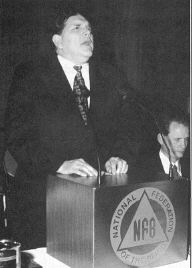
Allen Harris
Transformation
by
Allen Harris
**********
In 1967, having been graduated from college and preparing to look for a job as a
teacher, for the longest time I had wanted to coach wrestling and teach. Actually I wanted
to coach wrestling, and someone said you'd have to teach also. I said that I'd be willing
to do that. I just wanted to coach wrestling. So after an intensive and prolonged struggle
to find work, in the fall of 1967 I was employed by the Dearborn Board of Education to
teach social studies and to coach wrestling, the only things I ever wanted to do.
At that time another thing happened in my life. I said to myself--no one else, for
I was the one who felt it, knew it, and had lived it--that I didn't want to hear, think,
meet, or have anything whatsoever to do with blindness anymore. I had learned every lesson
I cared to learn. I had met every kind of barrier I could possibly face. I had struggled.
I had been diminished, demeaned, and generally abused by people over blindness, and I was
tired of it. I did not want anything to do with blindness whatsoever. I set off to become
a coach and a teacher and to do so without any hint of blindness. After all, the people I
worked with were all sighted, and they loved me. They thought I was terrific--I knew
better--but they thought I was terrific, and that was fine with me.
I went along like that, because deep down in your soul, if you are blind, you know
you're blind even if you cannot deal with it; even if you do not know what to do or think
about it, you know it's so. So for the next couple of years I went on like that. I kept it
buried as much as I could although it surfaced from time to time. In 1969 in the summer I
had completed my master's degree (feeling very proud of myself), had written something
that was accepted--not terribly profound, as I look back on it, but it fulfilled a
requirement. It was perfectly okay. I was prepared to hunker down and teach for the next
twenty-eight years, and that would be that.
I was still not the least bit interested in hearing anything about blindness,
meeting anyone who was blind, or otherwise being engaged in any blindness-related
activities. That summer Evelyn Weckerly, Ramona Walhof, Jim Omvig, and President Maurer
came into my life. Mrs. Walhof and Evelyn Weckerly came to visit me. They wanted to talk
to me about blindness. I was not the least bit interested. More specifically, they wanted
me to come to a meeting. I was even less interested. What was worse, they wanted to come
to my house and talk to me about it.
I thought that was a part of my life that was pretty much gone. They were
persuasive, and they came and talked to me about a meeting that they were going to be
having and that Dr. Jernigan would be there. I didn't know who Dr. Jernigan was. I
thought, "I hope you have a good time. I hope it works out well, but I will not be
there." I finally got them to leave. Mrs. Walhof can engage you for a while if she
chooses to. So, finally having gotten her on to her next appointment or wherever she was
going, I put that aside. That was the end of it.
On a Friday night came a call from Mr. Omvig. He said how much I was needed the
next day, how much people were looking forward to my being there, what a critical part I
would play in forming the affiliate, and all that he was very impressive; those of you who
know him know that. So I thought, well perhaps I should go just because he's such a decent
human being. A half a day--I would just go for half a day. In any case, I went still
determining not to have anything to do with blindness, no interest, nothing.
I got there and I met some other people, including President Maurer. We began to
write a constitution for the newly formed NFB of Michigan. Dr. Jernigan was chairing the
meeting, and I listened, and it wasn't very long before I thought, "There is
something very special about this person. There is something very different about this
person. When he talks about blindness, it is not the way I feel about it. When he talks
about blindness, he talks about it in a way which allows me to think, `Maybe it's
okay.'" When he talked about it, he talked with such confidence and such
understanding; he knew exactly how I felt, where I had been, and how troublesome it had
been to me. But he also said, "It is important for us to work together, to learn the
truth about blindness, to change what it means to be blind," all of that stuff.
By the end of that day (I didn't leave at noon as I had planned) I was at a
banquet, where I also had the pleasure of meeting Lloyd and Mary Jernigan and sitting next
to Dr. Jernigan. I was forever transformed. I will save you some of the details, but I was
forever transformed that very day. For Dr. Jernigan caught me in a way that nothing else
in my life had or will again. He touched me in ways that no one else ever could. He made
me feel that I was a perfectly capable person; although I had not come to understand that,
he had.
For the next couple of years--while I was very much interested in the Federation
and while I read the Monitor with particular
interest and especially enjoyed sessions when Dr. Jernigan would chair, and he would get
some big old you-know-what agency person up here and just work him over, I would sit back
and say, "Oh, right on, right on. Give it to him!" I found strength in it
although not the courage to be there. I found faith in what he did and in what the NFB
did, and oh, I loved him so much when I would hear that. I would think, "Exactly,
exactly! Tell 'em, tell 'em exactly how it is!" You've all experienced it, haven't
you? You know when Dr. Maurer or Dr. Jernigan or one of our leaders tells it like it is:
it's such a good feeling!
So, while I had not been active--totally inactive would be more accurate--I began
to think by the summer of 1971 that I ought to do something, so I went off to my first
convention. I don't remember a whole lot about the details, but I remember being
exhilarated. I went again in '72, '73, '74, '75, and every year since.
I want to tell you a couple of personal things that Dr. Jernigan did for me; there
are so many, I can't even begin to recount them. Could you? It would be very difficult.
Yet I know what they've done for my life and for yours and for the lives of blind people
whether they've ever met him or known him or not, whether they've ever heard of the
Federation or not. He changed our lives as blind people forever.
He called me in December of 1973 and invited me to a seminar, a leadership seminar
at that. I wondered why he picked me. I couldn't figure it out, but he had picked me, and
he sent me a bunch of stuff, and he said, "When you get it, read it, every bit of
it." By gosh it came and I read it--every bit of it. It came time to go off to the
seminar, and I went with great anticipation and with an absolute feeling of enthusiasm
like I had never known in my life. I got to Iowa, where I had heard about the Iowa
Commission for the Blind and where I had seen Iowans who distinguished themselves in
crowds of people, not just blind people, anywhere you saw them. I thought, what a terrific
thing! I got to the Iowa Commission for the Blind and I walked in the door and I felt so
different. I felt this is what it should feel like.
I had gotten there, but I had gone with a cane that was--it was a Lion's Club cane.
Many of you have seen them, kind of a hickory stick with a curve, more orthopedic than
travel. In any case, I hadn't been there very long before Dr. Jernigan called me into his
office. He said that he needed to talk to me. He sat me down and showed me this fiberglass
cane. He said, "I'm not sure that I like these; I'm sure you won't. I'm sure this is
not something you'd be interested in, but I'll just show it to you for your
information." He said "In fact, if you want, you can take it; leave it out there
if you like; or you could use it or whatever. In fact, if you find (you probably won't)
you like it, you can go back to the hotel by yourself tonight. Just go back, and see how
that works. Now maybe none of that is what you want to do, but if...." Of course, it
was all stuff I was going to do. I was busy taking notes of exactly the things that he
said I might not want to do. Then I was determined to do them.
That night I took that cane, which was twice the length of the one I had, and I
walked down the street, and I went back to the hotel. I remember finding the hotel--'cause
I sure was not certain that I would when I left. It was cold in Iowa, and the wind blew a
lot. I thought, if I get lost, I didn't know.... But in any case, I didn't think about it.
I had been changed again by Dr. Jernigan and didn't even know it.
That same weekend I was taking copious notes, writing down everything, not
answering questions very well. President Maurer and Mrs. Maurer were there also. I don't
remember how well they did. I don't think any of us felt that we did particularly well. I
liked them a lot, and other people were there. Hazel Staley was there; she is in this
convention hall, and she had never lit a match. I remember this vividly. She didn't want
to start then; she had no interest in starting then. She lit a match. She was so excited;
we were all excited, and it just went on like that. That was the way the weekend went.
Anyway, Dr. John Halverson was there also (Ph.D. from the University of Michigan).
In any case, I put my plane ticket away. I wanted everything to go perfectly. I
wanted to make a good impression. I wanted to learn and get optimum opportunity, so I put
my plane ticket away. Guess where I put it? I put it in the phone book, where it would be
safe in the drawer. Guess what, while I was out, the hotel which apparently changes its
phone books once a year, did it that weekend and threw the old ones out. My ticket was
gone. So I thought what is it I can do. Well I could start walking home, or I could just
face the music. I don't know what the music will be, but I'll face it. I went down, and I
got there early as a matter of fact. Dr. Jernigan was there; he was always there early and
late and in between. I had a chance to speak with him, and he was kind and gentle and
thoughtful as he always was. I thought, "How am I going to break it to him?"
Finally I managed to say, "Dr. Jernigan, I have misplaced my ticket."
He said, "Any idea where you may have misplaced it?" I told him the
story, and he said, "So it's gone, and you don't have it."
I said, "It's gone."
He said, "That's a little bit of a problem. You will need a ticket to get
home." But he said this--and tell me if you don't recognize all that he stood for in
all of us as individuals, as blind people. He said, "Step around here to the phone
and order another one."
I thought, "Yeah, that's what I'll do. I'll just get another one."
Because of his faith in me, because of his commitment to us, because of his unwavering
belief that I was somebody and worth something, and what we were doing as blind people was
so important, he said, "Stick around and get another one. Don't be bothered by
it." I'll spare you the details. We found the first one. But that illustrates in one
way many of the lessons he taught us.
Over the years I had the good fortune to speak to him, work with him, be around him
many times. Everything he taught me to do came to me as very important. I wanted to be
helpful at conventions starting in about 1973, so I asked about things I could do. He
always had something for me to do. In the early years, for instance, I think he gave me a
spot to stand by the elevators and said stay there and watch for anything you can be
helpful with, and if nothing comes along that you can be helpful with, then simply stay
there and finish up.
I thank Dr. Jernigan for what he gave me personally and what he gave every blind
person who has ever lived or will live and what he has done to make a difference for all
of us. While we all miss him very much, we must carry on and do the only thing he asked of
us: keep our Federation strong, support President Maurer, and do everything we can.