The Mental Discipline of the Movement
An Address Delivered by Marc Maurer
President of the National Federation of the Blind
July 5, 1999
**********
William Shakespeare thought that knowing what to do was easy. It was the doing of
it that was so hard. As he said, "If to do were as easy as to know what were good to
do, chapels had been churches, and poor men's cottages princes' palaces."
However, there are others who have a totally different point of view. They believe
that knowing what to do is the hard part. Remarkable achievement is attained (according to
these scholars) by thought--by exercising the ability to distinguish between the
significant and the mundane. As the American bacteriologist Hans Zinsser said, "The
scientist takes off from the manifold observations of predecessors and shows his
intelligence, if any, by his ability to discriminate between the important and the
negligible, by selecting here and there the significant steppingstones that will lead
across the difficulties to new understanding."
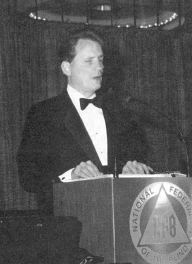
Marc Maurer delivers the 1999 banquet address.
Just as it is for an individual, so it is for a culture, a nation, or an
organization. Each of these must attempt to identify the steppingstones of progress. To
the extent that they achieve this difficult task and are committed to implementing what
they learn, growth and advancement occur. To the extent that they fail, there are
stagnation, deterioration, and aimlessness.
In the late summer of 1998 Dr. Kenneth Jernigan, the most forceful leader of the
blind of our generation, taught a seminar on leadership. Although this seminar was
conducted less than two months before Dr. Jernigan's death from cancer, which he knew
would soon overtake him, the seminar was upbeat and enthusiastic; it took its tone from
the teacher. He said during the class that principles of behavior are important--indeed
they may be the only things that matter. If we have the proper principles, all else will
follow. If we do not possess these vital characteristics for action and thought, the
progress we gain is accidental and cannot endure.
So what are the principles for us--for the National Federation of the Blind? What
do we believe, and how do we conduct our business?
I met Dr. Jernigan in 1969. I was a student, and he was the President of the
National Federation of the Blind and the director of the training program in which I had
enrolled. He was unusual, brilliant, fascinating, and challenging. One of his unusual
characteristics was that he always had an answer for everything. How could anybody know so
much, I wondered. I wanted to find out if he really had all that knowledge or if he was
just good at faking it. I had never before met anybody who could outthink me at
everything, but he seemed to be able to do it. I began to make bets with him. I thought
there must be something I know that he doesn't, and I wanted to find out what it was.
It will come as no surprise to those who are familiar with Dr. Jernigan that I lost
the wagers. However, I learned an important lesson. Dr. Jernigan used his mind--always and
rigorously. When two facts did not match, he noticed this phenomenon and wanted to know
why. He worked until he discovered the reason. Not only did he use his mind, but he
demanded that we do the same.
"Whether you like a conclusion or not," he told us, "observe the
evidence, and go where your mind leads you. If your reaction to a conclusion makes you
uneasy, hunt for facts you have overlooked. If you cannot identify any, accept the
conclusion. If you cannot stand what you learn, do your best to change it, but don't
reject it from emotionalism or a chuckle-headed imprecision of thought."
Consequently, one of the fundamental principles of the Federation is to trust your own
mind--have confidence in your capacity to think. Believe in what you know, and don't let
others talk you out of it unless they can demonstrate that they know more about the
subject than you do. Use your head; work hard; and go where your mind leads you.
Dr. Jernigan joined the Federation in 1949, and he became active at the national
level in 1952. For almost half a century he gave to us freely of his intellect, his
energy, and his spirit. His mind was a formidable weapon in the arsenal of the Federation.
One of the factors that made this mind so extraordinary was that Dr. Jernigan used it to
insist that we employ the same rigor in thinking that he demanded of himself. He showed us
that we cannot rely on somebody else's thought. Not only is this undesirable, but it is
completely unworkable.
Any group that wishes to achieve freedom--that intends to speak and act on its own
behalf--must be prepared to imagine and articulate its own philosophy. If that group
intends (as we most certainly do) to have a long-term impact on the broader society, it
must write that philosophy into an understandable literature, which can be read and
comprehended. The mental effort involved in imagining what might be written and committing
the ideas to paper changes the people who do it. The process of thought and creation and
the act of internalizing the ideas that result from this process force us to know what we
think and to plan for the implementation of that thought. This kind of planning is not
only helpful, it is a fundamental part of building civilization. The philosophy and
literature tell others what they may expect from us, but they also tell us--the people who
think and write them. This is an essential part of relying on our own intelligence.
Where has our intelligence led us? You know as well as I. There are those who
believe that the blind have little competence and less sense, that our lives are
necessarily filled with bitterness and despair, that we are immobile and sedentary, that
we cannot aspire to the business world or the professions, that our educational
opportunities are limited, that we cannot become leaders of government or society, that we
will never be able to compose and present to the public a literary description of our
talents and abilities which will be sufficiently lucid to capture the imagination (and
that somebody else will have to interpret our lives for us), that any suggestion of having
blind people teach other blind people how to travel with a cane is irresponsibly dangerous
or positively immoral, and that the assertion of the right of the blind to equal status
within society is not only a ridiculous dream but also a prescription for failure--failure
calculated to cause immeasurable harm and psychological trauma. Do we in the National
Federation of the Blind believe that this summation represents the truth? Are the blind
immobile, incapable, and inarticulate? Will we let somebody else determine our own
destiny, specify our future, or speak on our behalf?
The answer is obvious. We the blind of the nation from all walks of life, from
every state, and from every sector of the society have gathered here tonight in our
thousands. We would not be here if we did not intend to determine what our lives will be.
We have the capacity to observe; we have the mental discipline to understand; and we will
respond. We are the blind; we will speak and act for ourselves; and there is no force on
earth that can prevent it!
Throughout almost all of recorded history the blind have been written off, and the
literature about blindness has reflected this opinion. Even though there have been many
dramatically successful blind people, the common culture has dismissed the successes as
exceptions. All too many of the successful blind people (because it boosted their sense of
self-importance) agreed with the popular mythology. They accepted the view that blind
people are unproductive invalids, but that they (the successful ones) are different and
special.
With the coming of the National Federation of the Blind, an altered and much more
realistic perception of blindness has been developed. This perception is that blindness
need not be a tragedy--though, if it is not properly understood, it can be. With training
and opportunity blindness can be reduced to the level of a physical nuisance, and the
blind can compete on terms of equality with the sighted. We the blind are people of
capacity, who want to make contributions to our society. We are people that the members of
the public will want to know. An increasing number of us are leaders in our own
communities and a part of the social set. Nevertheless, the misunderstanding of blindness
persists, and it is reprinted and reinforced both by the popular press and sometimes by
uninformed blind people themselves.
In 1997 Stephen Kuusisto published his memoir, entitled Planet of the Blind. In his book he discloses
that his vision (until he reached the age of thirty-nine) measured 10 percent of what is
regarded as normal. Kuusisto could not see, but his parents urgently insisted that he try,
and he accepted their attitude about his blindness.
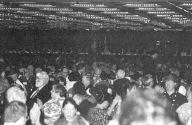
Diners in the Marquis Ballroom listen
to the banquet address.
On December 23, 1997, the New York Times
published a review of the Planet of the Blind.
The review reflects the tone of the book. It incorporates quotes and describes incidents
contained in the text, but it also adds reflections of its own--reflections in keeping
with the spirit of Planet of the Blind. This,
in part, is what it said:
**********
For almost four decades, the writer Stephen Kuusisto tried to hide the fact that he
was legally blind.
Though he could read only by holding a book an inch from his face, though he could
see little more on the street than blurry colors and shapes, he tried for years to pass as
a member of the sighted world. He careened around his neighborhood on a bike, insisted on
piloting his family's powerboat, traveled alone to Europe, and learned to ski.
**********
[I interrupt the Times review to point
out that the reviewer and the author of the book apparently agree that such activities are
reckless and irresponsible for a blind person. However, properly managed, there is
absolutely nothing wrong with a blind person's learning to ski, traveling alone, or riding
a bicycle. And a number of us have had our hands on the steering mechanisms of powerboats.
But back to the review.]
**********
In his luminous new memoir Planet of the
Blind, Kuusisto--who lost his sight as an infant, when he was placed in an overly
oxygenated incubator that permanently damaged his retinas--tells the remarkable tale of
how he feigned sight for so many years. He also tells us the affecting story of how he
eventually came to terms with his condition and began a new life, at the age of
thirty-nine, with a seeing-eye dog named Corky.
So [continues the New York Times] how did
Kuusisto manage to negotiate the world for so many years without help, without even a
white cane to help reconnoiter its terrain? Part of it was sheer recklessness, a
determination to plunge ahead, regardless of cars and walls and stairs. And part of it was
reliance on wit and acting skills.
**********
[I interrupt again to ask, what is there about dealing with cars and walls and
stairs that is so reckless for a blind person? Of course, it is much easier to manage
these things using a cane; but all of us have ridden in cars, walked on stairs, and
traveled around walls without using one; and the language of the reviewer is a bit much.
Let us suppose for a moment that Kuusisto wanted to avoid these objects--how could he do
it? Should he live under the stars on a flat patch of prairie and never stray from the
reservation? Is this what the New York Times
recommends for the blind? But back to the review.]
**********
He pressed his nose to the television set and used magnifying glasses and huge,
thick, telescopic spectacles to examine books, slowly deciphering their elusive words one
by one by one.
"The ordinary effort of reading is for me a whole-body experience," he
[Kuusisto] writes. "My neck, shoulders, and finally, my lower back contract with
pain. The legally blind know what it is to be old: even before the third grade I am
hunched and shaking with effort, always on the verge of tears, seeing by approximation,
craving a solid sentence. Then the words dissolve or run like ants. Nevertheless, I find a
lighted room inside my head, a place for self-affiliation. I am not blind, and not the
target of pranks."
**********
[I interrupt to ask, who does he think he's kidding? Not the target of pranks? Not
blind? Able to find a lighted room inside his head? We know better, and if he is honest
about it, so does he. But there is a ring of truth about part of this description. How
many of us have been forced to try to read what we could not see. How many of our teachers
have told us that, if we were not lazy, we would be able to observe visually what they
have displayed? How many of us have felt the pain of trying to be sighted when we were
not? How many of us have been sold a bill of goods--have been told that Braille is slow
and inefficient when it would have been much easier and faster than the print they were
trying to force us to use? But back to the New York
Times.]
**********
Having been brought up by parents who were reluctant to acknowledge his disability,
Kuusisto internalized their denial. He did not want to get a white cane. He did not want
to ask for help. He did not want to be regarded as someone who was blind. And yet for all
his efforts to appear independent, he says he was continually mocked as odd and clumsy and
slow. Schoolmates called him "Mr. Magoo," and one professor cruelly told him he
did not belong in graduate school.
**********
[The Times review concludes with this
paragraph] Although Kuusisto's love of poetry can result in patches of overly
self-conscious prose--[such as] "my ego crawls around blindness like a snail
exploring a piece of broken glass"--he is a powerful writer with a musical ear for
language and a gift for emotional candor. He has written a book that makes the reader
understand the terrifying experience of blindness and that stands on its own as the
lyrical memoir of a poet.
**********
This is what the New York Times printed
two days before Christmas just a year and a half ago, and it makes one wonder whether the
author of the review and the author of the book ever use their heads. Kuusisto is, by his
own estimation and by the opinion of the New York
Times, a lyrical poet and a powerful writer. Nevertheless, he looks down on his own
life and belittles himself because he is blind. Kuusisto tells us that he has been
misunderstood and that this has caused hardship. If these are the measures of a lyrical
memoir, each one of us in this room should have one. Kuusisto admits that his own
misperception added to the misunderstanding, and we can certainly agree with his
assessment. The question we ask is whether Kuusisto's present writing will help to solve
the problems he has identified or cause more damage. If the review of the New York Times is any indicator, it would be better
if he had not written. The impression left by the Times
is that living as a blind person requires extraordinary courage and that blindness itself
is a terrifying experience.
We need a literature which tells of our hopes and dreams--our abilities and
contributions--and we would like Kuusisto to use his lyrical pen to help in its creation.
But he must tell it like it is--not perpetuate ancient fears and add to misinformation.
Whether he writes it or not, it will be written because we will insist that it be written.
Indeed much of it we have already written. We have the capacity to observe; we have the
mental discipline to understand; and we have the ability to write. Our literature speaks
of freedom, and we will settle for nothing less. We are the blind; we will speak and act
for ourselves; the literature will tell our story; and we will be heard. There is no force
on earth that can prevent it!
A notion abroad in the land, which has been repeated in many different forms during
the past few years, is that blind people differ from the sighted not only because we lack
the capacity to see, but also because our brains function in a different way from the
sighted. The argument goes like this: Seeing is an important function that demands a lot
of effort from the brain. A portion of the cortex is devoted to managing visual images;
blind people do not use this cortex for seeing. The visual cortex of the blind is
reassigned to assist the brain with the functions of smelling, tasting, touching, and
hearing. Thus (according to this argument), the blind have a sharper sense of hearing, a
keener sense of taste, a more acute sense of smell, and a clearer sense of touch than the
sighted.
An article entitled, "Blind People Compensate with Hearing," which
appeared on October 5, 1998, in the Register Citizen,
a newspaper of Connecticut, says in part:
It might be true what they say about the blind having better hearing than people
who can see. Blind people apparently compensate for their lost vision with greater ability
to locate sounds than people with normal or partial vision, a Canadian study suggests.
Neuropsychology researchers at the University of Montreal found that, unlike people with
normal vision, blind people could correctly pinpoint the source of sounds even with one
ear deliberately blocked by the testers. "One important question left unanswered is
whether blind people learn to use their hearing more efficiently or undergo some kind of
physiological change," said William R. Wiener, chairman of blind rehabilitation at
Western Michigan University. Wiener said other recent research suggests, "There may
be some physiological changes that occur in the brain in the processing that make a blind
person more efficient." Dr. Steven Parker, director of developmental and behavioral
pediatrics at Boston Medical Center, said, "It is possible that part of the brain
commonly used to process images gets recruited to process sound. But in the partially
blind, those brain cells already are being used for sight, and they can't switch
over."
That's what the article says, and I wonder if the researchers are willing to take
the argument the whole way. Blind people are able to hear better, they say, because we
have lost our sense of sight. What would happen to us if we had also lost our senses of
taste, touch, and smell? Our hearing would be so acute that we would be able to hear the
ordinary sound a mile away, and the whisper in the next room would be plainly audible.
Imagine the advantages. The CIA would no longer need all of those listening devices; it
could use us.
Or imagine the sense of touch. Some years ago the argument was made that blind
people are better at kissing than the sighted because we are not distracted by extraneous
visual images. However, William Wiener puts the matter on a different footing. We kiss
better (it could be argued) because we have an enhanced sense of touch. Is the improvement
noticeable only by the blind, or can the sighted enjoy it too? What about the deaf-blind?
Is their sense of touch superior to that of those who are only blind? If they had lost the
senses of smell and taste, the experience of kissing might be so keen as to put them into
orbit.
Or consider another line of thought. Why is it that the researchers believe the
reassignment of the cortex affects only the senses? Maybe the blind, who do not use their
brains for seeing, employ this unused mental capacity for more intellectual pursuits.
Maybe we use the brainpower to think; maybe we are smarter than the sighted.
Our experience shows us that such speculation is just that--speculation. We don't
believe our loss of sight has altered our mental processes. I will admit that some of the
blind people I have met possessed most unusual ideas, but their thinking was no more
bizarre (and no less bizarre) than the mental gymnastics I have sometimes observed from
the sighted--especially those with experiments to perform on the blind.
We say this to the experimenters. If you want to know what blind people are like,
come to us--come to the convention of the National Federation of the Blind--come to us in
our thousands. We will help you learn what blindness is--and of equal importance--what it
is not. But keep in mind that we insist on equality in the Federation. If you insist on
conducting experiments on us, we think it is only fair that we be able to conduct a few on
you.
You may have thought that the negative stereotypes that were once so often
associated with blindness are a thing of the past--that they existed at one time, but that
nobody could possibly believe them today. Even if there remain a few unenlightened souls
who think the blind are inferior and the techniques employed by the blind are second-rate,
surely this attitude could not prevail in the highly-educated and well-informed circles of
programs established to serve the blind.
On August 12, 1998, leaders of the Puerto Rico affiliate of the National Federation
of the Blind appeared before a committee of the legislature to urge that a bill be adopted
to secure the right of the blind to learn Braille. The head of the Puerto Rico
Rehabilitation Administration, Dr. Jose Santana, the man responsible for directing
programs in Puerto Rico established to ensure that the blind learn what they need to know,
gave testimony against the bill. He said that teaching Braille to a blind person with any
residual vision whatsoever, no matter what skills or talents that person may possess, is
anti-pedagogical, anti-democratic, and cruel. He said that becoming blind is a form of
dying. He compared the teaching of Braille (if you can believe it) to having a healthy
person, on the theory that the person will one day die, climb into a coffin. Such
testimony boggles the mind.

The five-hundred or so Federationists who
enjoyed the banquet in the Imperial Ballroom
had large-screen video on which to watch the proceedigs. Spotters with two-way
radios made certain that nobody missed a door prize
Our experience is that Braille is a liberating skill, one that encourages
independence and expands opportunity. Dr. Santana argues that achieving literacy for the
blind is similar to seeking death. And they tell us that we have psychological problems.
What are the psychological implications of Dr. Santana's argument? Does he believe that he
is a whole person but that we who are blind are not? Does he believe that we are inferior
and that he is superior? Does he believe that administrators of programs for the blind are
put in place to look down upon the clients they are supposedly working to serve?
Dr. Santana would deprive us of our method of reading; he would insist that the
blind be illiterate. He thinks we are already partly dead, but we will not let his lack of
understanding help us into the grave. We will not let his psychological need for
superiority govern our future.
We reject Dr. Santana's formulation and all of the psychological myths--the hidden
insecurity and the unspoken fear--that are part of this ignorant misperception. We want
freedom, and Braille is one of the elements that will help us get it. We will not let
narrow-mindedness or bigotry on the part of administrators of programs for the blind keep
us from it. Dr. Santana believes he speaks for the blind, but he cannot--and he never will
speak for us. We will express our own views, and we will be heard. There is no force on
earth that can stop us!
Although an increasing number of the members of the public have come to recognize
the struggle of the blind to achieve first-class status in society and have joined with us
in this effort, there are a few who still believe blindness signifies a complete lack of
the ability to contribute. These unenlightened people think that we the blind are unable
to earn anything and that whatever we have must have been given to us. They hold the view
that the only contribution possible for the blind is to serve as the objects of somebody
else's pity, and they want to feel pity for others because they gain a sense of
superiority from doing so. They think that we who are blind want something for nothing.
Unfortunately, some blind people help to support this negative and uninformed
understanding.

Mementos of the 1999 NFB Banquet: left to
tight a replica of the bust of Dr. Jernigan,
the picture on the front of the souvenir mug, the picture on its back, the votive candle,
and the banquet ticket.
On March 8, 1999, an article appeared in Newsweek
Magazine, entitled "Navigating My Eerie Landscape" by Jim Bobryk, a blind person
living in California. Bobryk's description of his own experience is a strange mixture. It
demonstrates that his training in the skills of blindness has been minimal, that he has
not come fully to accept or understand blindness, that his determination to carry on the
activities of living is reasonably firm, and that he is looking for ways to exploit his
blindness. Here in part is what Bobryk says:
**********
Now, as I stroll down the street, my right forefinger extends five feet in front of
me, feeling the ground where my feet will walk.
**********
[I interrupt to point out that this is a catchy way of saying that Bobryk uses a
cane. He is not a freak with a five-foot-long finger; he is blind with a cane in his hand.
But back to the article.]
**********
Before, my right hand would have been on a steering wheel. I drove to work, found
shortcuts in strange cities, picked up my two daughters after school. Those were the days
when I ran my finger down a phone-book page and never dialed information. When I read
novels and couldn't sleep until I had finished the last page. Those were the nights when I
could point out a shooting star before it finished scraping across the dark sky. And when
I could go to the movies, and it didn't matter if it was a foreign film or not.
But [Bobryk continues] all this changed about seven years ago. I had battled
glaucoma for twenty years. Suddenly, without warning, my eyes had hemorrhaged. I now have
no vision in my left eye and only slight vision in my right. A minefield of blind spots
makes people and cars suddenly appear and vanish. My world has shapes but no features.
Friends are mannequins in the fog until I recognize their voices. Printed words look like
ants writhing on the page. Doorways are unlit mine shafts. This is not a place for the
fainthearted.
**********
[I interrupt again to point out that Bobryk uses the language to ask for sympathy.
Life was good before blindness, but now it is filled with minefields and unlit mineshafts,
with no foreign films and no driving, with no books at night before bed and no stars. Of
course a doorway is not an unlit mineshaft, but the image of falling and danger is
enhanced by such hyperbole. The message here is not complex. Bobryk says: give me pity; I
am blind. But back to the article.]
**********
My cane is my navigator in this eerie landscape. Adults will step aside without
comment when they see me coming. While I'm wielding my stick, strangers are often afraid
to communicate with me. I don't take this personally--anymore. Certainly they can't be
afraid that I'll lash out at them with my rod. (Take THAT, you hapless sighted person!
Whack!) Still, [Bobryk says] I refuse to take a dim view of this.
**********
[Once again I interrupt to say that this part of the narrative is slightly more
complicated. It indicates isolation, frustration, and anger. The white cane is a symbol of
independence and a means of travel, but in Bobryk's hand it is (at least in his own mind)
an instrument for separation from the public--not a means for participation in society.
And it is also a potential weapon to be used against the undeserving. Nevertheless, he
continues to use the cane because it gets him where he wants to go. However, he thinks of
it as an element of an eerie world--one filled with loss, regret, and bitterness. The cane
is not a valued part of an independent life; it is a necessary evil. But there is more in
the article. Bobryk continues.]
**********
It's not like it's inconvenient for friends to help me get around. Hey, have
disabled parking--will travel. Christmas shopping? Take me to the mall and I'll get us
front-row parking. Late for the game? No problema. We'll be parking by the stadium
entrance. And if some inconsiderate interloper tries to park in the blue zone without a
permit, he'll either be running after a fleeing tow truck or paying a big fine.
So you see [Bobryk continues] I'm a good buddy to know. I just carry a cane, that's
all. None of this is to make light of going blind. Being blind is dark and depressing.
When you see me walking with my cane, you may think I'm lost as I ricochet down the
street. But you'll find more things in life if you don't travel in a straight line.
**********
This is the description of blindness that appeared less than four months ago in Newsweek Magazine. Blind people can't walk in a
straight line; we ricochet through the world. Ours is a dark and depressing existence. We
take what we can get and have little or nothing to give in return, except a handicapped
parking space close to the stadium entrance. Bobryk exploits his blindness, and he does it
deliberately--extracting privileges from the public that are not necessary, on the false
and destructive premise of pity. Then he complains about isolation and backlash.
Newsweek printed this story as one acceptable way of understanding blindness,
but it is not acceptable to us. Blind people are not all angry, frustrated chiselers. We
are not victims, and we refuse to act the part of beaten-down, sniveling whiners. A new
literature about blindness is needed, and we the organized blind are setting the pattern
of its formation. The Newsweek article
represents the comprehension of a former day and is an illustration of the literature of a
bygone era. Its appeal to emotionalism is thin and superficial. Unlike our literature its
pattern is so thoroughly recognizable that the text demands almost no thought at all.
In our literature we speak not of anger, but of a willingness to work; not of pity,
but of self-reliance; not of exploitation, but of a shared commitment to join with others
to build a better future. We have the capacity to think and the mental discipline to tell
our own story. Our struggle for independence is real, and increasingly the insight of
reporters is recognizing the drama. The previous image was wrong, and we are helping them
replace it. We are the blind, and we will speak and act on our own behalf. There is no
force on earth that can prevent it.
Much of the work of the National Federation of the Blind is done through
correspondence. We write thousands of letters each year and distribute them to millions of
people. We include with our letters literature about blindness, especially Kernel Books.
Part of our mailing program is intended to educate the public, and part of it is designed
to locate individuals who need our help. Of course we receive thousands of responses. Some
of them are articulate and literary, but others are written in the simplicity and
eloquence of need. Here are excerpts from one of these:
**********
I'm very much in need of assistance for my nine-year-old daughter Satoria; she was
born blind. She had surgery on her eyes when she was one week old. And by the grace of God
she can do a lot of things. When she were two years old, she would take books from the
shelves and sit on the floor and try to read them. And I ran out of the room where she
were, and I started crying my poor little heart out until I couldn't cry no more. And when
she got ready for Head Start, she was going ahead of everybody in class. She has a
visually impaired teacher comes in and out of her class, checking on her. But it is very
hard for me. These people wants me to work while I have a child that can not see almost to
cross the street. I be frightened that some one will call me and say, "Your daughter
has got hit by a car," or anything. I'll tell you, this have me worrying, depressed,
and nervous. They really don't understand. I am a single parent with no transportation in
the city of New Orleans. But I'm glad this [letter] were sent through the mail--the first
thing I've got. You know we gets a lot of junk mail. I want my kids to grow up
right--feeling comfortable. Sometimes I really have it hard, and Satoria don't have a van
to pick her up to go to the clinic or no trainers to help her just in case her sight
leaves completely. I don't have enough of money to get her the help she needs. But I'm
going to send what I can afford. But thanks to that man upstairs; He's still blessing me
and my kids. I'm pleased to meet you and hope I hear from you in the future.
**********
Such is the letter from the mother of a blind nine-year-old child--a mother who has
almost no resources, few contacts, little knowledge of the system, and no realistic
appraisal of what to expect of her child. She cares deeply, and she is willing to give of
the little that she has. However, she is worried about the future for her child, and she
does not know what to do. She has received our message of hope and belief, and she has
begun to wonder if the opportunities we describe can become a part of life for her
daughter. Although she is not accustomed to writing, she has put words on paper and spoken
from the heart. She needs money, but this mother is afraid to work because she believes
she is needed constantly to watch over her child. This adds to the economic hardship of
the family. Despite this hardship she is prepared to give to us from what she has because
we offer an opportunity which exists nowhere else. I understand this feeling (as we in the
Federation do), for I have children of my own, and a sacrifice to assist them is one way
of believing in the goodness of tomorrow. We in the Federation must create opportunities
for the children of today that never existed for us, and of course we will. Because
Satoria's mother has written, her daughter will have an expanded future, for we will do
what we can to help with that future.
In 1940 (almost six decades ago), the National Federation of the Blind was founded
by Dr. Jacobus tenBroek and a handful of other stalwart people at Wilkes-Barre,
Pennsylvania. Circumstances faced by the blind in those days were extremely poor, and
prospects for the future were almost equally dismal. But Dr. tenBroek and those others
knew that the only method for improving the future for the blind was to form a mechanism
through which the blind themselves could take action to bring pressure on private and
public programs for the blind, to challenge commonly held beliefs about blindness, to
institute policy reforms respecting blind people, and to take other action to stimulate
enhanced opportunity for the blind. That mechanism is our organization--the National
Federation of the Blind.
Twelve years later the founder of the Federation, Dr. Jacobus tenBroek, and the
builder of the Federation, Dr. Kenneth Jernigan, met at a National Convention of the
organization in Nashville, Tennessee, and formed a lifelong friendship. Dr. tenBroek
continued to lead the movement until his death in 1968. He was more than a President; he
was the charismatic leader and the magnetic orator. Dr. tenBroek loved the Federation, and
his love was evident in his leadership. He also loved Dr. Jernigan, who became President
of the organization at the time of Dr. tenBroek's death in 1968 and who served as the
leader of the movement for the next thirty years.
Under Dr. Jernigan's leadership the Federation expanded to every corner of the
nation, and the number of its activities increased exponentially. The aids and appliances
program of the Federation was established; leadership training seminars were commenced;
presidential releases on cassette were distributed; Christmas programs were recorded;
public service announcements for television and radio were prepared; the National Center
for the Blind was discovered, remodeled, and furnished; a number of magazines were founded
including the Voice of the Diabetic and Future Reflections, the magazine for parents and
educators of blind children; training centers for the blind came into being in Louisiana,
Colorado, and Minnesota; greater harmony than had ever existed in the past was fostered
among agencies for the blind and organizations of the blind within the United States and
beyond our borders; the staff of the Federation was hired, trained, and integrated into
the fabric of the organization; the International Braille and Technology Center for the
Blind was established; the Kernel Book series was initiated and the books themselves
distributed to millions; the NEWSLINE(R) for the Blind network was invented and put into
operation; the America's Jobline system was developed; and funding to support all of these
programs and dozens of others was secured.
In his hands the Federation became a solidly harmonious and unified organization
with purpose, drive, and force. A corps of leaders throughout the movement was trained at
the local, the state, and the national levels in the mechanisms of the Federation and the
techniques of its governance. Dr. Jernigan also loved the Federation, and his love was
equally evident in his leadership.
Dr. tenBroek died more than thirty years ago, and Dr. Jernigan drew his last breath
in the fall. But the spirit of these two magnificent leaders is with us still. It is
present in the scholarships we grant, in the programs we pursue, and in the literature we
publish. They have given us a method of thought and a habit of living; they have given us
the inspiration to move forward with confidence in ourselves and in each other. They never
failed to plan ahead, and we have learned from their example to do the same.
So what of tomorrow--what does the future portend for us? Will we be misunderstood
and belittled by the press? Will the so-called scientific researchers (aided and abetted
by some of the less well-informed agency officials) tell us that our minds operate
differently from those of the sighted? Will certain administrators of programs for the
blind declare that being blind is a form of dying and challenge our right to learn
Braille? Will weak-spirited blind individuals seek something for nothing on the basis of
pity and encourage the press to print, for public display, their lack of confidence as if
it were news? Yes, all of this will occur and more. We will face misunderstanding of our
talents and capacities, mischaracterization of our actions and beliefs, and
misrepresentation of our purposes and objectives. Furthermore, we will not always have the
resources to meet the immediate needs that will come our way. But will this cause within
us, or within our movement, a crisis of confidence? Not a bit of it! We have set our
objectives, and we will not waver until we have reached our goal.
Yes there will be problems aplenty. But we have the means for solving them. We have
our own resources, and increasingly we have the goodwill and the understanding of others.
Some members of the press misunderstand us, but many others don't. Some agency officials
think us inferior, but many others have joined with us in the effort to bring acceptance
for the blind into the public mind. Some researchers regard us as abnormal, but many
others recognize us for what we are. Furthermore, we ourselves are, in ever greater
numbers, being welcomed as members of the press, administrators of programs for the blind,
and researchers within the scientific community. At one time we were alone, but today we
have more colleagues and more friends than ever before in history. And, of the greatest
importance, we have each other. We have the Federation in all its depth and strength--and
who could ask for more?
In 1986 you elected me President of the Federation, giving to me the highest honor
that anybody can bestow. I have done my best to take my standard as President from Dr.
Jernigan, who (in his turn) took his standard from Dr. tenBroek. I have tried to lead our
movement with understanding, good judgment, and firmness.
We in the Federation have a shared bond of love and trust from me as President to
you the members, and from you to me. As long as you want me to do so, I will do my best to
continue to lead our movement. I will be willing to stand in the front lines and to take
whatever comes without flinching or equivocating. I will give freely of my time, my
energy, my imagination, my resources, and my commitment; and I will meet the problems we
face head-on. I will not ask of you what I am not prepared to do myself. This is my
obligation and my pledge.
You the members of the Federation also have an obligation to the movement and to me
as President. I will expect you to give of your time, your energy, your imagination, and
your resources. When the challenges come to us and the difficult times arise, I will ask
you to support the movement and me--to give me your dedication and your commitment.
If we as a movement--if we, the great body of the Federation--are not prepared to
give all that is good within us, our growth and progress will diminish or cease to be. But
we will not hesitate or turn back. The stakes are too high and the cost too great to
permit it. We have tasted freedom, and we can never again be satisfied with anything less
than full independence for ourselves and those who come after us. Those who preceded
us--Dr. Jacobus tenBroek, Dr. Kenneth Jernigan, and those thousands of others in the
movement--have carried the banner, have sacrificed to gain opportunity for us, and have
fought the battles so that we might comprehend what can and will be ours. They led and we
followed; now it is our turn to lead. The spirit they kindled can never be extinguished
because we will fan the flame--we will add fuel to the fire--and we, the members of the
movement, will cause a great conflagration.
We are the blind of more than a single generation, of every segment of society, and
of every part of the nation. We have the capacity to think and the mental discipline to
reach conclusions that will alter the future for us all. We possess the confidence to
bring those conclusions to reality. Nobody else can do it for us; we must do this for
ourselves; and we will! Our future is bright with promise because it belongs to us, and
there is no force on earth that can stop us. Come, and we will make it come true!
**********