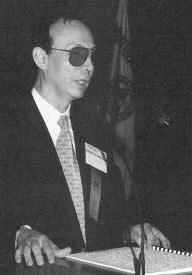
Dr. Fredric K. Schroeder
Politics and Rehabilitation: Serving the Customer,
Serving the Agency, Serving the Public
by Fredric K. Schroeder, Ph.D.
Commissioner
Rehabilitation Services Administration
U. S. Department of Education
**********
From the Editor: On Monday afternoon, July 5, Dr. Fred Schroeder addressed the
convention. As Commissioner of the Rehabilitation Services Administration he is in many
ways the single most influential professional in the blindness field today. In a year in
which we have sustained perhaps more attacks on separate agencies serving blind consumers
than ever before, his unequivocal endorsement of separate agencies and specialized
services was much needed encouragement and reassurance of RSA's recognition that the
separate agency is the service-delivery-system model most likely to provide effective
rehabilitation to blind Americans.
Contrast Dr. Schroeder's outspoken support for separate service-delivery agencies
with the position held by the National Council on Disability (NCD), an independent federal
agency which provides policy guidance to the Executive and Legislative branches of the
federal government. A couple of years ago, when the entire blindness field was fighting to
insure that the Rehabilitation Act reauthorization process did not result in language
supporting generic agencies slipping into the amendments, the NCD published a position
paper against separate agencies for the blind, and every organization in the blindness
field immediately criticized the Council, forcing it to back down. As a result it has
never taken an official stand on the matter. It continued to remain silent on the question
of separate agencies throughout the entire reauthorization process. Then, after the dust
had settled and the amendments were in place, NCD staff members published "National
Disability Policy: A Progress Report, November 1, 1997, to October 31, 1998." The
following passage appears in this document: "The Rehabilitation Act Amendments of
1998 were nonetheless disappointing in not going further in some areas. The illogical
division between the administration of VR services to people with visual disabilities and
all other disabilities was not addressed." That's what NCD staff said about separate
agencies once the coast was clear. In other words, the National Council on Disability is
perfectly prepared to speak out of both sides of its mouth. When the heat is on and an
entire field rises up in protest at its biased and short-sighted views, it is happy to
stay out of the separate-agency discussion, but having yielded to political pressure from
one segment of the disability field, its staff was eager to pop up with criticism once the
heat was off.
No one will ever criticize Dr. Schroeder for being equivocal on important matters
like separate agencies. This is what he said to the delegates at the 1999 Convention of
the National Federation of the Blind:
**********
Let me begin by updating you on important changes to the Rehabilitation Act of
1973, as amended (hereafter the Act) as a result of last year's reauthorization. One
change, about which we felt most strongly, was the need for presumptive eligibility for
recipients of Social Security Supplemental Income (SSI) and for beneficiaries of Social
Security Disability Insurance (SSDI). The Act now recognizes that individuals who have
been determined eligible for either SSI or SSDI should not have to demonstrate any
additional evidence of need for rehabilitation services to go to work.
Another important change is the recognition that not all people need the same level
of assistance in selecting an employment goal or in identifying needed services. The 1998
Amendments to the Act include a new provision allowing people to develop their own
rehabilitation plans or to seek assistance from a rehabilitation counselor or, for that
matter, to seek assistance from anyone else they may choose.
In the prior reauthorization of the Act the National Federation of the Blind sought
an amendment explicitly providing for individual choice in the rehabilitation process. The
1998 Amendments build on the earlier Amendments by consolidating and strengthening the
choice provisions. All in all, we believe that the 1998 Amendments continue to support
critical provisions in the Act, provisions recognizing the importance of informed choice,
the importance of ready access to services, and the importance of quality employment
tailored to the unique interests and abilities of each individual.
The Rehabilitation Act Amendments are included in a larger piece of legislation
known as the Workforce Investment Act (WIA) of 1998. The WIA seeks to improve employment
opportunities by consolidating dozens of employment programs and creating a seamless
system of job-related services that are delivered through local and regional one-stop
service centers. The unique aspects of the rehabilitation program are well defined in the
Act, and adequate protections exist to insure the organizational integrity of the
rehabilitation program and to insure that rehabilitation funds continue to be used only
for rehabilitation purposes. Nevertheless, as the vocational rehabilitation program
becomes an integral part of state workforce investment systems--systems that stress
short-term interventions to assist people in obtaining demand-side occupations, the
rehabilitation system will be increasingly pressed to function more and more like the
generic system.
I am concerned that consolidation of employment programs, with its corresponding
de-emphasis of specialization, is responsible for an increase in the number of proposals
in various states to eliminate separate agencies for the blind. These proposals are not
based on data, not based on experience, but rather they are based on the assumption that
consolidation automatically breeds efficiency.
Yet national data support what we have known intuitively--blind people have unique
needs that are best addressed by specialized services provided through separate agencies
for the blind. A study concerning the efficacy of separate programs for the blind is about
to be published by Cavenaugh, Giesen, and Pierce at Mississippi State University. Based on
an analysis of Rehabilitation Services Administration (RSA) national data for fiscal year
1989, they found that, when compared to the more generic combined state rehabilitation
agencies, separate agencies for the blind served people who are more socially and
economically disadvantaged, have more severe visual impairments, and have more secondary
disabilities.
Of all visually impaired individuals, separate agencies for the blind accept a
larger percentage of legally blind people, 52 percent versus 42 percent in combined
agencies. Separate agencies for the blind provide more comprehensive services, that is,
more services to people with the most severe visual impairments, and separate agencies for
the blind invest on average 61 percent more money in training and other services, $3,597
versus $2,241 in combined agencies. With such a strikingly greater investment, it is not
surprising that separate agencies for the blind have a higher rehabilitation rate; that
is, they are successful with a higher percentage of people who are accepted for and
receive rehabilitation services. And, contrary to the commonly held belief, separate
agencies close a lower percentage of legally blind people as homemakers; and perhaps most
significant, people served by separate agencies for the blind are nearly twice as likely
to be self-supporting at closure.
The finding of better wages is supported by a more recent analysis by Cavenaugh on
FY 1996 data which concluded that the competitive employment rate of legally blind clients
was significantly higher in separate agencies for the blind. These findings and other
studies argue for a policy of continued support, in fact, a policy of increased support
for separate agencies for the blind. Yet proposals to consolidate programs for the blind
with generic services continue.
What then to do? In recent times the word "politics" has become
pejorative at best, virtually synonymous with partisan bickering, posturing, and gridlock.
Yet politics is nothing more than the process by which people express their collective
views and seek to create change according to those views.
Of course there has been a long history of blind people supporting separate
agencies for the blind, and, when I speak of support, I am speaking of political support.
Of course blind people are no strangers to political action. Political support is
absolutely essential for agencies for the blind to withstand all manner of
challenges--threats to funding, threats to staffing levels, and threats to the separate
identity of the agency. But how is political support gained and maintained? How do
agencies for the blind win the confidence and trust and, most important, the loyalty of
blind people in the state? In my view the answer is quite straightforward; it is by
believing in blind people and by recognizing that the blind of the state must have a real
voice in shaping the programs and services of the agency--a partnership resulting in good
jobs with good wages and with good upward mobility potential--good jobs, not simply the
most readily available jobs.
But everyone believes in good jobs, so what are good jobs, and how do blind people
prepare for and obtain high quality employment? Blind people must receive good orientation
training. Good orientation training is the foundation of effective rehabilitation. It
gives blind people the skills and the confidence to pursue a particular occupation or
field. Once a blind person has good orientation training, he or she is ready to plan for
the future--a challenging job, an interesting job, a job with upward mobility potential.
As you know, I strongly believe in the power of education as a way for blind people
to lift themselves out of poverty. Of course not all good jobs require a college
education, and not all blind people want or need college degrees, but for those who have
the interest and aptitude, a college education is a powerful way of improving their
economic status. Karier (1998) in a study entitled "Welfare Graduates: College and
Financial Independence" compared what happens to people with four-year degrees,
two-year degrees, high-school degrees, and no degree. There are three pieces of
information for each of the four categories: 1) average annual wages, 2) percent in
poverty, and 3) unemployment rate. Beginning with earnings, the data show that people with
four-year degrees have average annual wages of $37,224. People with two-year degrees have
average wages of $26,363. Those with high school diplomas have average wages of $20,248.
And finally people who lack high school diplomas have average wages of $13,697. Look at
the range. Those with no degree earn $13,697, and those with four-year degrees earn
$37,224, nearly three times as much. Now look at poverty. One and one half percent of
people with four-year degrees are in poverty. For people with two-year degrees, 3.3
percent are in poverty. For those with high school diplomas, 6.1 percent are in poverty.
Finally, for people who lack high school diplomas, 17.2 percent are in poverty. Again look
at the range. No high school diploma, 17.2 percent in poverty, compared to 1.5 percent of
people with four year degrees.
Unemployment also tracks with education. The unemployment rate is 2.8 percent for
people with four-year degrees, 3.8 percent for people with two-year degrees, and 6.1
percent for people with high school diplomas. And for people with no degree the
unemployment rate is 11.6 percent. What a striking difference. Those with no degree have
an 11.6 percent unemployment rate while those with four-year degrees have an unemployment
rate of only 2.8 per cent.
But these data are for the general population; what about blind people? As is often
the case, data do not exist specific to blind people, but there are data for people with
disabilities which give at least some idea about the relationship between education and
employment for the blind. For people with disabilities, labor force participation is
nearly three times greater for college graduates than for people without high school
diplomas. The 1997 Current Population Survey (CPS) published by the U.S. Bureau of the
Census indicates that 18 percent of people with work disabilities with less than a high
school education are in the labor force compared with 53 percent of people with work
disabilities who are college graduates. Yet RSA data from FY 1997 indicate that for people
who were successful in finding employment, just 15 percent received college or university
training. With this meager investment in higher education, it is not surprising that only
17 percent were employed in professional occupations.
These findings are consistent with the findings of a longitudinal study of the
Vocational Rehabilitation Services Program. As I discussed with you last year, the Third
Interim Report found that people with less than a high school diploma who were
successfully placed in employment earned $6.30 per hour, compared with $9.07 for those
with any degree beyond a high school diploma.
The Office of Special Education Programs (OSEP) within the U.S. Department of
Education has also conducted a longitudinal study (Wagoner, 1992). Findings indicate that
a majority of youth with disabilities do not enter the labor market, nor do they enter
four-year college programs. The OSEP study found that, three to five years after high
school, 57 percent of youth with disabilities were employed, but only 43 percent full
time, and only 40 percent earned more than $6 per hour. Of those employed, the largest
single occupational group (26 percent) was employed as laborers while the second smallest
occupational group (7 percent) was employed in professional/managerial/sales occupations.
And for youth with disabilities, only 6 percent attended four-year college programs.
The June, 1999, Post-secondary Education Descriptive Analysis Reports (PEDAR)
indicate that students with disabilities, despite being qualified, are less likely than
students without disabilities to enroll in four-year programs. But here is the important
finding, PEDAR data also show that students with disabilities who finish a four-year
program have employment outcomes and graduate school enrollments similar to students
without disabilities.
The importance of a college education is particularly evident in light of trends in
future employment opportunities. The Bureau of Labor Statistics (BLS) projects that
through 2006 most of the occupations with the highest expected number of new jobs will
require higher education.
We know that undergraduate and graduate degrees lead to better jobs with better
wages and the opportunity to become self-supporting. We also know that good jobs lead to
political support by blind people in the state. The challenges facing separate agencies
for the blind are significant, but the support of a dedicated and loyal constituency is
also significant. Unfortunately, some rehabilitation agencies view their responsibility to
be accountable solely in terms of dollars, rather than in terms of high-quality
employment. Rehabilitation agencies need to economize, but they must not compromise
quality for the sake of saving money. It takes money, and a good bit of it, to prepare
blind people for good jobs, but good jobs have always been and will always be the
cornerstone of successful, well run rehabilitation programs. Not all good jobs require a
college degree, but college training is a powerful example of the cost-benefit
relationship between training and high-quality employment. Pursuing a four-year degree is
expensive, but there are few if any other types of training that can demonstrate such a
dramatic and consistent impact on earnings. We want people to go to work, but we want
people to have jobs that afford them opportunities for a good standard of living, an
opportunity to pursue a career with the chance to advance.
I am very concerned about the move toward generic services. Loss of specialization
inevitably leads to short-sighted policies with short-sighted measures of success. The
measure of success in the rehabilitation program is not simply the number of people who go
to work, but rather it is the quality of that work and the degree to which it affords the
individual an opportunity to use fully his or her own talents and abilities. The true
measure of success is the degree to which blind people and others are fully integrated
into the social and economic mainstream--the degree to which blind people work in all
types of jobs, from lawyers to factory workers, from teachers to carpenters, from laborers
to stock brokers. Not all good jobs require a college education, and not all blind people
want or need college degrees, but all blind people deserve the opportunity to live with
dignity. All blind people deserve the opportunity to receive good orientation center
training as the foundation to effective rehabilitation. All blind people deserve the
opportunity to seek services from an agency that believes in the capacity of blind people
and demonstrates that belief through its willingness to invest in the training and
assistance blind people need to obtain good jobs. And all blind people deserve the
opportunity to have a good job and a good standard of living, according to their own
interests and abilities.
Dr. Maurer recently spoke before the annual meeting of the National Council of
State Agencies for the Blind. He told the group that strong programs for the blind cannot
exist without strong organizations of the blind. There are both truth and wisdom in Dr.
Maurer's words. For agencies for the blind to withstand threats to their funding, to
withstand threats to their staffing levels, and to withstand threats to their separate
status, they need the support--yes, the political support--of well-organized, committed
blind people in the state. Political support is born of trust and mutual respect. This
fact has always been true, but its importance has never been greater or more immediate.
Dr. Jernigan demonstrated the power of political support, the power of partnership,
when he built the finest and most successful program for the blind that has ever been. As
Dr. Maurer told us earlier this week, programs for the blind need true partnership with
blind people, and blind people need true partnership with programs for the blind. The
future for separate agencies for the blind lies in a strong and well organized
constituency, and the opportunity for blind people to receive good training and good jobs
lies in strong programs for the blind. Our futures are inseparably intertwined. The future
for us all, the future for blind people and the future for agencies for the blind, lies in
our ability to forge a real and true partnership.
**********
**********