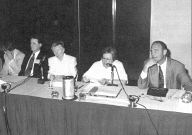
Sheryl Pickering reads a resolution during the Resolutions Committee meeting Thursday, July 1. Left to right at the head table are Peggy Elliott, Dr. Maurer, Sharon Maneki, Sheryl Pickering, and Jim Gashel.
Resolutions Adopted by the Annual Convention of
National Federation of the Blind, July 6, 1999
by Sharon Maneki
**********
By long-standing tradition the NFB Resolutions Committee meets on the first day of
convention registration. This year the committee met on July 1. Since the committee is
charged with the responsibility of determining which resolutions will be brought to the
convention floor for consideration, the committee always has a large membership,
representing all segments of our diverse Federation family. There were forty-two members
of the committee this year. When Mrs. Walhof took on duties involving our capital
campaign, President Maurer appointed me to chair this important committee. The experience
was both challenging and fun.
This year we had tremendous participation in the resolutions process. Resolutions
were sponsored by students, division presidents, and leaders in many state affiliates.
During its meeting the committee thoroughly discussed and debated the issues raised in the
resolutions. The final session of the convention is traditionally reserved for discussion
and voting on resolutions because these documents will become the policies of our
organization. One resolution, 99-10 concerning non-valid standardized test scores, was
debated for an entire hour during this convention session. Twenty-one people debated the
pros and cons of this resolution. Ultimately the Convention voted to defeat 99-10. I feel
confident that this subject will be back for discussion in another resolution next year.
The committee considered nineteen resolutions. While some of the subjects were
familiar: Social Security Disability, rehabilitation, education, and access to
technology--they encouraged the organization to try new approaches to solve longstanding
problems.
Resolution 99-03, sponsored by Priscilla McKinley, a graduate student and leader in
the NFB of Iowa, calls upon the 106th Congress to pass S 285 and HR 1601, which would
allow blind recipients of Social Security Disability Insurance to earn the same amount of
income as seniors receiving the Social Security retirement benefit because this is the
best way to promote work opportunities for the blind.
This year we passed six resolutions concerning rehabilitation. Resolution 99-02,
sponsored by Edward Bell, who just graduated from college and is teaching at the Louisiana
Center for the Blind summer program, reaffirms our commitment to maintain separate
agencies for the blind by ensuring that all states follow the regulations in the Workforce
Investment Act to maintain identifiable services for the blind.
Two resolutions concerned the Randolph-Sheppard Act. Resolution 99-05, sponsored by
Kristen Cox, a recent addition to the National Center Staff in the Governmental Affairs
Department, demands that the Committee for Purchase from People Who Are Blind or Severely
Disabled remove any services provided through vending facilities under the
Randolph-Sheppard Act from their procurement list and end its current practice of trying
to destroy the Randolph-Sheppard program. Resolution 99-06, sponsored by James Gashel,
Director of Governmental Affairs, concerns vending facilities.
Resolution 99-07, sponsored by Noel Nightingale, a newly elected member of the NFB
Board of Directors and President of the NFB of Washington, calls upon the Commissioner of
the Rehabilitation Services Administration to issue a policy directive to states to
include the clear messages that barriers to informed choice such as erroneous calculations
of costs are unacceptable and that states are required to provide information to consumers
about alternative providers of rehabilitation services.
Resolution 99-08, sponsored by Lynn Mattioli, First Vice President of the NFB of
Maryland, urges state rehabilitation agencies to provide competent computer training with
provisions to continue training to keep up with changing technology for blind clients. The
resolution also stresses the need to provide appropriate hardware and software so that the
client can maintain skills between the time of training and the time of actual employment.
Resolution 99-09, sponsored by Christine Hall, President of the National
Organization of the Senior Blind, urges Congress and the Administration to amend the Older
Americans Act to include enabling legislation for programming and funding in increased
amounts for rehabilitation services for older blind and visually impaired individuals.
Three resolutions concerned education issues. Resolution 99-10, sponsored by
Michael Bailiff, a tax attorney and frequent contributor of articles to the Braille Monitor, calls upon Congress to pass
legislation requiring institutions who use standardized tests as part of their admission
procedures to provide an alternative mechanism that does not rely on the use of
non-validated test scores. This resolution was defeated by the convention. We have been
wrestling for more than twenty years with the problem of testing authorities' insisting
that tests taken by applicants who receive reasonable accommodations are not valid. I am
sure that we will see future resolutions on this subject.
Resolution 99-16, sponsored by Shawn Mayo, President of the National Association of
Blind Students, petitions the U. S. Department of Justice to create a rule to change the
definition of a qualified reader to allow the blind the option to choose their own readers
and the right to decide whether they will bring a personal reader to a test site.
Resolution 99-12, sponsored by Pam Dubel, the Director of Youth Services at the
Louisiana Center for the Blind, calls upon the U. S. Department of Education to reconsider
and revise its interpretation of the Braille services provision included in the 1997
amendments to IDEA. The proper interpretation of this law should require the school to
provide Braille instruction to a student while waiting for a dispute among members of the
IEP team to be resolved.
The convention passed three resolutions concerning access to print information.
Resolution 99-01, sponsored by Brian Miller, a graduate student and leader in the NFB of
Iowa, urges cooperation between the publishing industry and the Library of Congress to
make digital editions of published texts widely available to the blind. The resolution
also declares our firm intent to promote legislation that will bring about universal
access to the printed word for the blind of this nation.
Resolution 99-14, sponsored by Connie Leblond, President of the National
Association of Blind Entrepreneurs, calls upon the Small Business Administration, its
state partners, the American Banking Association, and other economic development centers
to adopt a proactive approach by planning ahead for the provision of materials in Braille.
The National Association of Blind Entrepreneurs will supply the names and locations of
Braille transcription services to these entities.
Resolution 99-15, sponsored by Alpidio Rolon, President of the NFB of Puerto Rico,
urges manufacturers of adaptive technology to provide their manuals and instructional
materials in Spanish.
The convention passed three resolutions concerning nonvisual access to technology.
Resolution 99-17, sponsored by Christopher Danielsen, a leader in the NFB of South
Carolina, who chairs its resolutions committee, calls upon the Access Board to adopt a
proactive strategy promoting government-wide enforcement of standards to insure ready,
unimpeded access by blind citizens and employees to information controlled and managed by
the federal government. The resolution also calls on all departments and agencies in the
federal government to adopt and implement procurement procedures that comply with section
508 of the Rehabilitation Act as amended in 1998.
Resolution 99-18, sponsored by Gary Wunder, a member of the national Board of
Directors and President of the NFB of Missouri, calls upon manufacturers of automated
teller machines and the banking industry to incorporate speech output and universal
discernible tactile keypads in their machines so that they are useable by the blind
without the need for sighted assistance.
Resolution 99-19, sponsored by Nathanael Wales, an engineering student and leader
in the NFB of California, insists that blind persons have access to all new electronic
voting machines and interfaces. The resolution also affirms the blind person's right to
use another individual to assist with voting if he or she wishes to use that method of
voting.
Resolution 99-04, sponsored by Dr. Abraham Nemeth, a noted blind mathematician and
author of the Nemeth Braille code, calls upon the Federation to reject the Unified Braille
Code. The committee rejected this resolution, so it did not reach the convention floor.
Resolution 99-11, sponsored by Scott LaBarre, President of the National Association
of Blind Lawyers, reaffirms this organization's position that audible traffic signals
should be pedestrian-activated and should be considered on a case-by-case basis with input
from consumer organizations, particularly the National Federation of the Blind. The
resolution also states that highway officials should not assume that the provision of
federal funds for audible traffic signals means that such signals are automatically
necessary.
Resolution 99-13, sponsored by James Gashel, takes Western Michigan University to
task for creating a certification program for mobility instructors without bothering to
seek any input from blind consumers.
The texts of the resolutions passed at the 1999 convention follow.
**********
**********
Resolution 99-01
**********
WHEREAS, our American political, economic, educational, and social systems are
rooted in timely access to published information, but timely access is exactly what the
blind are consistently denied by the fact of not being able to read printed communications
without assistance or technology to provide access; and
**********
WHEREAS, timely access is crucial for the blind to be competitive, well-informed,
engaged citizens; and
**********
WHEREAS, the barriers to access resulting from exclusive use of print media need
not exist in the future as advances in communications and publishing occur, particularly
involving the use of digital text; and
**********
WHEREAS, advancements in publishing technology are being planned and carried out
largely without regard to access by the blind, resulting in the use of methods such as the
"portable document format" which, although relying upon electronic
communications technologies, is still not accessible to the blind; and
**********
WHEREAS, The National Library Service for the Blind and Physically Handicapped
(NLS) was established as a part of the Library of Congress in 1931 to provide blind
persons with reading matter in Braille and audio recordings and could now extend its scope
of service to include development and administration of standards for the preparation of
digital text in formats suited to non-visual access; and
**********
WHEREAS, achieving universal access to the printed word by the blind will require a
Congressional enactment to compel production and provision to a central authority such as
NLS of books in compliance with a universal standard along with safeguards that the
central authority will allow the newly-available information to be used only by eligible
blind persons and agencies providing them material in specialized formats: Now, therefore,
**********
BE IT RESOLVED by the National Federation of the Blind in convention assembled this
sixth day of July, 1999, in the City of Atlanta, Georgia, that this organization insist
upon the prompt development and implementation of standards for non-visual access with the
goal of cooperation between the publishing industry and the Library of Congress in order
to make digital editions of published text widely available to the blind; and
**********
BE IT FURTHER RESOLVED that this organization declare its firm intent to seek
appropriate legislation in the Congress to implement standards and procedures that will
bring about universal access to the printed word for this country's blind citizens.
**********
**********
Resolution 99-02
**********
WHEREAS, the Workforce Investment Act (WIA), enacted August 7, 1998, directs all
state vocational rehabilitation agencies to make plans to coordinate their programs with
generic job-training and employment services programs while maintaining identifiable
services for the blind and disabled; and
**********
WHEREAS, maintaining a strong link between service delivery agencies for the blind
and general employment and training agencies can promote integration of the blind into the
workplace; and
**********
WHEREAS, long experience has shown that specialized training in the skills and
confidence needed by the blind is essential for blind persons to succeed in competitive
employment; and
**********
WHEREAS, long, sad experience has also shown that specialized blindness training
cannot and will not occur in generic job training programs that try to be all things to
all people; and
**********
WHEREAS, after passage of WIA, several states (such as Texas, North Carolina,
Massachusetts, South Dakota, and Minnesota) have misapplied its fundamental concepts by
attempting to consolidate rather than coordinate programs, proposing various approaches to
submerge services for the blind into larger agencies such as general vocational
rehabilitation or human services agencies; and
**********
WHEREAS, history has amply demonstrated that absorption of specialized blindness
training into larger bureaucratic structures will result in poor and inadequate training
to prepare blind people to enter the workforce; and
**********
WHEREAS, federal regulations set forth to implement WIA specify that programs such
as those which serve the blind are authorized to continue their operations without threat
of merger with larger programs because of WIA; and
**********
WHEREAS, in order to address the 70 percent unemployment rate among blind persons
of working age and to avoid that unemployment rate's rising even higher, the boundaries
and lines of authority between blindness rehabilitation services and one-stop job training
centers defined in WIA must be understood and emphasized by maintaining an identifiable
service-delivery system designed to provide blind people with the specialized,
blindness-related services that generic job training agencies are not set up to provide:
Now, therefore,
**********
BE IT RESOLVED by the National Federation of the Blind in convention assembled this
sixth day of July, 1999, in the City of Atlanta, Georgia, that we call upon all states to
implement WIA in a way that maintains separate identifiable services for the blind; and
**********
BE IT FURTHER RESOLVED that this organization reaffirm its determination to prevent
adoption of legislation in the states which would result in a one-size-fits-all, one-stop
shopping approach instead of providing essential, specialized services, since the failure
to do so will ultimately bring to a halt the current progress toward full and equal
integration of the blind into the workforce.
**********
**********
Resolution 99-03
**********
WHEREAS, the blind face an unemployment rate that is in excess of 70 percent; and
**********
WHEREAS, the single factor that contributes more to this unemployment rate than any
other is the earnings limit in the Social Security Disability program which terminates
eligibility for blind recipients who earn a gross wage of $1,110 per month, often
resulting in a substantial loss of real income for beneficiaries who work and earn above
the statutory limit; and
**********
WHEREAS, the loss of income caused by working may also be coupled with
substantially increased premiums just to maintain health insurance coverage under Medicare
or another health insurance program; and
**********
WHEREAS, Congress in 1996 responded to the pleas of seniors who faced a similarly
low earnings limit by raising the limit even though most seniors have worked for many
years and lose only one dollar for every three dollars earned, unlike blind people, who
face an abrupt loss of income due to work; and
**********
WHEREAS, Senator John McCain and Congressman Robert Ehrlich have introduced
legislation to restore the policy of an identical earnings threshold for blind people and
age-sixty-five retirees; and
**********
WHEREAS, this legislation would provide blind persons with the same exemption of
earnings now provided to age-sixty-five retirees as a work incentive; and
**********
WHEREAS, a higher earnings exemption would bring forth a positive response from
blind people and bring additional revenues to the Social Security Trust Funds and general
revenues as the blind move into the work force in greater numbers than ever before: Now,
therefore,
**********
BE IT RESOLVED by the National Federation of the Blind in convention assembled this
sixth day of July, 1999, in the City of Atlanta, Georgia, that this organization call upon
the 106th Congress, particularly the members of the Senate Finance Committee and the House
Ways and Means Committee, to endorse this legislation--S. 285 and HR 1601--and approve its
passage, since, as in the case of retirees, this is the best way to promote work
opportunities for the blind.
**********
**********
Resolution 99-05
**********
WHEREAS,
the Randolph-Sheppard Act provides a legally enforceable priority for blind persons to
operate vending facilities on federal property; and
**********
WHEREAS,
the Javitts-Wagner-O'Day Act (JWOD) promotes employment in direct-labor jobs for blind and
disabled persons by awarding government procurement contracts to qualified non-profit
agencies; and
**********
WHEREAS, federal administration of the JWOD Act is vested in an agency known as the
Committee for Purchase from People Who Are Blind or Severely Disabled (the Committee),
which publishes a list (referred to as the procurement list) of products and services that
federal agencies must buy from eligible JWOD agencies; and
**********
WHEREAS, in publishing the procurement list under the JWOD Act, the Committee has
complete discretion in deciding which products and services to include or exclude, but by
contrast compliance with the Randolph-Sheppard priority for the blind is not discretionary
with any federal agency and is required whenever vending facility services are provided on
federal property; and
**********
WHEREAS, despite the unequivocal Congressional priority for the blind to provide
vending facility services on federal property, the Committee has placed federal food
vending services on the JWOD procurement list; and
**********
WHEREAS, the Committee has persisted in making aggressive assaults upon the
Randolph-Sheppard priority for the blind at the behest of NISH (formally known as National
Industries for the Severely Handicapped) and its member agencies such as Easter Seals,
Goodwill Industries International, the ARC, Jewish Vocational Services, United Cerebral
Palsy Associations, and WORK�TECH; and
**********
WHEREAS, NISH and its member agencies can perform their mission of creating job
opportunities for severely disabled persons by providing the federal government with all
the many other products and services on the JWOD procurement list and do not need to add
federal food services in contravention of the Randolph-Sheppard Act to achieve their
goals; and
**********
WHEREAS, even without competition from NISH and its large member agencies, the
Randolph-Sheppard Program already faces stiff obstacles in establishing large-scale
food-service businesses on federal property which comes from wealthy and well-financed
commercial food service operators willing to spend millions to acquire the locations
accorded to blind vendors by the Randolph-Sheppard priority; and
**********
WHEREAS, the Secretary of Education is charged in the Randolph-Sheppard Act with
the responsibility of government-wide leadership to insure compliance with the act by all
federal property managers and, in implementation of this duty, has adopted a policy which
seeks to uphold the priority for blind vendors, while recognizing that the JWOD priority
applies to the procurement of many other products and services that are unrelated to items
sold at vending facilities: Now, therefore,
**********
BE IT RESOLVED by the National Federation of the Blind in Convention assembled this
sixth day of July, 1999, in the City of Atlanta, Georgia, that this organization commend
the Secretary of Education for standing tall in support of the independent business
opportunities provided to blind persons under and pursuant to the Randolph-Sheppard Act;
and
**********
BE IT FURTHER RESOLVED that this organization demand that the JWOD Committee
exercise its discretion and forbearance by removing any services provided through vending
facilities under the Randolph-Sheppard Act from the procurement list; and
**********
BE IT FURTHER RESOLVED that this organization register its fervent opposition to
the efforts being made by NISH and its member agencies to destroy the Randolph-Sheppard
Program and call upon these groups to use their creative energies to expand employment
opportunities on behalf of persons with disabilities without resorting to a policy of
jealous attacks upon opportunities already provided to the blind by law.
**********
**********
Resolution 99-06
**********
WHEREAS, the most fundamental and overarching requirement of the Randolph-Sheppard
Act is the priority granted to blind persons to operate vending facilities on federal
property; and
**********
WHEREAS, regulations prescribed to implement the Act define the phrase
"satisfactory site," for the purpose of reserving space for vending facilities
in the acquisition and alteration of federal property; and
**********
WHEREAS, the regulations, but not the law, provide an exemption from the
satisfactory-site requirements when fewer than one hundred federal employees are on duty
during normal working hours, or, in the case of buildings with less than fifteen thousand
square feet where services are provided to the public; and
**********
WHEREAS, this exemption from the satisfactory-site requirements is being
interpreted by some agencies (most notably the United States Postal Service) as an
exemption from the rest of the Randolph-Sheppard Act, and especially from the
priority-for-the-blind provisions of the Act; and
**********
WHEREAS, these same agencies often provide for vending facility services by
contracting with commercial firms rather than abiding by the blind vendor priority to meet
the needs of their employees and the public, a practice which flagrantly violates the
Randolph-Sheppard Act; and
**********
WHEREAS, the satisfactory-site exemption, which applies to buildings of low
population and small size, is not an exemption from the Randolph-Sheppard Act altogether,
and should not be interpreted as such: Now, therefore,
**********
BE IT RESOLVED by the National Federation of the Blind in convention assembled this
sixth day of July, 1999, in the City of Atlanta, Georgia, that this organization seek the
cooperation of all federal property managing agencies in applying the blind priority
provisions of the Randolph-Sheppard Act to all buildings and facilities; and
**********
BE IT FURTHER RESOLVED that the Commissioner of the Rehabilitation Services
Administration in the United States Department of Education is hereby requested to issue
an interpretive-guidance memorandum to all federal agencies and state licensing agencies
to clarify the coverage of the Randolph-Sheppard Act in regard to all federal property,
regardless of building population or size.
**********
**********
Resolution 99-07
**********
WHEREAS, in the Rehabilitation Act, Congress explicitly recognized that disability
generally and blindness specifically are natural parts of the human experience and in no
way diminish the right of individuals to live independently, enjoy self-determination,
make choices, contribute to society, pursue meaningful careers, and enjoy full inclusion
and integration in the economic, political, social, cultural, and educational mainstream
of American society; and
**********
WHEREAS, in the light of years of experience in which rehabilitation professionals
pretended partnership but exercised absolute control over all rehabilitation decisions by
forcing clients to accept whatever the professional decided, Congress amended the
Rehabilitation Act in 1992 to provide that consumers of rehabilitation services have the
right to informed choice throughout the rehabilitation process, including the right to
make meaningful and informed choices about vocational goals, the means of achieving those
goals, and the service providers to be used in reaching those goals; and
**********
WHEREAS, through the informed-choice provisions Congress specifically intended to
empower consumers in the rehabilitation process, resulting in consumers' self-sufficiency
instead of dependency; and
**********
WHEREAS, in addition to the increase in successful rehabilitations, a secondary
benefit of the implementation of informed choice is the creation of a powerful incentive
for service-providers to improve services by responding to consumers' demands; and
**********
WHEREAS, historically, state-operated adjustment and training programs for the
blind have not emphasized positive expectations for the capabilities of blind people and
have largely provided ineffective adjustment and training as a result; and
**********
WHEREAS, in response to blind consumers' demands for better training, alternative
private nonprofit adjustment and training centers for the blind have been established
which emphasize positive attitudes and graduate hundreds of clients who go on to complete
their rehabilitation by finding competitive employment; and
**********
WHEREAS, many state rehabilitation agencies thwart the informed choice of blind
consumers by refusing to send them to alternative adjustment and training programs which
they wrongly claim are more costly or by agreeing to pay per month only the equivalent of
the agency's artificially reduced cost; and
**********
WHEREAS, many state rehabilitation agencies significantly understate the actual
cost to them of their adjustment and training programs by deliberately excluding the cost
of administration and other overhead from their calculations of comparative costs and also
by assuming that they will serve inflated numbers of clients, thus spreading the cost per
student over a higher number and artificially reducing their per-student cost; and
**********
WHEREAS, even where no financial barriers are erected to the selection of
alternative services, many state rehabilitation agencies do not provide adequate
information about the availability of alternatives to state-operated adjustment and
training programs; and
**********
WHEREAS, these barriers erected by many state rehabilitation agencies to the
selection of alternative services deprive consumers of the opportunity to make a truly
informed choice: Now, therefore,
**********
BE IT RESOLVED by the National Federation of the Blind in convention assembled this
sixth day of July, 1999, in the City of Atlanta, Georgia, that this organization call upon
the Commissioner of the Rehabilitation Services Administration in the United States
Department of Education to issue a policy directive providing appropriate guidelines to
states for implementing the informed-choice requirements of the Rehabilitation Act as they
relate to the provision of pre-vocational adjustment and training programs, including
adjustment and training programs for blind persons, and to include in such guidelines the
clear messages that barriers to informed choice based on erroneous calculations of costs
are not acceptable and that failure to provide consumers with accurate and complete
information about alternative providers of rehabilitation services is likewise not
acceptable.
**********
**********
Resolution 99-08
**********
WHEREAS, approximately 70 percent of blind people are unemployed; and
**********
WHEREAS, today the majority of jobs require or assume some degree of computer
literacy or technology training; and
**********
WHEREAS, timely, effective, and meaningful computer and adaptive-equipment training
for blind persons is crucial for securing and maintaining employment; and
**********
WHEREAS, too often blind people receive initial computer or technology training but
have no provision in their plan for rehabilitation or means to keep their skills up to
date once the training is complete, thus perpetuating their state of computer illiteracy
in relation to the jobs for which they are competing; and
**********
WHEREAS, those providing computer and adaptive-technology training are often not
competent users of either the technology or the blindness-specific adaptations themselves:
Now, therefore,
**********
BE IT RESOLVED by the National Federation of the Blind in convention assembled this
sixth day of July, 1999, in the City of Atlanta, Georgia, that this organization call upon
state rehabilitation agencies and other facilities with whom they contract for training to
make timely, effective, and meaningful computer and technology training a priority when
plans for rehabilitation are written and implemented, including provisions for subsequent
client training as technology changes; and
**********
BE IT FURTHER RESOLVED that this organization call upon agencies that provide
funding and training to state rehabilitation clients to provide access to both hardware
and software to trainees and those already trained, continuously from the time the
individual begins training until he or she is successfully employed; and
**********
BE IT FURTHER RESOLVED that this organization demand that training be provided by
individuals who are competent in using all the relevant technology themselves and that
compensation for persons hired to do the training be adequate to attract skilled people.
**********
**********
Resolution 99-09
**********
WHEREAS, the majority of blind and visually impaired individuals first experience
severe vision loss at age fifty-five or older; and
**********
WHEREAS, the population of seniors who are also blind or visually impaired is
expected to double by the year 2020; and
**********
WHEREAS, Congress currently recognizes the need for rehabilitation services for
older blind Americans in Title VII, Chapter 2 of the Rehabilitation Act although the
current funding level is only $11.2 million for services throughout the entire country;
and
**********
WHEREAS, No reliable statistics exist on the exact number of seniors who are blind
although the figure is generally agreed to be in excess of one million and growing, making
it clear that $11.2 million is only a tiny drop in this huge bucket of need; and
**********
WHEREAS, more and more seniors every year become dependent on expensive nursing
home care due to sight loss, a situation that could be remedied in most cases by simple
rehabilitation training as soon as the need arises in the effective skills of daily living
used routinely by hundreds of thousands of blind men and women throughout our country but
unknown to a person just losing vision who believes that lack of sight means dependence
upon others; and
**********
WHEREAS, the Older Americans Act does not currently provide for the rehabilitation
services desperately needed by many seniors experiencing sight loss, but rather provides
services such as congregate dining, Meals on Wheels, transportation, and recreation to all
seniors; and
**********
WHEREAS, rehabilitation training is essential to allow blind and visually impaired
seniors to continue living in their homes and to remain independent and contributing
members of their communities; and
**********
WHEREAS, a substantial increase in funding for Title VII, Chapter 2 services is
desperately needed at this time in order to assure that a service-delivery system for
older blind individuals will be maintained within each state; and
**********
WHEREAS, an amendment to the Older Americans Act to provide rehabilitation services
for older blind and visually impaired individuals would provide an additional source of
funding for rehabilitation services; and
**********
WHEREAS, funding could and should be provided to train personnel employed by
rehabilitation agencies, senior programs, and other social service providers in
cost-effective ways to assist blind seniors in making the adjustment to poor vision and
blindness; and
**********
WHEREAS, the need is so gigantic and will increase so rapidly that only a series of
planned, substantial increases in funding to both these programs can even begin to address
existing and future problems: Now, therefore,
**********
BE IT RESOLVED by the National Federation of the Blind in convention assembled this
sixth day of July, 1999, in the City of Atlanta, Georgia, that this organization urge
Congress and the Administration to adopt a series of planned increases in funding levels
for Title VII, Chapter 2, to begin bringing rehabilitation services for older blind
Americans closer to the point where the need of this growing population is better
addressed and met; and
**********
BE IT FURTHER RESOLVED that this organization urge Congress and the Administration
to amend the Older Americans Act to include enabling legislation for programming and also
funding in increasing increments for rehabilitation services for older blind and visually
impaired individuals to add more ways of reaching and teaching the members of this able
and woefully under-served population.
**********
**********
Resolution 99-11
**********
WHEREAS, the Transportation Equity Act for the Twenty-First Century (T 21)
authorizes matching federal funds for the installation of audible traffic signals
throughout America; and
**********
WHEREAS, the National Federation of the Blind is on record opposing the wholesale
installation of these signals, as most recently set forth in Resolution 92-06; and
**********
WHEREAS, good independent travel training enables the vast majority of blind people
to negotiate safely and competently virtually all traffic intersections, a fact that would
make wholesale installation of audible traffic signals a wasteful, unnecessary expenditure
of scarce public funds; and
**********
WHEREAS, massive deployment of audible signals will only create an unwise reliance
on electronic devices by blind persons who must rely upon their own senses and skills for
their own safety; and
**********
WHEREAS, audible traffic signals can in fact make intersections more dangerous by
masking the sound of traffic, which blind people rely upon to determine traffic patterns;
and
**********
WHEREAS, activation of the visual walk sign should not also be the means of
activating an audible traffic signal since the interconnection of the two would make use
of audible signals mandatory for everyone whenever the walk sign button is pressed; and
**********
WHEREAS, audible traffic signals may in rare cases be helpful to some blind people
at complicated intersections with con�fusing road patterns; and
**********
WHEREAS, the only practical and effective audible signals are those which are
pedestrian-activated and do not interfere with the sound of traffic; and
**********
WHEREAS, pedestrian-activated audible traffic signals are the only kind of signal
that should ever be installed to assist blind persons and should never be installed at the
demand of one or a small number of blind persons but rather only after giving blind
members of the community and organizations representing the blind a full opportunity to
participate in the decision-making process; and
**********
WHEREAS, many members of the sighted public mistakenly believe that all blind
people must depend on other persons or electronic devices to cross streets safely and
therefore believe they are helping the blind by putting audible traffic signals in the
community: Now, therefore,
**********
BE IT RESOLVED by the National Federation of the Blind in Convention assembled this
sixth day of July, 1999, in the City of Atlanta, Georgia, that this organization reaffirm
its opposition to the wholesale installation of audible traffic signals by state and local
governments; and
**********
BE IT FURTHER RESOLVED that this organization call upon any governmental or other
entity considering the installation of audible signals to consult extensively with elected
representatives of local organizations of the blind, and particularly with the National
Federation of the Blind, before any decision regarding audible traffic signals is made.
**********
**********
Resolution 99-12
**********
WHEREAS, literacy is now viewed as a fundamental right for all Americans in
addition to its crucial roles in independence, employment, and citizenship, and literacy
for blind and visually impaired persons means the ability to read and to write Braille
efficiently; and
**********
WHEREAS, failure to provide Braille instruction on a consistent basis is
detrimental to the development of literacy, future academic success, and employment
prospects of blind and visually impaired children; and
**********
WHEREAS, statistics from the American Printing House for the Blind indicate that
only 10 percent of children who are blind or visually impaired use Braille while in
contrast recent research reveals that 80 percent of successful blind/visually impaired
adults who are employed use Braille every day; and
**********
WHEREAS, these statistics suggest that America's schools are creating a generation
of illiterate, unemployable future blind adults; and
**********
WHEREAS, the 1997 amendments to the Individuals with Disabilities Education Act
(IDEA) require that schools must provide for instruction in Braille and the use of Braille
in the case of each blind and visually impaired child unless the team responsible for
choosing special services for the child determines that such instruction or use of Braille
is not appropriate for the child; and
**********
WHEREAS, the 1997 amendments to IDEA recognize the critical need for Braille
services by placing an affirmative obligation on the team responsible under the law for
planning special services to provide for Braille, absent a specific determination of the
team to the contrary; and
**********
WHEREAS, when disputes arise between the parents and school personnel on the
individualized education plan team about Braille services, any of the parties involved may
submit the dispute to due process procedures (including a hearing) to achieve a
resolution; and
**********
WHEREAS, resolution of these disputes can consume several years, the same critical
learning years during which other children are acquiring and perfecting literacy skills;
and
**********
WHEREAS, until the dispute is settled, the Braille services must be provided under
the law as amended in 1997 since the IEP team has not determined that such services would
be inappropriate for the child; and
**********
WHEREAS, the U. S. Department of Education has incorrectly interpreted the 1997 law
to permit exclusion of Braille services from the IEP in the event of a dispute, an
interpretation which turns the law on its head and essentially nullifies the 1997
amendment: Now, therefore,
**********
BE IT RESOLVED by the National
Federation of the Blind in Convention assembled this sixth day of July, 1999, in the City
of Atlanta, Georgia, that this organization call upon the Department of Education to
reconsider and revise its interpretation of the Braille services provision included in the
1997 amendments to IDEA to the end that Braille services will be provided to blind and
visually impaired children to the fullest extent prescribed by law.
**********
**********
Resolution 99-13
**********
WHEREAS, efforts to develop certification criteria and procedures in the field of
services for the blind have largely failed in the United States because those involved in
designing and implementing the programs have not involved elected representatives of the
blind in their efforts, the most notable of these failures being NAC--the National
Accreditation Council for Agencies Serving the Blind and Visually Handicapped; and
**********
WHEREAS, the latest effort to create a standards and certification program for
professionals in the field of blindness has been announced by Western Michigan University,
proposing to establish standards and a curriculum for instructors in independent travel;
and
**********
WHEREAS, the Western Michigan announcement also indicates that the standards and
curriculum will be developed in conjunction with a number of disability service agencies,
but says nothing about the involvement of consumer organizations of blind people and their
elected representatives; and
**********
WHEREAS, the choice of an alliance with disability service agencies rather than
consumers is inexcusable and cannot be attributed to an oversight, since the architects of
this latest certification scheme are well informed about the blind consumer movement and
have therefore chosen to ignore it; and
**********
WHEREAS, this latest attempt to promote standards and certification in the name of
quality service is essentially a self-serving plan to promote the vision of travel
instruction according to Western Michigan University and to perpetuate that vision without
regard to benefits for blind people: Now, therefore,
**********
BE IT RESOLVED by the National Federation of the Blind in convention assembled this
sixth day of July, 1999, in the City of Atlanta, Georgia, that this organization condemn
and deplore the Western Michigan standards and certification initiative, while recognizing
that the plan itself is an acknowledgement of the other failed efforts in this area; and
**********
BE IT FURTHER RESOLVED that we advise authorities of Western Michigan University
and any other potential sources of financial support for this effort that a project such
as independent travel standards for the blind must first pass muster with the blind
themselves before funds are approved to underwrite the effort.
**********
**********
Resolution 99-14
**********
WHEREAS, entities such as the Small Business Administration, Economic Development
Centers, and banking institutions provide cascades of printed information for the aspiring
small business owner to use in preparing business plans, seeking financing, and guiding
early development of a budding small business; and
**********
WHEREAS, these same sources of information and financing for small businesses are
rarely prepared to furnish blind entrepreneurs with Braille copies of their informational
brochures, applications, and other materials; and
**********
WHEREAS, aspiring blind entrepreneurs need the same information and need it in
Braille for the same reason sighted persons need the information in print--for the
opportunity to study and compare and refer again to important sections; and
**********
WHEREAS, most small business development entities do not provide their vital
information in Braille and do not know how to respond to requests for Braille when such
requests are made; and
**********
WHEREAS, the National Federation of the Blind has consistently supported and
encouraged the production of Braille and access to information; and
**********
WHEREAS, the National Association of Blind Entrepreneurs, a division of the
National Federation of the Blind, was established to encourage and assist blind people in
seeking self-employment opportunities; and
**********
WHEREAS, in the past ten years numerous for-profit Braille transcription services
have been established, often owned and operated by blind entrepreneurs with the skill and
sound business sense that could assist in the timely distribution of Braille information;
and
**********
WHEREAS, these Braille transcription services work by receiving printed material
and turning it into Braille upon order of entities with the need to provide Braille to
customers; and
**********
WHEREAS, the National Association of Blind Entrepreneurs is compiling a list of
Braille transcription services throughout the country to be made available to the American
Banking Association, the Small Business Administration and its state partners, and any
other business development entity that needs to locate a Braille transcription service:
Now, therefore,
**********
BE IT RESOLVED by the National Federation of the Blind in Convention assembled this
sixth day of July, 1999, in the City of Atlanta, Georgia, that this organization urge that
the Small Business Administration, the Administration's state partners, the American
Banking Association, and other economic development centers work with the National
Federation of the Blind and the National Association of Blind Entrepreneurs to make
available the information about the existence of and the locations of Braille
transcription services in order to serve all their blind customers better; and
**********
BE IT FURTHER RESOLVED that this organization urge these entities to adopt a
proactive approach by planning ahead for the provision of materials in Braille, rather
than having to scramble to respond to requests made by blind persons who are seeking to
enter the world of competitive business.
**********
**********
Resolution 99-15
**********
WHEREAS, more and more devices are being adapted to include speech and Braille
output for use by the blind, enabling blind people to be more competitive in education,
employment, and recreation; and
**********
WHEREAS, a growing number of Hispanics with little or no knowledge of English see
assistive technology as a means to further their integration into society; and
**********
WHEREAS, most manuals for adaptive devices for use by the blind have not been made
available in Spanish at all; and
**********
WHEREAS, a few companies have already made available Spanish versions of their
product manuals, but most of these are poorly translated and badly written; and
**********
WHEREAS, this limits the possibilities for employment and advancement for Hispanic
people: Now, therefore,
**********
BE IT RESOLVED by the National Federation of the Blind in convention assembled this
sixth day of July, 1999, in the City of Atlanta, Georgia, that this organization call upon
manufacturers of assistive technology equipment for the blind to make available more and
better Spanish versions of their product manuals.
**********
**********
Resolution 99-16
**********
WHEREAS, the Americans with Disabilities Act (ADA), passed in 1990, provides that
blind people are entitled to reasonable accommodation in situations covered by the Act;
and
**********
WHEREAS, Title II and Title III of the ADA and their implementing regulations do
not define "qualified reader"; and
**********
WHEREAS, one cause of trouble for blind persons prior to the ADA has not been
resolved by the Act, whose provisions have actually made situations harder for blind
persons: the area of readers for standardized tests; and
**********
WHEREAS, prior to the ADA blind people could often negotiate with testing
authorities for permission to bring their own personally trained readers to standardized
tests, the taking of which was then proctored by the testing authority to preserve test
security; and
**********
WHEREAS, since passage of the ADA, every large testing authority in the United
States has interpreted the term "qualified reader," a reasonable accommodation
for the blind under the ADA, to mean that the testing authority both provides and pays for
the reader; and
**********
WHEREAS, there is no national standard for reading to the blind similar to the
national standards for interpreting for the deaf and hearing-impaired; and
**********
WHEREAS, this lack of definition of "qualified reader" and the myth that
there is such a thing as a set of qualified readers just as there are qualified
interpreters for the deaf has led testing authorities and other entities to appoint anyone
they choose, while pretending the reader meets some non-existent standard, to serve as a
reader for a blind person in the highly charged testing context; and
**********
WHEREAS, each blind person trains his or her readers to suit his or her own
personal style since the method of using a human reader is identical in concept to using
one's own eyes and brain with the addition of another person to do the seeing and
vocalizing; and
**********
WHEREAS, the vast differences among human beings result in different styles by
different blind people for this very person�al task such as the development of
unverbalized instructions and expectations as the team of blind person and human reader
work together; and
**********
WHEREAS, imposing an unknown or very new reader on a blind person in the stressful
context of standardized testing does not permit the blind person's ability to succeed in
the test to be accurately assessed since the blind person is training a reader while
taking the test, resulting in a test score that measures the blind person's ability to
train a new reader under stress rather than the blind person's ability to pass the test;
and
**********
WHEREAS, the blind person is harmed and put at a disadvantage through the failure
to have necessary and relevant information communicated when the person serving as a
reader has not been trained specifically by that blind individual; and
**********
WHEREAS, blind persons choosing to bring their own readers must (or must be
prepared to) pay for the reader's time since the testing authority will (or may wish to)
hire a person to proctor the test for security reasons; and
**********
WHEREAS, the two key elements missing in the current definition of "qualified
reader" are (1) that the term "qualified reader" means that a blind person
must be able to bring his or her own reader, and (2) that the blind person and no one else
is the person entitled to decide whether to bring a personal reader or to use one
appointed by the testing authority: Now, therefore,
**********
BE IT RESOLVED by the National Federation of the Blind in convention assembled this
sixth day of July, 1999, in the City of Atlanta, Georgia, that this organization petition
the United States Department of Justice to initiate a rule-making procedure to change the
definition of "qualified reader" to allow the blind the option to choose their
own readers and the right to decide for themselves whether they will bring a personal
reader or will accept one appointed by someone else.
**********
**********
Resolution 99-17
**********
WHEREAS, electronic and information technology is increasingly prevalent in the
gathering, management, and dissemination of information by departments and agencies of the
federal government, but much of this technology is visually oriented and therefore
difficult or impossible to access by persons who are blind; and
**********
WHEREAS, as the result of forceful and persistent advocacy by the blind, and
particularly by the National Federation of the Blind, the 1998 Amendments to Section 508
of the Rehabilitation Act of 1973 were designed to strengthen the law to ensure that the
blind and other people with disabilities will have access to electronic and information
technology; and
**********
WHEREAS, Section 508 now requires that when federal departments or agencies
develop, procure, maintain, or use electronic or information technology, they will insure
that the technology allows federal employees who are blind to have access to and use of
information and data comparable to that provided to sighted federal employees; and
**********
WHEREAS, the statute further requires that blind members of the public seeking
information services from a federal department or agency must have access to information
or data comparable to that provided to sighted members of the public; and
**********
WHEREAS, all federal departments and agencies are required to be in compliance with
the requirements of Section 508 on and after August 7, 2000; and
**********
WHEREAS, in order to promulgate clear, strong, enforceable regulations to be
followed by federal agencies and departments in complying with these requirements, the
1998 Amendments to Section 508 directed the Architectural and Transportation Barriers
Compliance Board (commonly known as the Access Board) to develop and publish federal
standards for accessible electronic and information technology by February 7, 2000,
including a definition of "electronic and information technology" and setting
forth technical and functional standards to ensure that such technology is accessible to
the blind; and
**********
WHEREAS, the Access Board created the Electronic and Information Technology Access
Advisory Committee to develop the required standards and submit its recommendations to the
Access Board; and
**********
WHEREAS, the Committee has completed its work and filed its report, which is now
pending before the Access Board and awaiting final approval; and
**********
WHEREAS, the National Federation of the Blind believes that the recommendations of
the Electronic and Information Technology Access Advisory Committee hold great promise for
providing access to electronic and information technology by nonvisual means, comparable
to access by visual means: Now, therefore,
**********
BE IT RESOLVED by the National Federation of the Blind in convention assembled this
sixth day of July, 1999, in the City of Atlanta, Georgia, that this organization strongly
urge the Access Board to adopt the proposed standards set forth by the Electronic and
Information Technology Access Advisory Committee and not diminish or weaken in any way
these clear, strong, enforceable provisions; and
**********
BE IT FURTHER RESOLVED that this organization urge the Access Board to adopt a
proactive strategy in promoting government-wide enforcement of these standards to insure
ready, unimpeded access by citizens and employees to the wealth of information controlled
and managed by the federal government; and
**********
BE IT FURTHER RESOLVED that this organization call upon all departments and
agencies of the federal government promptly to adopt and implement procurement policies
and procedures which assure their full compliance with the law.
**********
**********
Resolution 99-18
**********
WHEREAS, the interaction between customer and bank is increasingly conducted by
means of electronic devices rather than by a live bank teller; and
**********
WHEREAS, the Automated Teller Machine (ATM) can handle deposits, transfers, and
cash withdrawals at lower cost to the bank and can afford to the consumer a greater level
of convenience because of its twenty-four-hour availability; and
**********
WHEREAS, in an effort to encourage the increased use of these devices, many banks
are now charging customers when those customers use the services of a live teller; and
**********
WHEREAS, Automated Teller Machines communicate with the customer using a screen to
display questions, prompts, and other necessary information; and
**********
WHEREAS, these machines are generally not equipped with alternative displays which
can be used by people who are blind, though speech technology has been available in many
consumer products for more than a decade; and
**********
WHEREAS, more and more ATM's are operated by touching the screen as opposed to
using tactilely discernible buttons although a keypad usable by touch can be installed on
every model; and
**********
WHEREAS, local banks have argued that no Automated Teller Machines are marketed
which are capable of generating speech output, while ATM manufacturers claim that speaking
ATM's do not exist because the banking industry has demonstrated no demand for them: Now,
therefore,
**********
BE IT RESOLVED by the National Federation of the Blind in convention assembled this
sixth day of July, 1999, in the City of Atlanta, Georgia, that this organization call upon
the manufacturers of Automated Teller Machines to incorporate speech output and universal
tactilely discernible keypads in their machines so they are usable by the blind without
the need for sighted assistance; and
**********
BE IT FURTHER RESOLVED that this organization call upon the banking industry to
demand such change in order that it may comply with the requirements of the Americans with
Disabilities Act and other statutes created to ensure full access to technology by the
blind; and
**********
BE IT FURTHER RESOLVED that this organization declare its firm and unalterable
intent to remedy this situation by legislative or judicial means if cooperation by the
manufacturers and the banking industry is not forthcoming.
**********
**********
Resolution 99-19
**********
WHEREAS, the right of all persons to participate fully in society and their
communities as equal, independent, first-class citizens as guaranteed by the United States
Constitution includes the right to vote, and this right is guaranteed to blind persons
just as it is guaranteed to their sighted fellow citizens; and
**********
WHEREAS, the Voting Rights Act of 1982 provides that the use by a blind voter of
another individual of the voter's choice as a personal assistant is a right guaranteed by
federal law for all federal elections; and
**********
WHEREAS, this method of voting by blind persons remains a viable and fully
independent method for voting by the blind which should not be altered or limited by any
subsequent enactments intended to broaden voting opportunities for the blind; and
**********
WHEREAS, new electronic technology is transforming the voting process for all
voters; and
**********
WHEREAS, access to new electronic interfaces is desirable as an additional option
for independent voting by blind persons; and
**********
WHEREAS, truly independent use of electronic voting machines by blind voters can
never be achieved by retrofitting existing machines as easily and completely as it can be
achieved at the design stage; and
**********
WHEREAS, implementation of any such design requirement by the federal government
could be fashioned to apply only to new machines being ordered by a jurisdiction, avoiding
the cost and inefficiency of retrofitting and the burden on jurisdictions still using
paper or mechanical voting while insuring that, over time and as a part of any
jurisdictions' improvements to voting methods, electronic access for the blind will be
required; and
**********
WHEREAS, Senate Bill 511 provides for the right of disabled voters to vote in a
Federal election independently, where independently is defined to be "without the
assistance of another individual"; and
**********
WHEREAS, for blind persons defining independence must continue to include the
personal assistant as defined in the Voting Rights Act of 1982 and must also include a
provision requiring design of accessible electronic machines whenever jurisdictions
purchase new ones; and
**********
WHEREAS, S. 511 contains other positive proposals such as election material in
alternative media, although the current wording may be so broad as to require production
of materials even though they are not wanted and will not be used; and
**********
WHEREAS, the types of alternative media as well as the exact method of implementing
accessible design for new voting machines are matters of such detail and potential
costliness if done wrong that they might more wisely be included in the topics to be
settled by regulation after broad statutory language sets the framework: Now, therefore,
**********
BE IT RESOLVED by the National Federation of the Blind in convention assembled this
sixth day of July, 1999, in the City of Atlanta, Georgia, that this organization strongly
urge supporters of S. 511 to assure that the protections for blind voters in the Voting
Rights Act of 1982 be re-affirmed and integrated into any future enactment on the subject
of voting accessibility for the disabled; and
**********
BE IT FURTHER RESOLVED that this organization insist upon full access to all new
electronic voting machines and interfaces used in the voting process, including media and
interfaces involving the Internet and electronic kiosks (and in particular, flat-screen
kiosks); and
**********
BE IT FURTHER RESOLVED that, during the consideration of changes in voting methods
and the technology to be used in voting by any political jurisdiction, this organization
advocate for the use of voting methods and materials which support full participation by
the blind in the voting process both with and without assistance as determined by the
individual voter.
**********