


by Gail Brashers-Krug
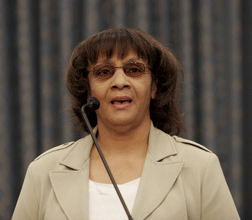 Lois
Williams, president of the National Federation of the Blind’s Diabetes
Action Network, wants to get the word out: People with diabetes can work together
to help each other live fuller, longer, and healthier lives. That’s why
the Diabetes Action Network has joined with two other advocacy and support groups
to reach out to everyone at risk for medical complications of diabetes.
Lois
Williams, president of the National Federation of the Blind’s Diabetes
Action Network, wants to get the word out: People with diabetes can work together
to help each other live fuller, longer, and healthier lives. That’s why
the Diabetes Action Network has joined with two other advocacy and support groups
to reach out to everyone at risk for medical complications of diabetes.
The Big Three
Diabetes is the leading cause of what many in the field call the Big Three: kidney disease, lower limb amputations, and blindness in working-age adults. For the first time, the leading advocacy groups for those Big Three conditions are working together to reach out to all diabetics.
The Diabetes Action Network (DAN), the Amputee Coalition of America (ACA), and the National Kidney Foundation (NKF) have been serving their diabetic members and constituents for years. Now, by working together, the three organizations can reach many more diabetics at risk of diabetic complications.
Once a diabetic has experienced one of the Big Three, he or she is at much greater risk of developing the other two, as well as other complications such as nerve pain and stomach paralysis. These complications result from damage to the smallest blood vessels, caused by high levels of glucose in the blood. Once a person has enough microvascular damage to cause one complication, the others may not be far behind. As a result, complications often come in clusters. A diabetic may begin with a lower limb amputation, and quickly begin losing vision and kidney function.
Feeling Helpless and Hopeless
Lois noted that many people do not take Type 2 diabetes seriously until they
experience a complication. “I know so many people who say, ‘the
doctor gave me this medicine to take for my diabetes, but I feel fine, so I
don’t need it.’” Once a complication like vision loss occurs,
they can feel shocked and overwhelmed, and not realize that a diabetic can live
a full and happy life while managing his or her condition. “Coming home
after my surgery, I went to open my door and I could not even get my key in
the lock,” she recalls of the day she lost her vision to diabetes. Fumbling
with her key she felt helpless, hopeless, and humiliated.
But with the help of fellow diabetics in the DAN, Lois learned how to control
her diabetes despite her vision loss, and with their support, she found the
will. The DAN offers tips and techniques to count carbohydrates, exercise adequately,
monitor blood glucose levels, and administer oral medicines and insulin without
vision, as well as support and encouragement. Today Lois is not only happy,
confident, and in control of her diabetes, she is also the president of the
DAN and an outspoken diabetes activist in her community and throughout the country.
Lois wants to make sure that all diabetics with complications have access to the kind of information, support, and inspiration she received from DAN members. As the NFB has been working to support its diabetic members, these other organizations are too. By sharing information, each organization can assist the others in fully informing patients about the other common complications. For example, when diabetics call the NKF for information about kidney failure, they need to learn about how to live independently while managing both diabetes and dialysis. They also need to know that they are at increased risk of vision loss and amputation, and where to turn. According to Lois, no diabetic should feel helpless and hopeless.
Working Together
Until now, each of the organizations focused primarily on providing information about their own condition—for example, the NKF has created reams of pamphlets and stacks of videos about kidney-related complications of diabetes, and the ACA has plenty of educational material about the link between diabetes and amputations. The DAN historically focused on providing information about managing diabetes with low vision or no vision.
In the last fifteen years, however, with growing demand from Voice readers, the DAN has begun to broaden its focus to include all complications of diabetes. According to Lois, more and more DAN members request information about kidney failure and foot problems, as well as other common complications. “We realized we needed to provide information and support to help people with all kinds of complications, not just blindness,” she said. Now, when someone calls the DAN volunteer support committees (see sidebar), he or she can receive information about all kinds of complications. As part of the effort to address all complications of diabetes more effectively, Lois, along with other NFB leaders, has been meeting regularly with representatives from the NKF and ACA.
Their goal is to pool their knowledge and resources to educate diabetics and the public about the complications of this disease, and highlight the importance of understanding the risks of these complications. Diabetics who are experiencing one of the Big Three complications need to know how to manage their disease independently and effectively. They also need to know that they are at risk for developing other complications, and how to be alert for signs of those complications.
To that end, the groups are already sharing informational materials and linking
to each other’s Web sites. In addition, the groups are discussing possibilities
such as speaking at each other’s annual meetings, creating joint educational
materials, and
developing a seminar to educate doctors, nurses and diabetes educators about
the Big Three diabetic complications.
The groups also want to educate policymakers about the links between the Big Three complications. As a first step, Lois and representatives from the NKF and ACA, as well as patients who have confronted one of these complications, recently met with members of Congress and staff members to explain the risks of the Big Three, and to describe how they successfully manage their diabetes despite their complications.
By working together, the three groups hope to be able to reach many more diabetics than each could reach individually. There is strength in numbers, Lois reminds us, and the three groups hope to share their strength with millions of diabetics, helping every diabetic live a longer, healthier, fuller life.
Diabetes Action Network
The Diabetes Action Network (DAN), a division of the National Federation of the Blind, is a team of diabetics who support one another as they manage diabetes and its complications. The DAN publishes the Voice of the Diabetic.
In addition, the DAN has a support committee for each complication, including blindness and visual impairment, kidney disease and dialysis, foot problems and amputations, transplants, neuropathy, heart disease, and sexual dysfunction. DAN also has a list serv e-mail group to provide an online supportive and informative community.
DAN members share strategies and technology advice to manage their complications,
and they provide support and assistance during the rough times. DAN members
receive membership in the peer support network, a free subscription to the Voice,
and access to a treasure trove of information about managing diabetes and its
complications. Members of the Diabetes Action Network also automatically become
members-at-large of the National Federation of the Blind.
If you are interested in joining the Diabetes Action Network, or have questions,
please call (410) 659-9314, extension 2335, or e-mail DAN president Lois Williams
at [email protected]. You can find out more at www.nfb.org.
National Kidney Foundation
The NKF seeks to prevent kidney and urinary tract diseases, improve the health and well-being of individuals and families affected by these diseases, and increase the availability of all organs for transplantation.
The NKF publishes a variety of informational materials about diabetes and chronic kidney disease. The NKF also provides resources and support for those undergoing dialysis or kidney transplants.
For more information, call the NKF at (800) 622-9010, or go to www.kidney.org.
Amputee Coalition of America
ACA advocates for the rights of people with limb loss. This includes access to, and delivery of, information, quality care, appropriate devices, reimbursement, and the services required to lead empowered lives.
The ACA publishes InMotion, a magazine that addresses topics of interest to amputees and their families. The ACA toll-free hotline provides answers and resources for people who have experienced the loss of a limb. In addition, the organization develops and distributes educational resources, booklets, video tapes, and fact sheets to enhance the knowledge and coping skills of people affected by amputation or congenital limb deficiencies.
To contact the ACA, call (888) AMP-KNOW (888-267-5669), or check out the Web site at www.amputee-coalition.org.