Becoming a Federationist: The Lesson I Didn’t Ask For
by Gary Wunder
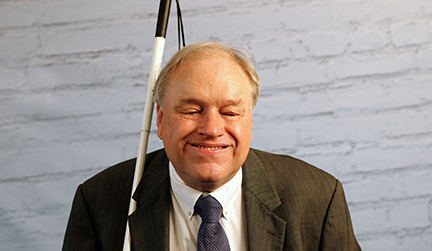 Anyone who has served as a National Federation of the Blind representative has perfected the story of how they came to join. Every banquet speech is constrained by time; people want a succinct biography in addition to a message. In my own case, I talk about guide dogs, donuts, and coming to love the people who took an interest in me—my desire to see approval in their eyes for who I was and who I might become. I would say that that is how I was pulled into the Federation, but how I was pushed into it is a different story, one I will try to tell here as I wrestle with irritation, the use of power, and an unintended, yet profoundly positive result.
The Philosophical Battleground
The National Federation of the Blind has long championed the idea that blindness should not be defined by pity, dependence, or low expectations. We fight for self-determination and the belief that, with the right training and opportunity, a blind person can compete equally in society.
This philosophy necessarily places us in opposition to the outdated and often paternalistic attitudes found within parts of the state/federal rehabilitation system. We deplore the arrogance that certain officials assume when they gain control over the destinies of blind people. We do not mind strong advocates for fostering good attitudes and skill-building, but when rudeness and condescension replace respect, a critical line is crossed.
I experienced this arrogance firsthand during a pivotal moment in my life—an encounter in the early 1970s that could have been a roadblock but ended up being the unexpected catalyst for my independence and my lifelong commitment to the Federation.
The Confrontation: Feet on the Desk
The summer of 1973 was supposed to be the beginning of my great journey toward independence. I had diligently planned my post-high school life: I would attend the renowned Seeing Eye training school in New Jersey to get a guide dog, then return home to start college locally while living with my grandmother. Everything was set; my approval and date to attend The Seeing Eye had been clear for at least a year.
Then, in February, those plans dissolved with the arrival of a sterile, bureaucratic letter. It informed me that my summer had just been planned by the Missouri Bureau for the Blind. Since I wanted to receive college assistance from the agency, I would be attending an eight-week summer orientation program sponsored by the Bureau and held in Columbia, Missouri. The path I had chosen, the path of self-determination, was instantly voided.
I was having none of it. I sought to appeal, but my counselor timidly denied me. I decided to go up the chain. My mother and I secured a meeting with the district supervisor of the Kansas City office, a man named Dan Cordell.
The memory of that meeting remains strikingly clear five decades later. When my mother and I were ushered into his office, Mr. Cordell was already settled into a posture of ultimate authority. He leaned far back in his chair, crossed his feet, and placed them squarely on his desk, his shoes pointed directly at my face.
“Tell me why you are here, young sir,” he drawled, the utterance dripping with a patronizing tone that suggested our visit was a colossal waste of his time.
I laid out my case: I had secured a spot at The Seeing Eye, I was ready for a guide dog, and I wanted to follow my original plan.
His response, though necessarily paraphrased after fifty years, was a masterclass in paternalistic dismissal. He ticked off his points: “First, you have no hearing problems, so you do not need a dog. A dog will only make your life more complicated. Dogs shed; dogs drool. They make others uncomfortable, and some people will not want you to come to their homes or ride in their cars.”
I pushed back, defending my choice and arguing that I did not view a dog as the catalogue of disadvantages he presented. His final ruling, however, was blunt and unappealable, delivered with the same feet-on-the-desk arrogance:
“You can believe as you want about the dog. If your parents can afford to send you to school, then do what you please. But if you are going to attend college under the auspices of the Bureau for the Blind, you will attend the summer orientation in Columbia.” I had never heard that word before, but the meaning of “auspices” was perfectly clear in context.
The Immense Power of the Purse
The conversation ended there, but its implications were immediate and chilling. It convinced me instantly that the power of the agency, specifically the power held by this single man, was immense, final, and absolute. It was control over my immediate future. My mother, who had sat quietly beside me with tears in her eyes, was visibly shaken on the drive home.
When I recounted the dialogue and the demeaning manner in which it was delivered to my father, I expected thunder. My father was a strong man, a steadfast defender of his family. Yet, as I explained the insult that had driven my mother to tears, he was strangely, devastatingly quiet.
A couple of hours later, he sought me out for a private conversation. The wisdom and pain in his words remain the most powerful lesson in pragmatism I have ever received.
“I know you want me to go to this man and set things straight,” he said quietly. “Son, I can’t do that. He has more money to help you than we can ever hope to give you. I can’t send you to college, but he can.”
His conclusion was a bitter pill: “Here is what you do. You follow his rules. And if, after you are done with school and no longer under his thumb, you are still mad about what he said and how he acted, then you do something about it.”
I was deeply disappointed. My protector had been forced to bow before the bureaucracy. It was a profound lesson in the real-world limits of personal strength against institutional power. But in that moment of disappointment, I began to see the Federation in a different light. The NFB’s fight was not merely theoretical; it was an existential battle against officials like Cordell who wielded the state’s purse to enforce their own low expectations and dismissive attitudes. Though it was likely the furthest thing from what he intended, Dan Cordell helped forge me into a committed Federationist.
The Unexpected Pivot to Independence
That supervisor’s arrogant decree, which robbed me of my carefully laid plans, may well have been the most significant turning point in my life.
My original plan—get my dog, go to college near home, live with my grandmother, and pursue an undefined, comfortable degree path—turned out to be insufficient. Instead, I arrived in Columbia, Missouri, to attend the summer orientation program and the University of Missouri.
The mandatory eight-week program was a crucible of transformation. It was a rigorous, challenging immersion into independent living. It taught me things I never knew I needed: how to hire, supervise, and fire human readers; how to order books on tape and in Braille; and how to strengthen and refine my cane travel skills.
But the real change happened outside the classroom. The program required us to live away from home, pushing us out of our comfort zones. I liked being able to travel on my own to businesses—the bank, local restaurants, and even the bars. I met a woman and had my first romantic relationship. It took little time to realize that I wanted more than to just go to school and come home to Grandma’s.
I met other people—people who used to be the “other” to me and my family. If you were black and we were white, you were different. If you were not heterosexual, you were a deviant. If you were a woman in a man’s world, you were to be admired and protected, but certainly not an equal. If you didn’t have much money, you lacked a work ethic. None of these people were to be treated badly, but they were not to be confused with normal.
The program forced me to see beyond characteristics that were once very important to me and to regard these people as friends, colleagues, loved ones, and equals. The change took time and effort, but ultimately, learning to understand other people and removing them from the box of inferiority has nothing to do with conservative or liberal politics. It has to do with weighing the evidence one sees against the prejudices that came so easily—the belief in “a place for everyone, and everyone in their place.”
The Paradox of Good Advice, Bad Attitude
This brings me to the paradox I have wrestled with for fifty years. While I do not, and never will, condone the feet-on-the-desk attitude and the rude dismissal given to my mother and me, I feel the need to acknowledge that the accompanying advice was, in effect, good. I have lived in Columbia now for nearly fifty years. I love the place, and I am profoundly glad for the doors that were opened.
My original plan, while comfortable, was insufficient. It would not have prepared me for the rigors of a truly independent life. Too many times since that summer, I have seen young blind people granted rehabilitation funds for college when their fundamental lack of travel skills, orientation know-how, and self-advocacy attitudes set them up for failure.
The Federation rightly champions our right to choose, but we must also acknowledge that sometimes, the state agency is correct in demanding a minimum foundation of nonvisual skills before investing in a college career. It is okay to try and fail; it is not okay to send someone on a journey you know they are destined not to complete when, with a few resources and a minor delay, they can attend school or any other activity with a real chance to succeed.
The easy yes from the rehabilitation system for persons who are lacking skills is not an opportunity but a recipe for failure. The unconditional yes that does not consider skills, attitudes, and sometimes even emotional maturity gives blind people the shovel we unintentionally use to dig a hole that is difficult to climb out of. Poor grades resulting from the inability to travel to class or a lack of study skills are hard to turn around.
Cordell was wrong in his diagnosis (I didn’t need a hearing problem to justify a dog), and he was absolutely wrong in his demeaning delivery. He violated the very principles of respect and partnership that define true rehabilitation. But by forcing me into that summer program, he put me on the path to independence, community, and my life in Columbia.
I want to thank Dan Cordell for my experience at the University of Missouri and for seeing, even if by coercion, that I got those essential skills. At the same time, I do not want to endorse the arrogant behavior that upset my mother and me.
That tension—between the undeniable good of comprehensive training and the inexcusable bad of bureaucratic arrogance—is precisely what fuels the work of the National Federation of the Blind. We demand skills, independence, and opportunity, but we also demand respect, dignity, and partnership. My life proves that independence can be forged even in the fires of frustration, but we should never stop fighting for a system that treats blind people as the equal, competent adults we know ourselves to be.