How to Be a Blind Wheelchair User
by Ellana Crew
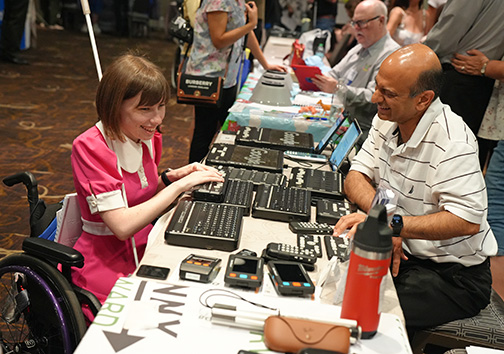 From the Editor: Ellana Crew has worn many hats in the National Federation of the Blind, including serving on our national staff in the Independence Market. She is currently secretary of the Central Maryland Chapter while pursuing a degree in disability studies.
When I first started experimenting with using a wheelchair almost three years ago, figuring out how to use my white cane at the same time was like searching for the proverbial needle in a haystack. I was a well-rounded cane traveler with hundreds of hours of blindfolded Structured Discovery training under my belt, so I figured that I could teach myself with a little research, but what I found was an information drought. I combed through online forums and internet search results, hunting for any scrap of information I could find, but I typically emerged from these research sessions largely empty-handed. The only blind people I could find making videos about it seemed not to use canes at all. An old APH document on the topic seemed to rely on a lot of traditional closed-minded assumptions. And though I successfully unearthed two articles by blind wheelchair users in the archives of our National Federation of the Blind publications—one by Maureen Pranghofer and the other by the late Treva Olivero—neither went into the kind of detail I needed to teach myself from the ground up. They provided excellent pro tips that I still use, but what I truly needed was a complete beginner’s guide, and I didn’t have one of those. I had only three or four tiny pieces of a much larger puzzle. I put those puzzle pieces together to the best of my ability, but there was still much that I was left to figure out on my own. It felt like I was reinventing the wheel—pun intended.
Since then, however, quite a few more of those pieces have fallen into place. Over the course of around six months, I built myself a network of contacts from whom to learn. Some of them were my old blindness skills instructors, such as my former Orientation and Mobility (O&M) teacher L J Bowens. Some of them were blind people I found online who did not have the same cane training I did but had the wheelchair-using experience, allowing me to ask them questions and then workshop my own solutions. And some of them were Federation members who had known blind wheelchair users.
Eventually, I was also able to successfully make the case to my state VR agency that I needed a new round of adjustment-to-blindness training, this time at the Louisiana Center for the Blind (LCB). It was there that I made the most progress, working closely with Roland Allen as my travel instructor to stretch my skills and test the boundaries of what was possible. I spent five full months re-learning how to cross streets, re-training the muscle memory of my cane arc so that I would quit smashing my rims into door frames, and practicing wheelies in the grass to get better at hopping over train tracks.
I am still by no means an expert. I’ve only been using my wheelchair for around three years, only have direct first-hand experience with manual chairs, have never used a guide dog with or without my wheelchair, and cannot speak for every blind wheelchair user and every situation. I have collected quite a breadth of information, though, and I think it’s high time that we take a firehose to the information drought on this topic so that others are not left in the same place that I was in the beginning.
In this article I plan to share the most fundamental things I believe you should know about using a white cane and a wheelchair at the same time, according to my research and experience. I have done my best to cover a wide range of factors and variables, although my aforementioned limitations should be fair warning that this guide cannot cover every situation. Hopefully, however, it will provide enough of a jumping-off point for you to experiment with solutions for your own needs and then perhaps spark further contributions to the Braille Monitor by those who can share perspectives that I cannot.
And so, with all of that said, let’s begin.
Cane Length
The first thing to know is that choosing the cane you use with a wheelchair will in many cases involve different considerations than choosing a cane for walking. To start, a wheelchair user will often require a cane that is longer than that of an ambulatory cane user. This is for two primary reasons:
- When seated in a wheelchair, or any chair for that matter, your feet are positioned farther forward than the feet of someone who is walking, particularly if your footplate is at an angle that sits farther forward than ninety degrees. This means that you lose some of the length of your cane to your feet, which decreases the reaction time you will have when you encounter an obstacle, making it harder not to run into that obstacle with your footplate. Your cane must be longer to account for your feet being farther forward than they would be if you were walking.
- A wheelchair often takes longer to come to a complete stop compared to someone on foot because of its rolling momentum. When walking, it is fairly easy to simply halt one’s entire body, but on wheels you need time to fully stop rolling without braking so abruptly that you are thrown forward in your seat. This effect may be much less significant on many power chairs depending on the configuration of the brakes, but power-chair users may still experience this when moving quickly, necessitating a gentler stop that covers more ground. This means that you again need extra reaction time, which necessitates a longer cane than an ambulatory person.
But exactly how much longer does your cane need to be? This depends on a wide variety of factors: how fast you tend to move in your chair, how high off the ground your seat is, how your disability may or may not affect your reaction speed, the angle of your footplate, whether you are using a manual chair or a power chair and how quickly you accelerate and decelerate on average, and the position in which you hold your cane relative to your body and chair. Because of all these variables, I believe that there is no set standard or universal rule that can be applied to all wheelchair users. However, when asked, I usually suggest taking whatever your typical recommended cane length would be when standing based on your height and go up two sizes as a starting point. If that’s not enough reaction time, continue to experiment with taller and taller canes until you find the one that allows you to move, navigate, and stop at a comfortable pace.
I am a firm believer that the cane should match the user, not the other way around, so if the cane you are using in your chair isn’t giving you enough reaction time, in most cases I believe a longer cane will be more beneficial than artificially slowing your pace to meet the limitations of your cane. I know I am not the only blind wheelchair user who has been unduly advised to slow down when I knew that I could keep myself perfectly safe with a longer cane.
All that said, one thing to keep in mind is that by being seated, to some extent your cane is automatically a little farther ahead of you than the same cane would be on foot because you are lower down in space, which changes the angle at which your cane tip meets the ground. This means that some people may be able to use the same cane in a wheelchair that they would when standing, especially if they tend to move relatively slowly in their chair and their seat is fairly low compared to other wheelchair users. But for many, this effect is not enough to compensate for the above factors, hence my general recommendation of a longer cane for most wheelchair users. But do keep this caveat in mind because there are always exceptions.
Cane Type
Due to a variety of factors, the type of cane you choose to use with a wheelchair may also need to be considered differently than it would if you are ambulatory. For instance, a lightweight cane can be even more important for many wheelchair users, both because some of our disabilities also affect our hand strength and dexterity and because we are often positioned lower down in space than someone who is standing, which can make the extra weight of a heavier cane feel even more pronounced. For similar reasons, using a cane that tapers to be skinnier at the bottom than it is at the top can also be extra important for a wheelchair user. That tapering changes the weight distribution of the cane to be more concentrated at the handle, so that you do not feel the weight as much down by the tip. Even when I am using my ultra-lightweight NFB rigid cane, which is the lightest cane I’ve ever used, its weight is more noticeable to me when I am in my wheelchair than it is when I am ambulatory because of the different angle.
For similar weight reasons, a rigid cane can also be more advantageous, just as it is when ambulatory. Many people are under the impression that a wheelchair user must always use a collapsable cane. But in most cases, rigid canes when using a wheelchair provide all the same benefits that they do when on foot, such as lighter weight and enhanced tactile feedback. They also feature all of the same drawbacks in terms of being slightly less convenient to store when not actively in motion. But holding a rigid cane while at rest in a wheelchair is not significantly different from doing the same while seated in an ordinary chair in my experience, and so if a rigid cane provides you more functional benefit than a folding one, I say use it anyway and experiment with the most comfortable resting positions for your needs. I frequently wedge my cane shaft between one of my clothing guards and the side of my cushion with the upper shaft resting against my backrest beside my push handle or with the handle leaning against the wall behind me.
It may also be possible to lean the cane against your shoulder with the tip held between your feet, clamp it between your knees, position it behind your footplate and lean it against your seat so the footplate acts as a stopper, lean it up against a nearby wall or corner, hold it between your shoulder and chin, or even stick the tip inside your shoe if the tip is small enough. For wheelchair users who may need frequent assistance being pushed, you may also experiment with the best position in which to hold it so that the upper half is not poking the person pushing your wheelchair in the face. Some strategies may also be utilized for clamping or strapping your cane to a spot on your frame, for which you can often draw ideas from wheelchair users who do the same for a physical support cane or crutches, with modifications for the height and diameter of white canes as needed.
There are certainly exceptions to this; I have met a handful of blind wheelchair users for whom the nature of their disabilities sincerely require them to use a heavier cane. However, this so far appears to be the exception and not the norm, and some of those same people still experience hand pain or other difficulties from those heavier canes but still choose them based on the overall pros and cons for their individual circumstances. And so, I would personally still suggest starting with something light and tapered like the NFB Chris Park cane, the D Cane, or the non-tapered Ambutech Slimline cane and working up to other options as needed. The Revolution graphite cane may be a good in-between weight for some users, while Ambutech canes are often the heaviest—at least until entering the heavy-duty market with options like the titanium All Terrain Cane.
Cane Tips
Just as the weight of the cane itself can be more important for wheelchair users, so too can the weight of the tip you choose. As mentioned before, some of our disabilities can also affect our hand strength and dexterity, and so heavier tips can be even more detrimental for us than they can for ambulatory users. And just as our lower position in space can make the weight of the cane itself feel more pronounced, the same is true for our cane tips. in most cases, therefore, I suggest using small and lightweight tips, such as metal glide and ceramic tips. These tips provide excellent weight balancing, great aerodynamics, and superior tactile and auditory feedback compared to larger and heavier tips. They are also versatile enough to enable the use of a wide variety of techniques for different situations.
Fixed tips can also be more advantageous than rolling tips for similar reasons. I have encountered a surprising number of people who believe that a wheelchair user must only use rolling tips. However, the user being on wheels does not automatically require their cane to be on wheels as well. Rolling tips are often much heavier than fixed tips, and for those of us with limited hand strength, the momentum created by a rolling tip can sometimes make it more difficult for us to wrench the cane back in the opposite direction after reaching the edge of the cane arc.
I have noticed that this momentum issue for me personally can cause great hand pain, and so I find fixed tips much easier to control for my particular disability. Others with greater hand strength and hand control may not experience such difficulty when changing directions, but a rolling tip will still be significantly heavier, and that extra weight may feel more pronounced while seated in a wheelchair. And of course, the usual disadvantages of rolling tips still exist when using them in a wheelchair, such as reduced tactile feedback and limited opportunity for auditory feedback from tapping the cane. The auditory effect is especially pronounced because rolling tips are often made from plastic, which does not produce such a crisp sound when tapped and does not generate as much detail through touch compared to materials like metal or ceramic.
One concern I have heard expressed not just by wheelchair users, but also blind people who haven’t had much experience with metal and ceramic tips, is that these tips cannot be used with constant contact. Although some vendors like Ambutech may advertise metal glide tips in particular as being only designed for two-point touch technique, this is not true, and in fact a good cane tip should be designed for numerous techniques, as the well-rounded cane traveler should ideally be making use of multiple techniques for different situations. The questions of when and where to use each cane technique are beyond the scope of this guide, but I can say with certainty that both a metal glide and ceramic cane tip are versatile enough to be used with virtually any technique. So, for those wheelchair users whose disabilities make the dexterity involved in two-point touch extremely difficult, you need not worry that the tips I’ve suggested here will not be usable if you need to make more frequent use of the constant contact technique.
Again, though, there will be exceptions. Just as the nature of some disabilities can sincerely necessitate a heavier cane, they can also sometimes necessitate a heavier tip, and some find the momentum of a rolling tip to be a help rather than a hinderance. Some disabilities can also impair a person’s proprioception—the body’s ability to perceive its position, movement, and spatial orientation without visual input—such that they struggle to detect large drop-offs, such as stairs and curbs, without a tip that is either large or heavy enough to make the sensation significantly more obvious. Still others may use a small lightweight tip for greater functionality but use something like loose metal washers or tied-on bells to produce an obvious sound to alert them of such changes if they are not physically able to detect them reliably by touch.
Given that falling off of a curb or step can be far more dangerous to someone in a wheelchair than it can be to most on foot, ensuring you have adequate drop-off detection for your disability is imperative. That said, these cases are often still the exception and not the norm in the experience I’ve had so far, and so I would still recommend starting with something small, lightweight, and with great feedback for most and then experimenting with other options once lighter options have been thoroughly exhausted. No need to risk pain, tiredness, or repetitive stress injury from a heavy rolling tip if something small and lightweight will get the job done just as well. I will also discuss some technique options later on that may aid in better drop-off detection without requiring a specific tip type.
Using the Chair and Cane at the Same Time
And now we move onto the real meat of the question: How do you use a white cane and a wheelchair at the same time? The first thing I will say is that there is not one single answer to this question. There are many types of wheelchairs and power attachments and many different individual needs. However, I will try to cover the main options available to you, and we will talk separately about power chairs and manual chairs.
Power Chairs
If you use a power chair, I have good news because your answer to this issue is much simpler than manual chair options for most. The majority of power chairs that I know of are operated fully one-handed, leaving your other hand free to use your cane as usual. This certainly gives many power-chair users an advantage in learning to use their canes from their wheelchairs. So long as you have enough hand function in at least one hand to use a white cane and enough hand function in the other to operate your chair, you shouldn’t have too many other factors to worry about. The primary consideration will likely be in which hand to use the cane and which to use the chair control, particularly if you do have issues with hand function, and you may want to try a wide variety of joysticks and control methods for your chair to find what works best for your needs.
If hand function or coordination is an issue such that using a cane in one hand and chair controls in the other is not possible but one hand can still use the cane, you may want to look into alternative control methods for your chair that do not require the hand. I will admit to knowing extremely little about these alternatives other than that some do exist, however, so this will be something you will want to research heavily on your own time to determine if they would work for you or not. There are certainly some who will simply not be able to use a cane and operate their chairs independently at the same time due to the nature of their disabilities and hand function in particular, but it may still be worth researching as many options for chair controls as possible if you have the ability to use a white cane.
Note: if you use a power chair which allows you to adjust the height of your seat for easier access to tables or conversations, you may want to pick a consistent seat height at which you keep your chair when traveling, at least while you are still learning, and find an accessible way to return your seat to that same height. Inconsistent seat heights when using your cane could produce varying reaction time with your cane due to changing the angle at which your cane extends forward and thereby altering exactly how far ahead your cane tip is from one outing to another.
Manual Chairs
We manual wheelchair users often have to get a little more creative about how we operate our chairs and canes at the same time. The typical manual wheelchair requires the use of both hands on the push rims, which does not leave a free hand for the white cane. There are several options to try out, however, so the answer need not necessarily be to just use a power chair instead.
The first option, requiring the least specific chair design and augmentation choices, is to hold both the cane handle and one push rim in the same hand, sweeping the cane between each push as you move. I confess that I have had significant trouble learning how to perform this technique. However, I have met several manual wheelchair users who do, one of whom was our very own late Treva Olivero, as she described in an article she wrote for the Future Reflections magazine entitled “From Tumbles to Triumphs: Using a Cane from a Wheelchair.” You may need to experiment quite extensively with this technique to determine if it will work for you, trying different grip positions, arc movements, and potentially different push rim shapes and textures. Some may need to wrap the whole hand around both the cane handle and push rim, some may split their fingers between cane and push rim like some crutch users do when carrying other objects, and some may only use the palm or heel of the hand to push the wheel and so have the cane wrapped with all of the fingers. Making this technique work can be very individualized and require plenty of trial and error. However, if you can achieve it, it will often allow you to have the greatest choice and flexibility in your chair features, since it does not require any special customizations to make it work.
When using this technique, however, you may want to pay special attention to your cane arc to ensure that it is even. Because this technique means that your arc will begin with the handle held off to the side instead of the center of your body, it can require more practice to ensure your arc does not fall too short on one side or the other. I have personally found myself prone to not sweeping far enough out on my right side when experimenting with this technique, leading to swiping my right push rim on things too frequently as I pass. If you find this technique effective for you, be sure to pay close attention to your cane arc as you practice it in order to build good habits.
A second option is a one-arm drive system on your manual chair so that both wheels can be pushed with only one hand. These systems place both push rims on one side, the standard push rim that controls the wheel on that side and a second, smaller push rim that controls the opposite wheel via a removable axle. To move forward or backward, the user grips both push rims at once, and to turn, you only operate one push rim. One-arm drive systems are used most often for those with one-sided upper limb differences or significantly reduced hand and arm function on one side, but they can be repurposed for those of us who need a hand free for our second mobility aid.
The largest potential downside to this feature is that it can be more challenging to push yourself long distances or up hills with only the power of one arm. It can also make the chair slightly heavier overall and require some dexterity, so it may be best for those with reasonably good hand function and upper-body strength or may need to be augmented with a power-assist attachment. It can also lead to your chair arm building up a bit more strength from pushing compared to your cane hand, but so long as you do not mind some slight asymmetry of your arms to those who look closely enough, a one-arm drive system can offer great freedom to use your cane normally in the other. It also leaves your cane hand free to hold the cane in the center of your body, if you are able, rather than off to the side, avoiding the more complex cane arc work involved in the first option we discussed. This customization can be quite pricey, however, and so you will want to ensure that you have a wheelchair occupational therapist (OT) who is very good at writing medical justifications for your desired features.
A third option—assuming you have the leg function—is foot propelling. This is how I have personally chosen to use my manual wheelchair most of the time because my disability allows me to do so. This option will certainly not be possible for many whose disabilities prevent it, but if you are physically able, foot propelling can be a great option that leaves both of your hands free, allowing even more flexibility than most power-chair users. I am often seen on my college campus rolling along with my cane moving in one hand and a Starbucks cup in the other. It also allows me to keep my cane centered in front of my body, avoiding the more complex cane arc practice required of the first technique, and having my feet on the ground allows me to get a little extra feedback about the surface, as I would when walking. Having my non-cane hand free also means that I can use that hand for extra leverage on small slopes or when turning or even just for a little extra momentum on occasion.
However, for larger slopes, foot propelling can be quite difficult on its own, and so you may find yourself needing to use both hands for a push or two with a sweep of the cane in between or opting for a power-assist attachment as I have. The major downside to foot propelling, however, is limiting your options for rigid-frame wheelchairs, as the fixed footplate will inevitably get in your way. However, some manufacturers, such as TiLite and Sunrise Medical, offer rigid chair models and customizations that include split flip-up or fully removable footrests, so it can still be possible to have both if you can get insurance to pay the extra price for it. I plan on going for this in my next chair. Do also note that if you plan to use foot propelling as a primary technique, your seat height will need to be much lower to ensure you have good traction.
You may also be able to make use of some combination of both foot propelling and pushing with one hand if you are able to do so but neither one is good enough on its own. Having the strength of both feet and one arm may be a great combination for some people depending on your disability, or even one arm and one leg if one of your legs is capable of foot propelling but the other is not. You may even be able to combine foot propelling with a one-arm drive system to make this method more effective. I do not have a one-arm drive system on my current chair, but just having one hand on my left wheel can give me a little extra speed or power from time to time. If you do this without a one-arm drive system, however, be aware that putting only one hand on one wheel like this may sometimes cause you to turn or veer slightly in the opposite direction. I have found that my feet doing most of the directing largely sidesteps this issue but be sure to pay attention to your trajectory when doing this to stay on track.
Power Assists
If manual propulsion on its own will not meet your needs well enough, you may also consider a power-assist attachment. This is a motorized device that attaches to a manual wheelchair in different ways to enable the user to have some power at their disposal while not losing the overall lightness and maneuverability of a manual wheelchair.
Power assists come in three primary configurations. The first category includes options such as the SmartDrive, SMOOV, Empulse R90, Klaxon Twist, and Light Drive, which come in the form of an extra motorized wheel attached to the back of the chair between the large rear wheels, which is operated by a one-handed control unit that consists of either buttons or dials. Rear mounted power assists usually cannot steer for you, however, they may be best for blind users who are able to steer either by foot propelling, as I do, or by moving their hands between the cane plus control unit and the wheels.
The second category are rear wheel replacements that have power built in and are activated either by pushing them manually or operating a control device like a joystick. With manually pushed powered wheels, they are steered the same way as regular rear wheels, by using your hands on the push rims. With joystick-operated wheels, the joystick allows you full directional control with one hand, essentially turning your manual chair into a power chair. Some available manually-operated power wheels include the E-Motion and NaviONE wheels, and these may be well suited to those who are able to hold the cane and the push rim in one hand, as they cannot be operated one-handed. Some joystick-controlled options include the E-Fix and NaviGo wheels, which can be great for those who need one-handed control, and some powered wheels like the Empulse M90 can do both joystick and manual push power. These options are great for blind users who want their power assist to also be able to handle the steering.
The final category includes choices like the Firefly, Batek, Klaxon Klick, Triride, and Empulse F35, which consist of an extra motorized wheel mounted to the front of a wheelchair. Front-mounted power assists lift the front castor wheels off the ground, effectively turning your wheelchair into a tricycle. They typically have handlebars on top, which the user must use to steer. I will personally admit that I have largely excluded front-mounted power assists from my own pool of options because they obstruct the use of a white cane. Based on my experience trying them, they can also be somewhat difficult to control with only one hand on the handlebars if the other is using a cane, though readers may want to do their own research.
These are all of the options that I have thus far discovered for manual wheelchair users. For some, however, none of these options will be suitable, even if they would be able to push a manual chair in the traditional way if they did not need to use a white cane, and in these cases it may indeed be necessary to move to a power chair. I have found that I and other blind wheelchair users have been pushed unnecessarily toward a power chair simply on the basis of white cane use without being given the chance to explore other options that may work perfectly well for us, but as I have hopefully driven home already in this guide, there will always be exceptions and edge cases for whom none of the other suggestions here will work. I believe in making sure your wheelchair meets your physical mobility needs before making changes based solely on the use of the white cane because, as we wheelchair users know, an ill-suited wheelchair can do more long-term damage to our bodies and our health.
But there may be situations in which the second-best option is preferable if the drawbacks are minor enough to make the ability to use the cane significantly more possible, which can sometimes mean using a power chair instead of a manual. Because every case can be so radically different from the next, however, I highly recommend requesting from your wheelchair OT to be able to physically test out various options with your white cane before making a final decision. Some wheelchair seating clinics can offer temporary loaner chairs that share some of the features of the chair you are considering, and if not, you may want to consider visiting the nearest-to-you mobility-aid showroom and spending several hours trying out options firsthand.
Technique Tips
Finally, I want to share a few tips and tricks that may help you move more smoothly in your wheelchair with a white cane. You may not find a need for all of them, but I hope that they are helpful to you in developing your wheelchair cane technique.
- Be sure to experiment with the speed at which you sweep your cane back and forth to determine what works for you. Wheelchair users often cannot rely on the pace of our steps to time our taps or sweeps, but as a general rule, the faster your chair is moving, the faster you should be sweeping. If you struggle to keep your arc consistent without making one direction faster or slower than the other, you might find it helpful to keep a musical beat in your head or imagine the ticking of a clock or metronome.
- So long as your disability itself does not prevent you from using one cane technique or another, I have found that using a wheelchair does not usually inherently necessitate a stronger allegiance to any particular technique. I have read several articles implying that a wheelchair user must use constant contact as their primary technique simply because of their wheelchair, but I have not at all found this to be true. Most wheelchair users should be able to make use of the full variety of techniques so long as they are physically able to. Constant contact, two-point touch, touch and drag, tap and slide, pencil grip, and many others can be done in most of the same situations in which you might use them on foot.
- Make sure that your cane arc covers the full width of your chair, not just your body. The conventional O&M advice is to make your cane arc slightly wider than your shoulders, but for many wheelchair users, our chairs make us wider than our bodies alone. For manual chair users, your widest point is likely your push rims (or more accurately, your push rims plus your hands), and for power chair users, your widest point is likely either your wheel base or armrest, depending on model and configuration. Make sure your cane arc accounts for your entire footprint and just a tad extra.
- If your disability or method of operating your chair prevents you from being able to hold the cane handle at the center of your body, make sure your cane arc is still even on both sides. If holding the cane handle closer to one side, this will often require reaching slightly farther forward on your opposite side to avoid your cane arc falling short on that side, while also being sure not to overcompensate too far in that direction.
- When traveling outdoors or on other uneven surfaces, you may find it useful to pay extra attention to other sensory cues to help prevent more frequent veering in your chair, especially if you are new either to blindness or being on wheels. Wheels love to follow the path of least resistance against gravity even on the slightest slopes, and when your body is not making direct contact with the ground, it can sometimes be slightly more difficult to detect if you are veering or slightly turning, and so making more frequent use of cues such as the sound of traffic and the angle of the sun on your body can be extra helpful to a blind wheelchair user.
- If you have difficulty identifying down curbs or drop-offs in your chair, you may find it helpful to pull your cane up into a more vertical pencil-grip-like position when searching for them. Being lower down in space often changes the angle of our canes to be more parallel to the ground, which can sometimes make it harder to detect drop-offs, so this more vertical position may help if you are having trouble. This tip comes from Maureen Pranghofer’s Braille Monitor article entitled, “Wheels And White Canes: Tips For Blind Wheelchair Users.”
- Be sure to experiment with different canes in your chair to find out what works best for your needs. You may find that the type of cane you find most beneficial in your chair is not the same kind that you prefer when on foot if you are ambulatory. For example, I have met one blind wheelchair user who, although he prefers the D cane when on foot, actually prefers the NFB Chris Park cane in his chair because he prefers less flexibility in the cane when using his chair due to the lower position and different angle.
This guide is by no means a complete instructional manual that can cover every aspect of using a white cane with a wheelchair, but I hope that it can serve as a valuable foundation for many blind wheelchair users to build on. I always recommend working with a trained orientation and mobility instructor if you can access such services, but I am also acutely aware how many in our community across the globe either do not qualify for O&M services or whose instructors know little to nothing about this topic themselves. My hope is that this guide can serve as a set of useful building blocks that you can expand and modify, as well as an introductory crash course for O&M instructors themselves who may be struggling to find information on this topic. And if you are a blind wheelchair user with something to share that I did not include here, I encourage you to submit your own article to the Braille Monitor to share your experiences and add even more perspectives to this very small body of literature.
When I first embarked on this journey of becoming a blind wheelchair user, the extreme lack of information on wheelchair-friendly O&M strategies led me to believe that those of us in this situation must just be incredibly rare and mythical, but since then I have met dozens and dozens of us that have proved that assumption wrong. Some of us had to figure it out on our own, some of us got training by an O&M instructor who was doing their best but felt underprepared, and many more were simply led to believe that using a cane in their chairs would be impossible and had been struggling to get by with vision alone. My hope is that this article will serve as just one of many that will raise greater awareness of the need for better wheelchair-inclusive O&M services and empower many more blind wheelchair users with the tools they need to achieve greater mobility than they had before. The system is failing us, but it doesn’t have to. And as we always say in the National Federation of the Blind, if they won’t teach us, then we will.
If you’d like to get in touch with me, you can find me on most social media platforms with the username @AskABlindPerson, or find my blog at https://askablindperson.wordpress.com. I have some expertise on other mobility aids as well and will be happy to answer any questions you may still have about using a white cane and a wheelchair at the same time.