Reflections on My Hook
by Barbara Loos
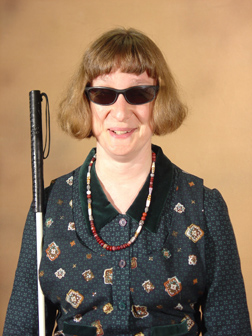 From the Editor: This issue focuses on membership—what it is, why it is worth being a member, and just how it is that some of us were invited and have been blessed by participating. When I mentioned that we were dedicating an issue to this subject, one of my favorite authors asked if I would consider something she had written. When she asked, I knew it was going to be a wonderful day, and it is a pleasure to run this. She provides enough biographical information that I will not do it here. I hope you enjoy her experience as much as I do:
If we look carefully at what motivates us, we'll often discover a pattern in what draws us in, hooks us, and compels us to act. For me, from the time I was a small child, I have been deeply influenced by literature. I've always loved to read and have often figured out how I feel about things by writing about them. I vividly remember what hooked me on the National Federation of the Blind, even though it happened over forty years ago. I invite you to join me on a brief walk down Memory Lane, close to where it intersects with Action Avenue.
As early as 1941, one year after its founding, there was an affiliate of the National Federation of the Blind in Nebraska. There was even a National Convention in Omaha in 1955. The former predates me and the latter would have found me to be a child of four, about to get my education at the school for the blind, where the Federation ranked among the unpopular. So it wasn't until 1971, when Mary Ellen Anderson (now Jernigan) and Arlene Gashel (later Hill) came to Nebraska as part of a team to reorganize the affiliate, that I had my first brief encounter with the organization. That January, although my sister, Laurie, and I, both of us blind and students at the University of Nebraska, Lincoln, met with them, we neither attended the organizing meeting nor joined the movement. We did agree, though, to receive the Braille Monitor, the Federation’s monthly magazine.
Our initial response to the Monitor was heavily influenced by the approach at the school for the blind, where Federationists were said to be pushy "pie in the sky" radicals with respect to expectations for the blind who would do anything to get their way. We derisively dubbed the publication the “Jernigan Journal,” because it was replete with articles and editorial comments by Kenneth Jernigan, who was, at the time, the Federation's President.
Typically, I read, ridiculed, and rejected the Monitor out of hand. I did so, that is, until the September 1974 issue. That one included the convention banquet speech entitled “Blindness: Is Literature Against Us?” Upon reading that speech, I found myself quietly, almost guiltily slipping it into a shelf reserved for things to ponder. And ponder it I did.
I was fascinated by his opening statement: “History, we are told, is the record of what human beings have done; literature the record of what they have thought.” But what caught and held my attention were his comments concerning the future of the blind as seen through literature:
If we turn to the future, the answer is that the future—in literature as in life—is not predetermined but self-determined. As we shape our lives, singly and collectively, so will we shape our literature. Blindness will be a tragedy only if we see ourselves as authors see us. The contents of the page, in the last analysis, reflect the conscience of the age. The structure of literature is but a hall of mirrors, giving us back (in images slightly larger or smaller than life) exactly what we put in. The challenge for us is to help our age raise its consciousness and reform its conscience. We must rid our fiction of fantasy and imbue it with fact. Then we shall have a literature to match reality, and a popular image of blindness to match the truth, and our image of ourselves.
Poetry is the song of the spirit and the language of the soul. In the drama of our struggle to be free—in the story of our movement and the fight to rid the blind of old custodialism and man's ancient fear of the dark—there are epics which cry to be written, and songs which ask to be sung. The poets and novelists can write the words, but we must create the music.
We stand at a critical time in the history of the blind. If we falter or turn back, the tragedy of blindness will be great, indeed. But, of course, we will not falter, and we will not turn back. Instead, we will go forward with joy in our hearts and a song of gladness on our lips. The future is ours, and the novelists and the poets will record it. Come! Join me on the barricades, and we will make it come true!
That didn't feel like "my way or the highway" to me. It felt like choice! And literature as "the song of the spirit and the language of the soul" certainly resonated with me, and I sure did want to go forward with that joy in my heart and song of gladness on my lips. I even longed to be one of those creating the music. Was it really "pie in the sky"? I determined to find out.
In December of that year, I was offered an opportunity, as part of my job at the Nebraska Rehabilitation Services for the Visually Impaired (now the Nebraska Commission for the Blind and Visually Impaired), to go to another agency for the blind to see how it operated and bring back possible suggestions for the fledgling Orientation and Adjustment Center we were in the process of creating. That was a no-brainer for me. I wanted to meet the author of that literature speech and see if the agency he directed, the Iowa Commission for the Blind, was as good as the rumor mill claimed. I came away from that experience not only believing that it was, but doing all I could to ensure that the center we built here emulated that one.
On Louis Braille's 202nd birthday, January 4, 2011, I purchased a booklet from National Braille Press by D. Croft. Entitled “Monday Morning Quotations,” it contains fifty-two leaves, each of which offers words of wisdom. The first quote on the second leaf, attributed to Bertrand Russell, aptly summarizes what I learned at the Iowa Commission: "Even when all the experts agree, they still may well be mistaken." The second quote on that page, penned by William Safire, succinctly comments on the growing connection with reality I was experiencing: "Never assume the obvious is true." Things, indeed, aren't always what they appear to be.
Once I began to engage with those who both truly believed that it is respectable to be blind and that the average blind person, given proper training and opportunity, could do the average job in the average place of business as well as his/her sighted colleague, life began to unfold for me in most fascinating ways. As my expectations for myself and those blind folks I was teaching rose, so, too, did our confidence. And with confidence came competence. Ken Hakuta's quotation on the first leaf of the aforementioned booklet conveys, to some degree, how things next began to play out: "People will try to tell you that all the great opportunities have been snapped up. In reality, the world changes every second, blowing new opportunities in all directions, including yours."
In January 1975, about a month after my trip to Iowa, I joined the Lincoln Chapter of the National Federation of the Blind of Nebraska. The following month, I was elected its president. Before the year was out, I had attended both my first state and national conventions, a leadership seminar in Des Moines, and a demonstration against the National Accreditation Council for Agencies Serving the Blind and Visually Handicapped (NAC) in Little Rock. Since then, I have held numerous positions, both elected and appointed, within the movement.
Many of the opportunities which have blown my way have involved literature. One of the first was a request from Mr. Regler, superintendent of the Nebraska school for the blind, who asked my sister (who had also joined the NFB) and me to write a song for the school's centennial celebration. He told us that the theme was a quote from its blind founder, Samuel Bacon, "Not just a living, but a life." Pleased to so soon have a chance to be part of writing a song which had, in fact, asked to be sung, I fleshed out that quote for the chorus and wrote a couple verses, then handed it off to Laurie to write the literal music. It was truly awesome to hear blind youth proclaiming that message of equal expectation and to have it adopted as the school song, knowing that the National Federation of the Blind, the organization that had been maligned there, had had a hand in it through my sister and me. Our mom, who had discussed our change of perspective with Mr. Regler at some point, mentioned that his response to her had been that if we raise children to think independently, we shouldn't be surprised when they do.
With increased involvement in the Federation, I found myself writing letters, delivering testimony to legislators, drafting resolutions, writing reports, and generally immersing myself in the business of contributing to the voice of our nation's blind. In 1990, when the NFB celebrated its half-century mark, I received the awesome privilege of being one of two Federationists to represent the 1970s on a panel of ten, two from each decade, at our National Convention in Dallas. A video of that session, items from chapters, divisions, and state affiliates as well as other selected materials were placed in a time capsule to be examined in 2040. That panel discussion is available in an article entitled “The National Federation of the Blind: Five Decades of Progress.” In December of 1998, exactly twenty-four years after I had first met and questioned him, I received the sad but unparalleled honor of paying tribute to Dr. Jernigan at his memorial service in Baltimore with remarks entitled “Making It Count.” Two years later, I was thrilled to be invited to deliver a speech, “Employment Creation,” at the Fifth General Assembly of the World Blind Union in Melbourne, Australia. The following year found me speaking at the groundbreaking ceremony for the building we now call the Jernigan Institute, those comments appearing in an article entitled “A New Day Dawning: The NFB Breaks Ground for the National Research and Training Institute for the Blind.” (A precious side note is that I got to stand beside a seven-year-old blind boy as we used giant scissors to cut the ribbon for the Institute's grand opening in 2004.) When I served as the first chairman of the newly-established Nebraska Commission for the Blind and Visually Impaired (NCBVI) board of commissioners from 2000 through 2007, I was mindful of setting precedents for future commissioners as we wrote formative documents and as I delivered annual reports to state conventions as NFBN's designee on the board.
Over the years, I have attempted to meet the challenge Dr. Jernigan spoke of "to help our age raise its consciousness and reform its conscience" about blindness through both presentations and vignettes. A partial list includes my introduction to the Federation (The Missing Piece), grieving (A Vinegar and Oil Federationist), alternative techniques (Fueling the Fire), teaching and networking (The Cribbage Game), Braille (A Morsel to Chew On), parenting (A Lesson From Marsha), mentoring (United We Stand), living our philosophy in the world at large (For Laura), giving back to society (Feeding Our Future), influencing blind youngsters (Laying the Groundwork for Independence), experiencing convention through streaming (Dancing in the Rain), going outside the comfort zone (Corky Canvas) and unusual blindness-related experiences (A Boa in My Brailler and Barring the Chaos Factor). Interestingly, not only have these and other writings of mine appeared in our NFBN newsletter, the Federation's Kernel Books and Future Reflections, but they also have found their way into the Braille Monitor, that publication that I once found so unnerving. I now find it to be both a treasure trove and a lifeline, and I hope you do, too.
Whether serving as state president, treasurer, board member, committee appointee, or, my personal favorite, rank and file member of this organization, literature of some kind is always influencing my approach. As I was writing this article, for instance, I received an observation in an email message by Bob Perks which I think sums up well how the Federation can turn around your life, whatever your initial hook may be. He wasn't talking about blindness, but I think it applies. He said, "I used to say, 'I'll believe it when I see it.' Now it's, 'I'll see it when I believe it!'" The first part of that statement is, of course, a slight rewrite of that old, untrustworthy stereotype "seeing is believing." The second part could be restated in a phrase I have often heard my husband say which I liked so well I used it for the title of another of my writings about mentoring, "Attitude is everything." The former sets a trap, while the latter sets you free. And that, really, is what the National Federation of the Blind has done for me. It has set me free, and it can do the same for you.
I think our stroll down memory lane has taken us right up to that intersection I mentioned earlier, the one with Action Avenue. Yes, a submission deadline is just around that corner. I hope I'll find you there, too, either on the pages of this publication or responding to your hook in another place along the avenue, living the life you want and changing what it means to be blind in positive ways.
Media Share
