Blindness, Dual Disabilities, the Federation, and Aira
by Eric Duffy
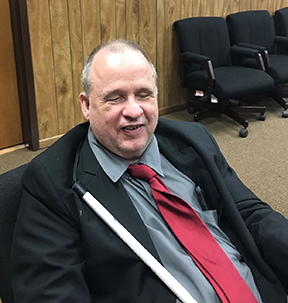 From the Editor: Eric Duffy lives in Ohio, and he is well-known in the Federation for his service as the president of the Ohio affiliate, his work at the Jernigan Institute as the director of technology, and the kindness and enthusiasm he brings to everything he does. This first appeared in the spring issue of the Buckeye Bulletin and has been updated as a result of recent discussions ongoing at Aira. Here is what he has to say about functioning with dual disabilities.
Neither of my parents graduated from high school, but they both had more than a healthy dose of common sense. I was born at least two months early in 1963. I was quickly placed in an incubator, which of course saved my life, but it also left me blind. I don’t know how old I was when my mom took me to the doctor and said to him, “This baby is blind.”
The doctor said, “Lady, there is nothing wrong with this baby.”
My mom said, “He doesn’t look around, and he doesn’t turn his head until he hears a sound.” She said, “I’ve had enough children to know what I’m talking about.”
After a little more convincing by my mom, the doctor performed some tests and told her she was right. He said, “Your son is blind, and the best you can do is to take him home, keep him clean, and take good care of him. Someone will have to care for him for the rest of his life.” That is the story my mom told me more than once many years later.
Of course my parents were devastated. They knew nothing about blindness. They had just been told that their youngest son was going to have to be cared for for the rest of his life. But their troubles weren’t over yet.
My mom soon noticed that I wasn’t reaching some of the appropriate milestones for movement, such as sitting up, crawling, and walking. The doctors eventually told her that I had cerebral palsy. They wanted her to put braces on my legs at night and get me into physical therapy.
I remember the braces and the physical therapy all too well. The braces were heavy, they felt tight on my legs, and if they thought it was hard for me to walk before, what were they thinking the braces were going to do? So naturally I fought the braces and the therapy.
When I was still very young, I remember having two surgeries on my legs to lengthen muscles. For some little time I walked on my tiptoes. I remember being in casts for months. And of course there was more physical therapy.
When most kids my age were starting kindergarten and first grade, I was dealing with leg surgeries and their aftermath. I wasn’t thinking about school, and neither were my parents. I had to walk better before I could go to school, so I started school at a later age than most kids.
I have a younger sister, and of course she was walking, running, jumping, and doing a lot of physical activities long before I was. So at some point in my life I learned that I was different from everyone else in my family. I was told that I was blind. I was told that I couldn’t walk like everyone else. I don’t know when I heard the term “cerebral palsy” for the first time, but I do remember being told that I couldn’t do certain things until I learned to walk better.
I was also told that I was going to go to the school for the blind and that I was going to have to stay there during the week and come home on the weekends. I wanted no part of that. When the day came for me to go to the school for testing, I told my mom that I wasn’t going to do it. She could take me there, but I wasn’t going to talk to them.
Well, I did what I said I wasn’t going to do, and they got the testing done. I don’t remember how that happened. But they told my mom that I wasn’t going to be able to read and write Braille. They said that my hands weren’t strong enough. I heard my mom telling other people this. By that time, I wanted to learn to read and write Braille. I was placed in the classroom of first grade teacher Mary Butler. She started teaching me to read and write Braille. I started school in April, and by June I could read and write Braille as well as anyone in my class. In fact, one evening, when my dad came to pick me up, they called him into the office and asked him who was teaching me Braille at home. He said that no one was. No one in my family knew Braille. They told him they couldn’t believe how fast I was learning to read and write.
Their concerns about my physical strength were put to rest also. I played on the playground, took physical education, and did the same things that the rest of the kids did. To their credit, that is exactly what the teachers and staff at the school encouraged me to do. I soon figured out that I couldn’t run, jump, and do some of the things that the others in my class could do. I also didn’t take long to figure out that, if I could use my upper body to compensate in any way for the leg strength that I didn’t have, I would have a great equalizer. I started to do things to build my upper body strength. While everyone else was running around, I was hanging on the monkey bars and the jungle gym. I knew that I could build my hand and arm strength and that doing so was going to be to my advantage. I don’t remember anyone telling me to do this. It just made sense.
As most boys do, my friends and I liked to wrestle, and yes, occasionally we got into fights. Word soon had it that whatever you do you can’t let Duffy get his hands on you. If he gets his hands on you, it’s all over. You’re done.
I wrestled in elementary school and made the high school varsity team. Balance and leg strength just weren’t a big issue anymore. I completed all of my physical education requirements, from which I could have gotten an exemption. At some point I got smart enough to realize the long-term value of physical therapy, and I actually volunteered for it. So it went throughout my time at the school for the blind until it came to orientation and mobility.
I was given basic cane travel instruction. In fact, I had permission to leave the campus alone and travel to nearby locations. As I continued to work with instructors, however, they became concerned with the fact that I fell occasionally. For me it was not a big deal. I fell, got up, and kept going. But the school decided that they were no longer going to give me orientation and mobility instruction. When I asked what I was supposed to do when I started college, I was told, “You’re smart enough to figure it out.”
Figure it out I did. I taught myself to use the bus system in Columbus. I was soon traveling wherever I wanted to go. I then began to question why so many people were nervous about traveling in new places alone. Why did we have to have these highly educated professionals teaching travel? It just didn’t seem to be a big deal.
As I began spending time around other Federationists, I learned that there were others who didn’t spend a lot of time thinking about how to get from one point to another. Like me, they thought traveling as a blind person just wasn’t something to spend a whole lot of time thinking and worrying about. I got a lot of good tips from Barbara Pierce and Bob Eschbach.
There came a time when I was elected to the board of directors of the National Federation of the Blind of Ohio. This meant that I was also traveling on behalf of the organization. Sometimes during that travel I would fall. No one made a big deal of those falls. One time, as I was walking through a gas station with a glass Coke bottle in my hand, my foot hit a pump island. I went down. The bottle broke, and my hand was cut. The cut seemed bad, so I went to a nearby fire station and from there to an urgent care center. I went from the urgent care center to an emergency room, where they told me I needed stitches. I won’t take up space here describing everything I said to try to convince the doctors that I didn’t need stitches. Let’s just say that they weren’t amused when I started talking about what I had learned about stitches in medical school.
Long before that point I had come to understand that society tends to judge all blind people on interactions with just one or two blind people. I was proud of the work that the Federation was doing and that I was beginning to be a part of the leadership in Ohio. But I also knew I had balance problems. I did not want people to judge our work and our organization based on my falls. I called Barbara Pierce and told her what had happened. I also told her that, if she thought I should, I was prepared to resign from the board.
She said she wouldn’t hear of it. She said, “You didn’t fall because you’re blind.” After that point I had no more questions. It was a refreshing change to go from a school where I was told that I wasn’t good enough for its orientation and mobility program to an organization that embraced me.
I have often heard people criticize the Federation by saying that we are not accepting of people with multiple disabilities. When it is pointed out that I have a disability other than blindness and that I am a leader in the Ohio affiliate, the critics don’t know how to respond. I was once walking with Jim Gashel and other Federationists at a rather fast pace while Jim was still employed as the director of strategic initiatives for the Federation. We were walking on some narrow and rather uneven sidewalks. Jim asked if I would like to take his arm. I did, and I began to explain about the cerebral palsy. Jim simply said, “I know,” and we didn’t discuss it any further.
John Paré has always been good about pointing out ramps and asking whether or not I need assistance when steps were the best way to go. President Riccobono has done the same thing when we have walked together. All of this is part of the reason I say the Federation is an accepting family that I’m proud to be a part of.
In 2016 I began to use what was then a new service called Aira. When signing up for the service, I created an online profile. I was asked if there were health issues or medical concerns that I wanted Aira to know about. I did not mention the cerebral palsy. I said nothing about balance concerns.
While taking my first walk using the Aira glasses, I hit my foot on the bottom of a construction fence. The Aira agent had told me the fence was there, and I touched it with my cane. Nevertheless, as I walked along the fence, my foot hit one of the supports that were sticking out, and I went down. I popped up quickly and went on walking. Of course the agent asked me if I was ok, and I said I was fine. I continued my walk to the Walgreen’s store. When I reached into my pocket to get my wallet, I noticed there was a problem with the little finger on my left hand. Actually, I thought I had broken it. That night I spent several hours in the emergency room only to find out that it was a sprain. I never told anyone at Aira until about eighteen months later when I had lunch with the agent with whom I had been working when the fall happened.
In late July of 2017 I was walking to a barbershop in Baltimore. The Aira agent told me I was approaching construction ahead. She suggested that I turn around, walk back to the corner, cross the street, get past the construction, and cross the street again. I said no, that sounded way too time-consuming. I said I would step out into the street and get around the construction that way. Wouldn’t you know it, my foot hit a traffic cone, and I went down. A very concerned Aira agent asked if I was ok, and I told her that I was. I could hear the concern in her voice, and I tried to reassure her. I continued my walk to the barbershop, got my haircut, and walked back to the Jernigan Institute.
Later that evening I received a call from an Aira team lead. He and I had developed a good rapport. He said he was calling out of personal concern and because the Aira agent had reported my fall and that she was very concerned. I assured him that I was fine and that there was no further need for worry.
I knew then, however, that something had to change. I then called my friend Amy who is still a vice president at Aira. I explained what had happened, and of course she was already aware of my fall. I told her about the cerebral palsy. I told her that it is something I have dealt with all of my life. I explained that I know how to fall without getting hurt. I also said that, if I needed medical assistance after a fall while I was working with an Aira agent, I would let the agent know. I told Amy that I understand that the agents will be concerned when I fall and that in fact I appreciate the concern. But I said that I am always going to fall. Sometimes I will fall while working with an Aira agent. But somehow, you have to help me deliver the message to the agents that, if I fall and tell them that I’m ok, I am ok. We should go on as normal. I can’t have agents panic every time I fall.
Much to Amy’s credit and to that of Aira, the message has gotten through. New agents get it as well. My falling is not a big deal to me, to the Federation, or to Aira, and that is how it should be.
I believe Aira has saved me from many falls. They can spot uneven terrain ahead and warn me of it in advance. They point out rough or cracked sidewalks. As I get older, falling takes a bigger toll on my arms and shoulders, so I appreciate it when an Aira agent or anyone else for that matter helps me avoid a fall.
Aira has a policy that requires agents to remain silent while an explorer is crossing the street. At first glance this policy makes sense. However, many people want to know when they are veering into the parallel traffic. This kind of information can be extremely helpful to those with hearing loss. I would like to know when I am veering, and I would also like to be directed to the curb cut. An agent giving direction while I am crossing can help me avoid a fall. I am one of Aira’s biggest champions, and I have been since the first time I used it on that walk to Walgreen’s when I sprained my finger. I will continue to champion Aira, but I am making a simple request. Let me check a box, sign a waiver, or do something to indicate that I understand the company’s street-crossing policy, but I am waiving liability in order to get the information I need.
Many of us have been in ongoing discussions with Aira about this policy for more than a year. They tell us they are listening. They hear our concerns. I believe them, and I believe they will be responsive. I know many of the people in the administration of Aira. They are good people, and I believe they want to provide the best service possible while protecting the best interests of the company.
I do not know how the revised policy Aira is working on will turn out, but I am an optimist, and I believe the change will be acceptable to all concerned. Whether or not it turns out to my liking, I will continue to use Aira just as much as I always have. I will continue to champion the service as much as I always have. But I am intelligent enough to ask for the information I need and use it in a responsible and appropriate way, and I trust Aira to know this and to act accordingly.
Media Share
