But Is Voting a Blindness Issue Really?
by Nathanael Wales
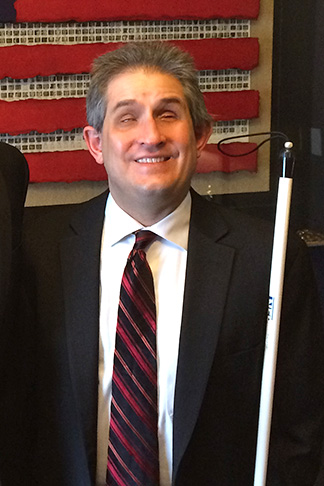 From the Editor: Nathanael Wales is a longtime member of the National Federation of the Blind who is held in high regard by all of us who know him. In this article he discusses the issue of voting and makes an effort to discern what is and is not a blindness issue. This is sometimes thorny. There are those who would contend that the requirement of a driver’s license is not discriminatory because it is applied to the blind and the sighted alike. Since blind people can’t get a driver’s license, this is an easily refuted argument. Other issues are more difficult to discern. Our author has been very kind in letting me edit his work. He was prompted to write in part because he had problems with a resolution we passed in 2021. But, by policy, we do not debate previously passed resolutions. We can talk about an issue before it is policy, but once it is, the Monitor is not the place to argue against it. Once the convention has spoken, it has articulated the view of the Federation until our supreme body changes its mind. Here is what Nathanael has to say:
But is voting a blindness issue really? My question is not about whether there are blindness issues in voting, such as casting a ballot or accessing voter registration forms. The answer to this latter question is that there are and that there have been for decades. We have addressed them. Examples include allowing a blind voter to bring a person of her or his or their choice into the polling booth to pull the chosen levers of democracy decades ago, and having accessibility to electronic voting machines and ballot-marking machines since at least as far back as the late 1990s. I specifically recall authoring and serving as the proponent for a resolution on this topic in 1999, which became our Resolution 1999-19, calling upon Congress to ensure that electronic voting machines (then very new) be accessible to blind residents. And, of course, there are our most recent efforts: encouraging the distribution of absentee ballots (most notably during the COVID-19 pandemic) that can be marked and cast accessibly and privately by blind and disabled voters. The National Federation of the Blind has overwhelmingly agreed and led the way on these blindness issues in voting, and I am proud to have played and to continue playing my own part in the effort and appreciate the support and trust of fellow Federation leaders at all levels, including Lou Ann Blake herself.
What is surprising about Ms. Blake’s article in the January 2022 Braille Monitor is that she expresses surprise at the controversy over her and Jeff Kaloc’s resolution, 2021-02, considered and passed by the convention. This resolution deals with the issues of voter ID requirements and reducing the number of locations of polling places and ballot drop boxes and days for early voting. These issues are new to us as blindness issues, but they are not at all new to anyone following the news over the past few years. These issues are controversial and divide people in our nation; so, as a cross-section of people in our country, it is no surprise to me that we were not all of one mind. The prevention of voter fraud is a big concern to many, whether blind or not, and I should note that no study of which I am aware showed evidence of voter fraud that would have altered the outcome of any of our elections.
On the issue of reducing the number of locations of polling places and ballot drop boxes and days for early voting, the practices of states vary widely: for example, Connecticut has never had early voting and no-excuse absentee voting (Concerns about COVID were legislatively added as an acceptable excuse at least in 2020 and for the short term). My fellow Federation members and I in Connecticut didn’t believe that not having early voting—ever—nor having to provide an excuse to vote absentee (even if that excuse was concerns about COVID exposure) suppressed our votes; we know for ourselves what issues for blind voters in our state are. One of my greatest joys in having been a part of the National Federation of the Blind for some twenty-seven years has been getting to know fellow members from every part of our nation and from a wide diversity of backgrounds. Politically, I have met Republicans and Democrats, Libertarians and Greens, Marxists and Christian Democrats (Christian Democrats, for example, being the leaders in the organization of Solidarity who drove the authoritarian, Soviet-backed government out of Poland in the 1980s). Among this diversity of blind people would be those who believe in states’ rights and those who believe in distributism. Before my colleagues and I in the Federation consider taking a side on a broadly hotly debated current issue, I remind myself of an important point that Dr. Jernigan made in his article “Reflections on Race, Religion, Disability, Sex, and Broader Issues” in the October 1994 Braille Monitor. This was one of the first of many then-fresh pieces of Dr. Jernigan’s wisdom that I read. I am struck by the beginning of his second paragraph: “We deal with only one set of issues—those related to blindness. As an organization we deal with nothing else.” In decisions about when to become involved in an issue of the day, we begin by asking ourselves whether the issue is of special concern because we are blind. If so, we engage; if not, we leave it to members to get involved in other ways to express their views. Remember the issue Dr. Jernigan had to wrestle with, that being the Vietnam War? The Federation decided this was not a blindness issue or at least decided not to resolve anything about it.
I have been heartened to read how Maurice Peret (a colleague with whom I may have differences on matters not related to blindness—and perhaps some surprising agreements) also takes wisdom from Dr. Jernigan’s article, and I was glad to see it reprinted in the December issue to edify all of us.
I was concerned to read the following assertion in Ms. Blake’s article:
The exercise of our fundamental right to vote is how we, as members of the blind civil rights movement, elect government leaders who will adopt policies and pass legislation that may improve the ability of blind children to receive a free and appropriate public education, improve the ability of blind adults to receive training in the alternative techniques of blindness, improve the ability of a blind employee to receive accommodations in the workplace, and improve the ability of a newly blind senior to receive books and newspapers in audio format. Any legislation that could adversely affect our ability to exercise our fundamental right to vote is absolutely a blindness issue because it may impede our ability to elect government leaders who support legislation that will improve the lives of blind Americans.
First, it seems that the word “may” does some heavy lifting in this argument. More importantly, this assertion implies that members—and perhaps our Federation as an organization—should support particular candidates, even in partisan elections, presumably because those candidates have agreed to support our positions on blindness issues such as those that Ms. Blake lists. Are we to score candidates on their support, much like both gun rights and gun control advocacy organizations do? I strongly suspect that the blind vote would not sway an election anyway because we are, admittedly, an incidental minority. I do not see that providing the sort of leadership we’ve already earned on voting accessibility and many, many other issues (such as, again, the ones Ms. Blake lists). I continue to believe that the best way to achieve our legislative objectives, including all of the ones that Ms. Blake lists, is by having positions based in facts and with the goals of equality, security, and opportunity. Political leaders on almost every part of the political spectrum can be convinced by the rightness of our data and the righteous desire for equality.
Taking as an example an issue that Ms. Blake did not list, I believe that we can—and should—convince the most conservative legislators that subminimum wages are unequal, unfair, and not supported by ever-increasing data—even if those same legislators are eagerly awaiting the elimination of all minimum wages for everyone.
The concern that a person may impersonate another for her or his or their own benefit exists in the broader society. For example, to dine indoors at a restaurant that I frequent near my office in New York City, I was asked to show my photo ID along with my COVID vaccine card in accordance with NYC regulations. For months photo ID along with a vaccine card was similarly required in Washington, DC (Ah, how I’ve missed the Holiday Inn Capitol’s peanut butter pie the past two years). And for two decades or more photo ID has been expected of passengers to travel by air or even by Amtrak (which aspires to provide essential transportation to many remote communities many hours by car from commercial airports). I think that we should do our best to address the concerns on both sides about the issue of identification. Maybe the way to address the blindness issues is to advocate for exceptions for all blind people. Blind people could produce a proof of legal blindness with their name, a determination from Social Security with their name and address matching their voter registration, or an NLS (National Library Service for the Blind and Print-Disabled) registration with a matching address. For some blind veterans, perhaps a statement from the Veterans Administration would fill the bill. Maybe, as in the case for other programs, a statement from our doctor might meet the need. Such exceptions could be extended to our allies and comrades with other disabilities if they wish, much like we have done on the issue of subminimum wages. This would simply be a request for a reasonable accommodation like those we have made before and would fall clearly in our concern that we deal with blindness issues.
I stand ready to carry on our decades-long work to solve blindness-related accessibility issues in exercising our right to vote. I write with the hope that I have stated both what we are against and what alternatives we could consider to ensure our right to vote.