Creating Content with Accessibility as the Default: Celebrating Drupal’s Olivero Theme and Calling for More Blind Contributors
by Mike Gifford
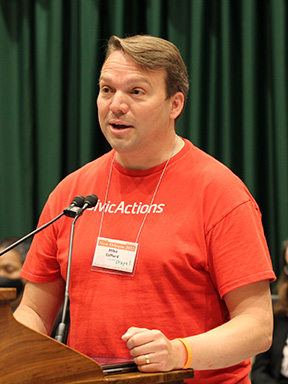 From the Editor: Mike Gifford is a developer with Drupal who came to tackle the challenge of accessibility in 2009, believing that it was an eighteen-month project. As you can see from the article that follows, he is still hard at work on the task, and the wonderful news is that many at Drupal are joining him. So too is the news that the National Federation of the Blind is being acknowledged as is the work of one of our most proactive technology experts, Rachel Olivero, now deceased. Here is the presentation that Mike Gifford gave on July 10 at the 2022 National Convention in New Orleans:
Thank you for inviting me here today. I arrived yesterday and really enjoyed all the great presentations. I've learned a lot more about the work that your community does. Very impressive!
Speaking of impressive work, let's hear it again for Global Accessibility Awareness Day!
How many people have participated in GAAD events in the past? Please make some noise.
My name is Mike Gifford, and I am one of four "accessibility maintainers" who are part of Drupal Core. If you're not familiar with Drupal, it's software that manages content on websites across the internet. It's used by many websites that you visit on a daily basis. There are more than a million sites running Drupal around the world, representing about 2 percent of the web; including the NFB's website and that of several chapter sites. More than software, Drupal is a community.
Drupal is also a community that is participating in the GAAD Pledge. Drupal is just the third open source tool to commit to a higher level of accessibility compliance.
Drupal is just one of millions of open source projects. The open source movement is founded on the idea of standing on the shoulders of giants. That idea has been echoed several times already at this convention.
I work for CivicActions, but for twenty-one years prior to this I had my own web development business in Canada. While running OpenConcept, we implemented sites for the Alliance for Equality of Blind Canadians, Broadcasting Accessibility Fund, Canadian National Institute for the Blind (CNIB), and the Government of Canada's Accessible Standards Canada.
How many people here know what Drupal is? Please make some noise. I've been spearheading Drupal's accessibility since 2009, and I am regularly reminded of how much more I need to learn. Back when I started, I had expected that we could get it fixed up in a year or two tops.
Drupal's Themes
What brings me here today is Drupal's new default theme. The default theme defines Drupal's "look and feel." I was asked to introduce this new theme to the NFB. I am here to represent all those who worked hard to build this new very accessible default theme.
Names are important. The old default theme, Bartik, was named after Jean Bartik, who was a pioneer in computer science. We often forget that women have always been a critical part of the computer science sector. The Drupal community wants to help improve the proportion of women involved in the open source movement. The name Bartik is a reminder of this.
It is unusual for a name of a theme to generate much attention, but in this case, it is more than just a name. The people behind this theme wanted to honor someone who inspired them—someone who might help remind us all of the constant need to build a more inclusive world.
A small group of front-end developers began meeting to discuss how to best modernize Drupal's default look/feel. They needed a name for the project—Olivero! These front-end Drupal developers wanted it to be beautiful, dynamic, modern, and to do so without compromising accessibility. It was critical that it have excellent support for both mobile and desktop views. It was also important that this theme would work fine with or without JavaScript.
When they heard of Rachel Olivero's untimely death, they felt inspired by her contributions to the Drupal community. They chose Olivero as the name for their new theme. After settling on this name, it became especially important that we lived up to Rachel's example and ensure it be as inclusive as possible. The name Olivero is a reminder of this.
How many people here knew Rachel? Please make some noise. Rachel was well known to the NFB as both a leader and a staff member at the main NFB office. Many here knew her, perhaps before she even started working at the NFB. I believe that her partner Karen is here as well.
Rachel likely had an impact on many of us here today. In her career, we know that one of the last things she did was launch the new NFB site, built with Drupal 8.
This new theme was largely led by the Lullabot digital agency and especially Mike Herchel. This wouldn't be possible without contributions from Matthew Tift, Kat Shaw, James Sansbury, Jen Witkowski, Jared Ponchot, Putra Bonaccorsi, and many others.
The themes for Drupal Core have been pretty accessible since Drupal 7. That just wasn't good enough for Olivero. This ultimately meant committing to doing considerably more testing and evaluation for accessibility. Hundreds, if not thousands, of hours went into making this theme as accessible as we could.
Accessible by Default
The Drupal community believes in addressing accessibility early in the project management life-cycle. The Olivero team brought in the expertise of Drupal's accessibility maintainers. We pushed to test with a wide range of devices and settings so that we could support as many users as possible. We know that the best way to build the best design for everyone is to ensure it supports the fringe.
I want to highlight the contributions of two of Drupal's accessibility maintainers. Andrew Macpherson provided very careful consideration in improving this theme's accessibility. Rain Breaw Michaels also provided support for both cognitive disabilities and for users who use switch devices.
In most sites, the menu structure is critical for navigation but also often a source of accessibility errors. The Olivero menu system has undergone extensive work on its accessibility. ARIA control attributes have been added. Screen reader-only text was built-in for better sub-menu support. Overflow support was added for longer menus. Logical focus orders were reviewed in both mobile & desktop. Testing was done for Windows High Contrast Mode including custom style sheets. Interactions were carefully considered to see that a wide range of scenarios with assistive technology were evaluated.
The Olivero team engaged with the NFB to help with this. We wanted to make sure that people with lived experience of disability were involved in testing it early in the development process. Karl Belanger did much of the testing for the NFB.
We were happy that the NFB was able to review the draft theme and help us improve its accessibility. Drupal's accessibility issue queue is always open, and we welcome feedback when new items arise.
Just last month, Drupal 9.2.0 was released and Olivero officially became the default theme. There are now at least a dozen public presentations on this theme available for free on YouTube. Our community is excited about our work and eager to share it with the world.
Accessibility Journey
But this isn't the end of the story. How many people here have contributed a bug report to a piece of software? Please raise your hand, and I will try to roughly capture this. How many people have reported an error on a website? Please make some noise. Web developers need to hear from you. People are way more compelling than guidelines. We need your involvement—not just with the Olivero theme but with all of Drupal.
It probably won't surprise people here, but Drupal's accessibility has already benefited from input from the blind community.
Everett Zufelt was our first Drupal Core accessibility maintainer. Everett pushed us to consider the authoring environment along with front-facing pages in Drupal 7. I hired Everett in 2009, fresh out of university. He worked exclusively on Drupal Core in that time and played a critical role in helping our community understand accessibility. He is now the vice president of product & partnerships of a large digital design agency in Toronto.
Vincenzo Rubano was finishing high school in Italy when he started contributing to Drupal 8. Vincenzo found places in which accessibility had been broken when refactoring parts of Drupal 7. He contributed to a number of issues and caught several barriers we had missed. I helped fundraise to bring Vincenzo to DrupalCon Portland in 2013. At the time he mentioned to me that he had multiple job offers from people at the conference. He declined all of them to go to university. He is now finishing his PhD in computer science.
Get Involved
The earlier accessibility is addressed, the more robust it is. It also often costs less to develop. If we can improve the accessibility of the framework used by a million sites, then it is fair to assume that the Drupal platform will benefit many of the billion people who have disabilities. These changes often take years to actually get implemented by the sites that you and I use regularly. However, getting involved can really pay off over time.
Olivero is the new Drupal default theme. This is what people will see out of the box for years to come. In Drupal 10, we will see the introduction of the new starterkit theme. This theme will likely be the basis of many, if not most, new Drupal sites. The starterkit theme is a basic, unstyled theme that is set up to allow front-end developers to quickly make a site look and function the way the client wants it to. It contains all the structured HTML but with minimal CSS styling. Unlike Olivero, it isn't designed to look good.
Getting involved in the starterkit theme is a great way to help influence new sites to not only meet WCAG requirements but also provide a good aural experience. Part of this is simply documenting best practices so that developers and designers don't need to hunt for them. The other part is finding new ways for best practices to be incorporated.
We need your help. The web keeps changing and assistive technology is struggling to keep up. Our use of technology changes. We need people with disabilities engaged in ensuring that open source tools meet all of our needs. There will always be accessibility barriers identified in any tool. The earlier we catch these, the better it will be for everyone.
We want your help to make the starterkit theme more accessible.
How many people are more interested in contributing to an open source project like Drupal? Again, please make some noise.
"Nothing about us without us" is a rallying cry for us all. There are lots of ways to become involved.
Thank you for your time. If you like, I will be available at lunch for a session on contributing to Drupal. I will be at Salon B at lunch. Hope to see you at Salon B to talk about making Drupal better for everyone.
You can also reach out to CivicActions and connect with me there.