Is It Respectable to be Deafblind?
by Rocky Hart
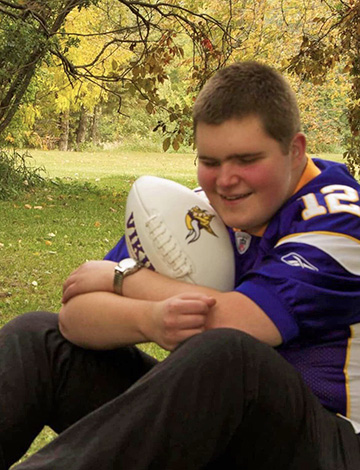 From the Editor: Rocky began writing for the Braille Monitor as a young high school student. He has talent, passion, and is a good communicator. In this article he speaks both to his love for the Federation and two areas in which he believes we fall short. Just as fervently, he believes that we can and will make adjustments so that we are more inclusive. Here is what he says:
We in the National Federation of the Blind have asserted for over eight decades that blindness is not the characteristic that defines a person or their future, that we must raise the expectations of blind people and, as we often say, we can live the lives we want in spite of our blindness. This philosophy was what initially drew me to the NFB as a child, and the reason I joined the organization as an adolescent four years ago. Becoming a member of the Federation was a decision I do not regret and in fact has provided me with a great deal of opportunity as a high school and college student. I have advocated with the Federation at both the state and federal levels on issues affecting blind people, have served in positions of recruitment in both my state student division and state affiliate, and have served as secretary of the At-Large Chapter of the National Federation of the Blind of Minnesota since July 2018. I have also participated in activities with BLIND Inc, our NFB affiliated training center in Minneapolis. I have enthusiastically enjoyed my activities in the Federation, and it would not be hyperbolic to say that I would give my life for the movement and what we stand for, considering how much you have given to me.
Through all of my support and passion for the NFB, however, I have consistently noticed a trend within the organization that concerns me deeply, one which is very near and dear to my heart.
When I was four months old, I was diagnosed with Norries Disease, the genetic condition which caused my congenital blindness. At age ten, I began to develop a hearing impairment directly linked to the same condition. It began with a mild hearing loss in my left ear, and I was fit with my first hearing aid in May of 2013. Three years later, I had lost even more hearing in my left ear as well as in my right, and I was fit with a matching hearing aid. This condition is progressive, and my hearing has declined even further since then. At this point, hearing aids still work for me, and time will tell if I will ever be in need of further interventions such as cochlear implants.
Several people in my state affiliate are aware that I have a hearing loss because I have been very open about it; however, most do not know the extent of it. Having been a member of both the blind and deafblind communities for the better part of seven years, I am well aware that I am not the only deafblind Federationist. That being said, since I have joined the organization, I have noticed that there is, at the very least, a great hesitation to discuss deafblindness, as well as a lack of awareness of issues affecting people with a dual sensory loss. I have colleagues who are deafblind who have expressed that while they know the Federation knows how to handle issues affecting the blind, we are not as aware—and therefore not as well versed—in how to also address those issues affecting people with a hearing impairment. I also know an individual outside the Federation who was totally blind, and although he knew I had a hearing loss, he was reluctant to ask me about it because he believed I might feel as though he was judging me, that I might be upset that he knew about it. This occurred despite the fact that I initiated our first conversation on the matter.
It is certainly true that the Federation has taken actions over the years on behalf of the deafblind community such as making NFB-NEWSLINE® accessible to those who use Braille displays, but this scratches the surface of the issues with which we must deal.
It seems to me that there is a great deal of stigma in the blind community about losing one's hearing, and this bothers me. Perhaps it is because we who are blind use our hearing at length to gain vital information about our world that the sighted receive through their vision; however, the fact that some of us do not have this—or at least at a normal level—does not mean we cannot also use certain alternative techniques to perform certain tasks. In my view, a blind person with a hearing impairment is no different from a blind person with diabetes.
In his 1963 banquet address entitled "Blindness, Handicap or Characteristic," Dr. Kenneth Jernigan boldly declared, "No one is likely to disagree with me if I say that blindness, first of all, is a characteristic. But a great many people will disagree when I go on to say that blindness is only a characteristic. It is nothing more or less than that." Is this not also true of those who are deafblind? He also asserted in this speech, as he did in many of his others, that it is respectable to be blind. If this is true—as we in the Federation believe it to be—is it not also respectable to be deafblind?
I have had a hearing impairment for the past nine years, and I now self-identify as deafblind. This fact I am perfectly content with others knowing. I am confident that while there are those who prefer to be silent on the matter, most people who are deafblind would be comfortable being identified in this manner, and many do not mind discussing their dual sensory loss if approached in a respectful, courteous manner. In fact, it was just recently that the Helen Keller National Center officially replaced the term "deaf/blind" with "deafblind," after decades of requests from the deafblind community. We believe our combined vision and hearing loss—and the degree to which we possess it—are one and the same. It is not that one sensory loss is inferior or superior to the other. Rather, deafblindness is one characteristic upon which our identity is built.
One of our goals in the Federation is to become more inclusive, and this effort must, as I see it, include those who are deafblind. At our conventions, we should continue to ensure that those who require interpreters receive them and that those who need a front row seat to accommodate their hearing loss can obtain it. What many do not know—as I did not until just recently—is that American Sign Language (ASL) interpreters can provide services to individuals who are hard of hearing. This includes repeating what a speaker is saying if the individual cannot hear it (voice over), signing to them for the same purpose if they know ASL on any level, or, in the case of those who are blind, provide human guide where that is needed.
One of the most common misconceptions about deafblindness is that those who are classified as such have no hearing and no vision. While there are those who fit this definition, many with a dual sensory loss have some residual hearing and/or vision. This must be taken into consideration whenever accommodating those with this dual sensory loss.
Also, as loss of hearing is becoming more common in the blind community, we should equip our NFB affiliated training centers to instruct those affected in ways that do not solely rely on their hearing. As an active member of the deafblind community, I have heard stories of individuals who have attended programs at one of our centers who were told they are not trying hard enough when performing tasks such as crossing an intersection. In many cases they may be trying as hard as they can; their hearing is simply unreliable, and they may require more assistance with this task than the ordinary blind person would. As a member of this organization, I am committed to making us as inclusive to those who are deafblind as possible. It is indeed respectable to be deafblind, and this dual sensory loss is just a characteristic like any other, just as is blindness itself. I believe that as long as we recognize this, we will be in an even better position to grow our organization!