Archaeology Through Touch
by Natasha Ishaq
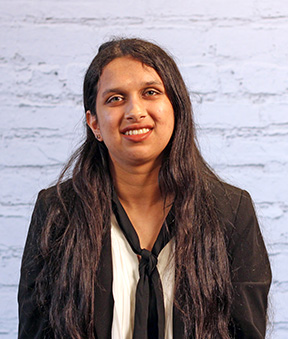 From the Editor: This article is about playing in the dirt, something I once did with gusto, but this is all about playing in the dirt with a purpose. When Natasha promised me this article, I thought it would be good to have because we don't get much about people talking about how they do their work. Her work makes it especially interesting. Enjoy:
My name is Natasha Ishaq and I am a senior at The College of New Jersey. I am also a proud member of the National Federation of the Blind and was a recipient of a national scholarship this past year.
I am majoring in anthropology and have a minor in political science. For the last year and a half, I have been fortunate enough to conduct original research in paleoanthropology. In fact, I am hoping to publish my work in an academic journal in the near future.
This past summer I took part in my first-ever excavation and archaeological dig. The site was a historic one, and although historical archaeology does not necessarily align with my research interests, I figured that the hands-on experience of working in the field would be worthwhile. I joined a team of two archaeologists and several other college students to carry out this excavation.
Our team excavated a historic farmhouse and property located at the edge of my college campus. This farmhouse is called the William Green House. The house was used as a billet for Washington’s cavalry during the American Revolution. Additionally, archival research has revealed that enslavement occurred on the property as well. For several years the school’s anthropology faculty and students have been excavating this historic site in search of artifacts to help tell the story of the house, its history, and its inhabitants. So far, hundreds of artifacts have been excavated and cataloged.
Although I was excited for the opportunity to gain experience in the field, I could not help but wonder how I would navigate this experience as a blind person. I have always been comfortable with finding innovative ways to accomplish visual tasks, but this was completely new territory for me. When I tried to find information online about blind archaeologists and anthropologists, I had very little luck. I was shocked and saddened to learn about the lack of blindness representation in my field of study.
Nonetheless, I had a fantastic time out in the field and found that I was able to use my sense of touch extensively. For example, I would dig with a trowel in my right hand and then use my left hand to feel the dirt for artifacts. After filling my bucket with dirt, I would then head over to the sieve. Using the sieve allowed for the dirt to fall out, leaving behind rocks and artifacts. At this point I was able to use both of my hands to feel and search for artifacts. What I found included shards of glass, a brown eighteenth or nineteenth-century bottle cap, shell, and brick. While my peers examined the artifacts with their eyes, I examined them with my hands and fingers.
A key component to the excavation was the collection and recording of field notes. When one is out in the field digging, it is vital to write down everything. Keeping track of how far down one has dug and what they found in that soil layer is important. Noting something like the soil stratigraphy is also helpful. Typically, field notes are recorded in a field notebook. I, on the other hand, recorded my field notes on my iPad using my screen-reading software and accessibility features.
Overall, the team came across a variety of artifacts. While each person’s individual archaeological finds were interesting and unique, we made some extraordinary discoveries as a collective group. One such discovery included the unearthing of the stone and brick foundation of a late nineteenth and early twentieth-century springhouse in the heart of a bamboo forest that stands next to the house.
In no shape or form was my blindness a hindrance to my ability to succeed out in the field. Fields of study and careers like archaeology that are often presumed to be visual in nature are by no means unreachable for blind people. I encourage other blind people not to fear archaeology, science, or fieldwork. Embrace it. Challenge yourself. You will find that you will gradually adapt to the environment and will find, or perhaps even create, innovative ways to succeed within it. I sure did.