Accessible Pedestrian Signals (APS): An Effort by the National Federation of the Blind of New Jersey, Northern Chapter, to Address this Concern in Essex County
by Rick Fox and Ellen Sullivan
From the Editor: This article is taken from The Sounding Board, Spring/Summer 2022. Rick Fox and Ellen Sullivan are both wonderful leaders who dream and then give those dreams form. Here is something they have done recently that shows what work and determination can do:
Introduction
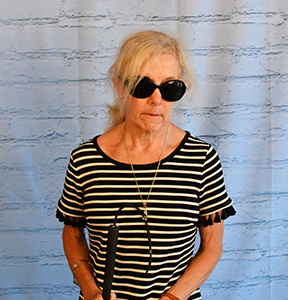
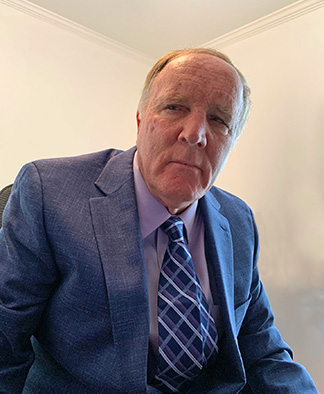 Have you ever had one of these days? Rick needs to walk his service dog, Flash, and Ellen is literally dashing out the door to her appointment at the dentist nearby. The weather is dreary, and we are on the go! We both live in very walkable environments—let us say a walkability score of 87 percent (out of 100, according to standards set by the US Environmental Protection Agency for the ease of living, shopping, and using one’s local amenities without having to drive a car.) Rick lives in Bloomfield and Ellen in Maplewood.
Oh yes, we are both blind and sometimes have difficulty crossing complex and often confusing intersections because the access button to cross the street can be non-existent or, literally, twelve feet away from the intersection. Yes, indeed, Rick and Ellen are in a hurry and listen carefully for the traffic flow and surge, and say that “Hail Mary” as they each bolt across the street.
Oh no! We forgot about that invisible “delayed green” button signaling cars to turn right, and so did the driver, so Rick and I find our lives in peril for a brief moment! Hence, you can see why Rick and I and the members of the Northern Chapter are interested in Accessible Pedestrian Signals. For blind people, it may be the difference between life and death.
Definition
 Many people have asked us what Accessible Pedestrian Signals (APS) are. There are many definitions for these devices and the one we’re using here is:
Devices that communicate information about the WALK and DON'T WALK intervals at signalized intersections in non-visual formats to pedestrians who are blind or who have low vision. They involve both auditory and tactile information about the location, direction, and timing to cross an intersection.
Information Provided to Pedestrians by APS
- Existence of and location of the pushbutton
- Beginning of the WALK interval
- Direction of the crosswalk and location of the destination curb
- Intersection street names in Braille, raised print, or through speech messages
- Intersection signalization with a speech message
- Intersection geometry through tactile maps and diagrams or through speech messages
Benefits of APS
Since intersection controls are now computerized, traffic patterns can vary depending on time of day and traffic flow. Research has found that APS improved crossing performance by blind pedestrians including:
- More accurate judgments of the onset of the WALK interval
- Reduction in crossings begun during DON'T WALK
- Reduced delay
- Significantly more crossings completed before the signal changed
In addition, sighted pedestrians begin crossing more quickly and safely. Okay, that was a lot of background information. So, back in early March 2020—just prior to the Covid lockdown—Rick Fox, president, and Ellen Sullivan, vice president of the Northern Chapter, suggested identifying some useful locations for APS in Essex County and then doing what was necessary to have the APS installed. This is an objective for the Northern Chapter—and worth considering as a possible project for your NFBNJ chapter, too.
Progress was quite slow at first, but we started by identifying intersections in Essex County where these signals would be most beneficial in terms of blind pedestrian safety.
In October of 2021, Rick Fox met with Lukas Franck, a senior consultant at The Seeing Eye who has trained guide dogs and their handlers for many years. Lukas was a wonderful source of information and guidance and, from this time on, we felt like we were finally moving ahead with our project.
Under Lukas’ guidance, Rick and Ellen reached out to County Commissioner Carlos Pomares of Bloomfield and Wayne Richardson, president of the Essex County Board of Commissioners. They just happened to be Rick and Ellen’s elected representatives.
Rick and Ellen received immediate feedback from Commissioner Richardson’s office and were invited to meet with the Commissioner and his staff, including the Essex County Engineer, to discuss this issue. We developed a mutually agreeable agenda and scheduled a meeting at the Commissioner’s office on October 28, 2021. At the meeting, we explained our roles in the National Federation of the Blind of New Jersey, the primary purpose of our organization, why Accessible Pedestrian Signals are so important to us, and outlined specific examples in Essex County.
Together we developed an action plan that included:
- NFBNJ to provide a list of high priority intersections to be evaluated for APS.
- NFBNJ to provide an engineering guide (given to us by Lukas Franck) to the Commissioner’s office that would help prioritize intersection and APS needs.
- The Commissioner’s office agreed to work with the NFBNJ to access and install APS at new and planned upgraded intersections in Essex County.
- The Commissioner agreed to alert the NFBNJ when these devices are added and allow assessment by our blind members.
Coincidentally, on Tuesday, December 28, 2021, the New York Times published a front-page article on the subject. Here is an excerpt:
A federal judge ordered New York City to install more than 9,000 accessible pedestrian signals at city crosswalks. In a response, Nick Paolucci, a spokesman for the city's Law Department, said that the ruling acknowledged the "operational challenges" the city has faced in its attempts to install the systems over the years. We are carefully evaluating the court's plan to further the city's progress in increasing accessibility to people who are blind and visually impaired, Mr. Paolucci said in a statement.
This ruling in New York City is encouraging news for its neighbors in Essex County, New Jersey, and Rick and Ellen continue to keep the lines of communication open with Essex County Commissioner Wayne Richardson. While the fluctuations in the COVID pandemic and the icy winter weather have presented immediate challenges to our meetings at this time, we are grateful for the encouragement given to us by Commissioner Richardson and his staff. This may be a long journey, but we believe the outcome will be what blind and vision-impaired people in our state need.
Note: For additional information on walkability and its importance to human health, the environment and other impacts, visit: National Walkability Index Methodology and User Guide.
https://www.epa.gov/sites/default/files/2021-06/documents/national_walkability_index_methodology_and_user_guide_june2021.pdf