Remarks by Daniel F. Goldstein
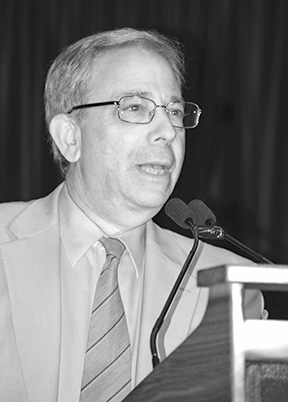 My name is Dan Goldstein. Like Scott, I represented blind individuals at the behest of the NFB. I apologize for not being with you in person. I am in France where it is well past midnight.
How wonderful it was to have Scott LaBarre as your friend. When you ran into him, his smile and hearty laugh could shake you from any mood you might be in. And then you needed to have your feet planted squarely, because he would begin to express his enthusiasm of the moment, picking you up and carrying you along as though you were surfing a tidal wave. Warm, generous, open—all of these characteristics were constants with Scott and made you look forward to being with him. And you never had to guess with Scott—his honesty and candor came without any calculation of the cost to him.
I know I am on the agenda to talk about Scott as a lawyer, but the qualities that made him a lawyer of the highest order were his personal qualities. There was no separation between Scott the person and Scott the professional. I mentioned earlier Scott’s enthusiasm. His passion didn’t wane in the face of obstacles and setbacks. It was coupled with a persistence and determination that ensured that Scott would persevere for that client, no matter how great the odds against success. Scott took many ADA job discrimination cases—without question the hardest cases at which to succeed. Many lawyers would shy away, not wanting to tackle cases where bias and stereotypes can triumph over truth and justice. But Scott embraced those clients, embraced their cases, and gave each one absolutely everything he had—and that was a lot. Whether he won or lost or settled, every day Scott did something to repair the world, and there are few who can say what we say of him—the world is a better place because Scott LaBarre was on this earth. And his legacy leaves us direction from where to go from here.
Judges and juries could trust and like Scott. Just as was true in his interchanges outside the court, with Scott, what you saw was what you got—and what you saw was a straightforward, thoughtful, smart, and humble man. Let me say something about the humility, as it is a very rare characteristic in trial lawyers. Scott knew he had a good mind, I am sure, and was aware that he had a commanding voice. But he knew there were limits to his knowledge—there was no arrogance to Scott. And to judges and juries, as with the rest of us, I think there can be no more endearing quality, except perhaps his kindness and gentleness.
Does it come through that I not only admired and respected Scott, but that I loved him dearly?
When I would encounter Scott, be it at NFB headquarters or a conference, he would wait for me to ask after Anahit, Alexander, and Karter, but that was the end of his hesitation. Over the next fifteen minutes—his love for his family, how proud he was of them—just shone out of him, and somehow you ended up feeling embraced too. His family’s love was the source of his strength. His family was his joy.
It seems to me that to approach lawyering as Scott did—with such openness and such a determination to seek justice—takes not just great strength and bravery, which he most certainly had, but also requires believing that the world can be fair if we work hard to make it so. At times like this, at least for me, the idea of fairness seems absurd, like some kind of horrible bad joke. Yet if I wish to honor Scott’s memory, and I do, I owe it to Scott and his family to kindle that belief in myself.
My life is richer for having had Scott as a friend. He called me a mentor, but the truth is, he taught me lessons of great value. Thank you.