Define Your Future
by Patti Chang
From the Editor: This was delivered as the keynote to the 2023 graduating class at Harbor Springs High School in Harbor Springs, Michigan, on June 4, 2023. Readers will recognize Patti Chang as our current director of outreach, a former board member, and a former state president in Illinois. Her talents are certainly seen both in the Federation and outside it. Here is the way she was introduced and her address:
Patti Gregory-Chang, Development Director, Attorney, Advocate, Mother
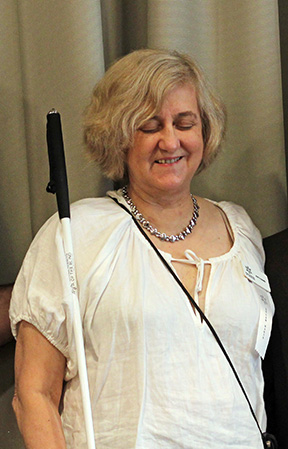 After graduating from Harbor Springs High School in 1981, Patti planned to attend school with hopes of becoming a teacher of blind students. After earning her teaching certificate at Michigan State University, she discovered a passion for law and enrolled in the University of Chicago Law School.
Patti graduated from law school in 1988 and worked in the City of Chicago Law Department for twenty-eight years. She became senior assistant corporation counsel for the City of Chicago Law Department in 1998. She belongs to several professional associations including the National Association of Blind Lawyers, the Association of Fundraising Professionals, and the Illinois State Bar Association. Patti currently serves as vice chair of the Disability Law Committee of the Illinois State Bar Association and as a member of the Administrative Law Section Council of the Illinois State Bar Association.
In 2016 Patti embarked on a second career, accepting the position of director of outreach for the National Federation of the Blind, the largest organization of blind people in the world. She currently serves as the second vice president of the Illinois affiliate of the NFB and has served on its National Board of Directors as well as working as national scholarship committee chair for some years.
Patti lives in Chicago. In her spare time, Patti and her husband love traveling, dancing, and spending time with family and friends.
Here are Patti’s remarks:
Good afternoon. I am so honored and happy to be here with you today. Let me say thank you so much.
To begin today, I have an admission. I should share that I applied to present today at the behest of my mom, Eve Lauer. I honestly did not plan to be selected. After I received a call from the principal, Leigh Inglehart, I realized, oh my gosh, I need to write a speech, which I did while enjoying the beach in Belize, Central America—greatest place to write a speech ever.
The message I want to share with you resonates with me and has since before our graduates were born. I currently serve as a director of outreach for a nonprofit, and I work now in development, which is an indirect way of saying that I am a professional fundraiser. As part of my job, I talk with members of the public who want to do good and corporations like Google, Microsoft, and Oracle on a regular basis. You hear a lot of negativity in the news and especially on social media, but if you talk with people and even businesses as often as I do, you see that there is a lot that is hopeful and good too.
The nonprofit I work for is the National Federation of the Blind. Our one-minute message is also hopeful, and it is the message I want to share today with all of you:
The National Federation of the Blind knows that blindness is not the characteristic that defines me or my future. Every day we raise expectations because low expectations create obstacles between blind people and our dreams. You can live the life you want. Blindness is not what holds you back.
That elevator speech speaks to blindness, but it should be taken more broadly too:
We know that our characteristics do not define us or our future. Every day we raise expectations because low expectations create obstacles between us and our dreams. You can live the life you want.
If we unpack that message, what does it say?
For me it means that I cannot allow the low expectations for blind people that I encounter every day to define me or my future; to determine what I can and cannot do, will, or will not do, should or should not do, or even what I want to do. I surround myself with people who understand my capacity, and I strive to be all that I can be. There have always been people in my life who possessed lofty expectations and pushed and prodded me along the way. After all, none of us accomplish all that we do on our own. Ironically enough, given that I am standing here today, my parents fought to keep me in Harbor Springs Public Schools because the academics were more rigorous than the school for the blind in Lansing, Michigan. My great aunt Daisy spent hours and hours teaching me about the Gregory family history and taking me to the homestead and Grandma Matthews’s house. Do you know that the Gregorys, my dad is Don Gregory, lived in this area since before Michigan was a state? I possess the family archives, including a marriage certificate and indenture papers which are centuries old, in our home in Chicago, to prove it. My family trusts me with these gems because Aunt Daisy fostered my interest and understood that I possess ability. At one time this stadium was filled with wooden log seats skidded out from the school forest by my grandfather, Clarence Gregory, with draft horses.
But I digress, I was talking about how we all have people in our lives who make us better and anticipate much. I attended Michigan State University—Go Green. Professor Harold Spaeth at Michigan State University encouraged me to apply to the University of Chicago Law School after seeing my grades and LSAT scores. It had never occurred to me to apply to tier one law schools. And thousands of blind people over the years demonstrated for me that I could get married, raise two children, work as a litigator for the city of Chicago for more than twenty-eight years, travel independently all over the United States, and do all that I set my mind to do.
If I had allowed others to decide what I could accomplish, I would have done none of the above. It takes vigilance to define for myself what I choose to do. Some examples of the low expectations I encounter may elucidate.
I mentioned we were recently in Belize, Central America, where I wrote this speech. My husband of thirty-nine years was raised in Belize, so we travel there often. On our most recent trip, we went to check into a hotel on Caye Caulker, and the desk clerk, Ernie, decided that we needed a first-floor room. Caye Caulker is a sandy island, and first-floor rooms fill up with dust, so with my asthma, a first-floor room is a terrible notion. Even after I reminded him that I could climb stairs and had asked for a second-floor room when I made the reservation, he told a fib and said that all the second-floor rooms were dirty, but miraculously all the first-floor rooms were clean. Being the vigilant (some would say stubborn) self I am, I said we would come back after we ate and check in. We could go across to the Rainbow restaurant on the dock and be back in an hour or so. He finally gave it up and presented us with keys for a second-floor room, which was in fact clean. Some of you are a bit uncomfortable with that story. Now most of you are thinking he meant well, and I am certain he did mean well, but if I added all of the well-meaning people up who wanted to decide for me what I could and could not do or what I should or should not do, I would be sitting in a rocker on the first floor and doing lord knows what with my life.
While in law school an insurance law professor offered me a passing grade for mere attendance. Sounds like a deal, right? Not so much; if I leave the book closed and skip the exam, what do I learn? What does that say to the other students? I turned down his offer of a free pass, and it is a good thing I did because my first real job ended up being in insurance law, where the readings from that class came in handy.
Defying low expectations works
Instead of letting stereotypes and negativity determine my future, I have, to the best I know how, learned from positive role models and determined my own future. So instead of that rocker, I am blessed with a great family, loads of friends, a job I love, and the privilege of talking with you all here today.
All of us have something in our life, a characteristic that could hold us back. Maybe it is poverty, maybe it is wealth. Do you think you are smart enough, attractive enough, and on and on. Whatever that characteristic is for you that could hold you back—do not allow it to define you. Decide how you want to live your life—whatever that means for you. You will not do it on your own, but if you focus on those who encourage, prod, and envision much, and in addition push yourself to succeed, you can live the lives you want.
Dr. Kenneth Jernigan, a leader of blind Americans in the twentieth century, once responded to a letter he received from some blind students at a training center. The students were asking about his use of a long white cane and another technique called human guide. Human guide is a technique in which a blind person touches the elbow of another person, sighted or blind, and navigates by following that person. The students wondered why especially at conventions they observed Dr. Jernigan using human guide to navigate. After assuring the students that he did in fact have the skill to use his cane without a human guide, offering to demonstrate that skill, and explaining that sometimes efficiency or convenience led him to choose to travel holding the elbow of another person, Dr. Jernigan shared a conviction that is even more important. He said something like, but even if I lacked the skill to use a long white cane well without a human guide, I hope that the next generation of students coming after me would possess that skill. We all hope that the generation after us does better.
Dr. Jernigan ended his letter to the students in the same way I will end this speech:
You have the opportunity to profit from the collective experience of all of us—the things we tried that didn't work and those that did. On the foundation of love which we have established, you can make for yourselves better opportunities than we have ever known—and I pray that you will. The future is in the hands of your generation, and I hope you will dream, work, and build wisely and well. Congratulations.