Updating and Clarifying the Regulations Implementing the Americans with Disabilities Act
by Representative Tony Coelho
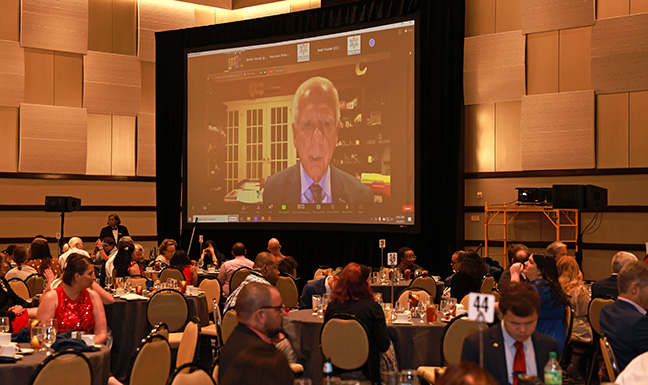 From the Editor: Former Representative Coelho appeared twice during the 2023 National Convention, once as a winner of an award, and once as a presenter on the agenda. His remarks will appear later in this issue, but for the moment here is his reaction to the proposed rulemaking the Department of Justice has submitted for public comment. As the Father of the ADA, Representative Coelho’s remarks are noteworthy and on the mark. Here is what he said to the Department of Justice:
September 22, 2023
Rebecca Bond
Chief
Disability Rights Section
Civil Rights Division
U.S. Department of Justice
P.O. Box 440528
Somerville, MA 02144
Re: RIN 1190-AA79
Dear Chief Bond:
I write in response to the Department of Justice's Notice of Proposed Rulemaking regarding Accessibility of Web Information and Services of State and Local Government Entities. I have spent my entire adult life helping advance the lives of people with disabilities. As a United States Congressman, I was the primary author and sponsor of the Americans with Disabilities Act (ADA). Therefore, I have a strong interest in the regulations proposed to implement the ADA.
The current proposed regulation is particularly important, as it will govern how people with disabilities are able to interact with the new world in which we all live—the digital world. This regulation will, quite simply, mean the difference between full inclusion and second-class citizenship for people with disabilities in state and local government services, programs, and activities. Because virtually all state and local government services, programs, and activities are moving, at least in substantial part, online, the proposed regulation will either facilitate or block access for people with disabilities to the most important aspects of community life: public education, policymaking, health care, voting, transportation, libraries and sources of arts and culture, law enforcement, courts, government contracts and employment, civil rights enforcement, housing, and emergency services, just to name a few. People with disabilities simply will never be able to be full members of their communities without full and equal access to the online information and programs provided by their state and local governments.
I appreciate the Department's proposal to clarify that state and local governments' web presences are covered by the ADA, although that coverage has long been clear. I also appreciate the clarification that compliance with the Web Content Accessibility Guidelines 2.1 Level A and AA is the standard for web accessibility, although soon WCAG 2.2 will be the most appropriate standard.
However, the proposed regulation includes several exceptions that completely undermine the benefit of the proposed rule. I cannot support a regulation that would so drastically undermine current law, as well as the intent of the ADA.
The ADA was not intended to be static, applying only to the world as it existed in 1990. Its principles are designed to apply, even as technology changes. As expressed in the ADA's legislative history, "the types of accommodation and services provided to individuals with disabilities, under all of the titles of this bill, should keep pace with the rapidly changing technology of the times." (H.R. Rep. 101-485(II), at 108 (1990), 1990 U.S.C.C.A.N. 303, 391). Thus, the ADA requirement of equally effective communication applies equally to print, in-person, telephone, and web-based communications. In fact, accessible communication via the internet is easier to achieve than most other forms of communication, as it does not typically require a covered entity to provide a human interpreter or special equipment such as a TTY.
The ADA already provides for defenses to the effective communication requirement if accessibility would constitute an undue burden or fundamental alteration. Importantly, neither defense provides a blanket exception to the effective communication requirement. The undue burden defense depends on the actual circumstances, including the difficulty and expense of accessibility and the resources available to the covered entity. Both the undue burden and fundamental alteration defenses take into consideration the development of future technologies, such as artificial intelligence solutions that will make accessibility even easier. Unfortunately, the proposed regulation goes far beyond these defenses and provides permanent blanket exceptions to the accessibility requirements for broad swathes of content. These exceptions do not take into consideration either the ease or difficulty of making web content accessible, the (often free) resources available for doing so, or the likelihood that accessibility solutions will continue to develop to be even less expensive, less difficult, and more automated.
First, and above all, no exception to accessibility should be permitted for any new web content posted after the effective date of the regulation. There is no basis for assuming new web content would be difficult to make accessible and, in fact, decades of real-world experience shows that new content is easily "born accessible." The existing defenses of undue burden and fundamental alteration are more than sufficient to address any new types of technology that might be difficult to make accessible. It is unacceptable that the proposed regulation forces people with disabilities to carry the burden of inaccessible content when it would be no burden for covered entities to achieve accessibility of new content. Therefore, no exception should apply to new content, including archived content that was posted after the effective date, new educational content, new conventional electronic documents, new third-party content and links, or new individual-specific conventional electronic documents.
The proposed exceptions are also problematic, even as to pre-existing content, because they provide a permanent exception to accessibility even though the exempted content is important and accessibility could easily be achieved over time. As with physical facilities, the goal is not only to make new facilities accessible and leave large swathes of existing buildings to stand as permanent barriers. Instead, the ADA requires physical facilities to engage in ongoing accessibility barrier removal over time. Similarly, a rule which permanently exempts existing web content would fail to ever reach the goal of equal access—a goal that is easier to achieve for digital content than it is for physical facilities. Rather, pre-existing web content, like pre-existing physical facilities, must become accessible over time. The undue burden defense provides an existing mechanism for such gradual remediation of existing content.
Most currently inaccessible content is not inaccessible because accessibility would be difficult, but simply because the website owner did not require accessibility. Much existing inaccessible content could be remediated or replaced during the two- and three-year compliance periods the proposed regulation provides. For the remainder, the undue burden exception provides a mechanism for later compliance. Thus, for example, archived content should be made accessible over time. This is particularly important for covered entities, such as libraries, for whom the archive is part of the program. Pre-existing educational content should not be made accessible only when triggered by the registration of a particular disabled student, with all the risks that the student will be diverted from the class in order to avoid accessibility and the risk that accessibility will not be accomplished timely. Instead, it should be made accessible over time, with priorities established based on the importance (e.g., mandatoriness) of the class or content and the number of students who take the class. Pre-existing third-party links or content, pre-existing conventional electronic documents and individual-specific electronic documents should also be made accessible over time.
Regarding third-party content and third-party links, such content and links should not be permitted to be inaccessible, even if it pre-exists the effective date of the regulation, if it is used in any way to access a public entity's programs, services, or activities. Whether content or links are "used" for the government program should be defined broadly to include content that provides information about the entity's programs, services, and activities.
Finally, any inaccessible content must be accompanied by a requirement that the covered entity make a plan to remediate the content and provide a mechanism for people with disabilities to request the material be made accessible and for accessibility to be provided (and thereafter maintained) with a short, firm deadline. The means for requesting access must be easy for website users to find and particularly associated with any inaccessible material. Without such a mechanism to request and receive accessible format versions of inaccessible content, the exceptions will be a complete bar to important government information and programs. In addition, people with disabilities should not be required to repeatedly request accessibility for each document they will encounter. In continuing programs, such as education, for example, once a parent or student requests accessibility of pre-existing documents, future documents the student or parent will need to encounter or use must be made accessible without a subsequent request.
State and local government services, programs and activities are increasingly being offered through online means. At the same time, in-person access to information and participation in such programs is being restricted in favor of online access. Town, City, and County offices are reducing their staffing as more and more services and information are offered online. Therefore, residents no longer have sufficient options to avoid using online services and information. Denial of access to the digital world is not merely a closure of one of many means of access. It is a complete exclusion from access. There simply is no other feasible way of interacting with one's government. The pandemic has already accelerated this trend and it will only continue and grow. For that reason, it is absolutely essential that people with disabilities have full and equal access to online information and services by their governments. And it is absolutely unacceptable that large swathes of that information and services be foreclosed to people with disabilities. This rule not only closes off large swathes of government information and services but proposes to do so permanently and even for new content. Such unequal access fails to recognize that accessibility solutions are constantly developing to overcome accessibility barriers and that, even now, accessibility is achievable. Such unequal access fails to recognize the essential nature of government programs, services, and activities—they are not optional. And such unequal access fails to value the contributions of people with disabilities to their communities—if they are allowed to contribute.
I urge the Department to proceed with the proposed regulation without the proposed exceptions for new content and without permanent exceptions for existing content.