What is Blind: Reframing the Narrative
by Casey Martin
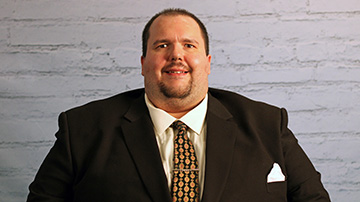 From the Editor: Casey Martin is a member at large in our North Dakota affiliate and was surprised by the question, “Are you blind?” Even with all of the education in speech-language pathology, political science, and certification in professional ethics, the question seemed too difficult to address. Here is the story and the thinking that went into an eventual answer:
In a small NFB leadership meeting in Grand Forks, North Dakota, I was challenged with the first question about my blindness that I was unable to answer. To describe my conundrum, it is important to get some perspective. I have achromatopsia, a congenital genetic retinal disorder that results in me being completely colorblind, light sensitive, and low vision. I was a thirty-seven-year-old student pursuing my master's in speech-language pathology and had the definitions of handicap, disability, and impairment drilled into me through years of disability support work, along with educational pursuits in speech-language hearing sciences and ethics.
All of this, and the question that got me to wonder, was when then North Dakota NFB President Jesse Shirek and affiliate president of the affiliate in the District of Columbia Shawn Callaway asked those present if we considered ourselves blind. Initially, it seemed like a straightforward question, but the meaning behind that "label" was something I never bothered to ponder.
As an aspiring speech pathologist, we learn about a language technique used at an early age called Fast Mapping. This describes a child's ability to rapidly learn new vocabulary by applying knowledge about labels to help categorize words and their semantic features. A child for instance will use the label "farm animals" and immediately think of goats, cows, sheep, horses, etc. This is a meta-cognitive skill that we continue to develop as we learn how to quickly catalog information about specific words within our language. It serves to contextualize language within known paradigms for faster retrieval from our lived experiences.
Upon hearing the word blind, some people have the image of Stevie Wonder or Matt Murdock [Daredevil]. Others might think of a friend, family member, or colleague who is blind. Others still might draw upon an image of someone using a cane or needing assistance crossing the street. The result is that everyone upon coming across the term blind has their own internal context of what it means to them, and with this simple question from Shawn and Jesse, I realized that my own semantic knowledge of the term was incorrect despite living with my condition and being trained vocationally in disability supports for two decades.
It reminded me that our language choices also vary depending upon the communication partner. While I often refer to myself as having "low-vision" or that I am "legally blind," these terms serve to create a more precise picture of my functional vision for communication partners. While others may not know what constitutes these definitions, it generally creates a different impression than saying I am "blind." I have learned through the years that saying blind carries with it a certain stigma, and this word in their minds often results in underestimating my ability. My personal language choice is further affected by being trained to use Person First Language; however, this is at odds with the growing trend of Identity First Language. I see the benefits of both Person and Identity-based language, but it has occurred to me that my continuation of the status quo with what I consider myself only reaffirms that societal stereotypes surrounding the term blind, and I am certain I am not alone in this realization.
To shape the way I think about a term, I need to examine the information presented with this label. To do this I must first consider what blind means to me. When asked if I considered myself blind, I thought, "Of course not," I have some functional vision. After some consideration though, I realized I was using a narrow definition of blind. Now in this regard speech pathologists are uniquely trained to assess certain questions, as we must consider both an educational and clinical approach to answers. Any individual working with people knows that when it applies to humans, there is never a one-size-fits-all definition. That said, it dawned on me that I needed to adopt a more fluid definition of what blind means, not just the cookie-cutter someone who cannot see. Even still, I needed to remember that there are degrees of blindness (i.e., color blindness, legal blindness, and cortical blindness) and that I still fit several of those degrees contained within the term blind. The obvious analogy is that many other labels have degrees or are viewed as a spectrum, but why does blindness carry a different meaning to so many?
After considering what I think about the label blind, I need to come to terms with some realities to reframe what I know about the label. Labels are tricky in that they can misrepresent important aspects, but in many years studying social sciences, everyone agrees that labels do not define someone. Beyond that, we know that all decisions are based upon information, and it is up to the Federation to become the main disseminator of information about the blind community, including expanding what the very definition means. What I have seen thus far is that the Federation works well internally, however, in a more globalized society, we as the Federation need to be sure we are writing the narratives about ourselves and in doing so defining the labels to others elsewhere.
Each chapter should push for broad information and knowledge sharing as a key component to their platform. Many of the struggles we face and the changes we seek affect others, and we can and should bring similar like-minded individuals and groups into our movement. At the conference in North Dakota, we ran into several cases where even the service providers who support blind people were unaware of the programs that each offered. This exposes a gap in the ways in which blind individuals can be empowered and access information. Knowledge and information sharing should be incorporated as a founding principle to the movement since true independence comes from the power of choice and acting as our own decision-maker. Choices and decisions are entirely dependent upon the information to which we have access. The Federation has a communications team and a research team, but separately these are in their own spheres, and it comes to the states to act as the information teams. Bring about the exchanges in your community and reshape the narrative of what it means to be blind.
Each chapter and affiliate should dedicate a portion of their website and larger conferences to providing important information about services and supports in their region because this varies across the nation. This should be checked and updated often. The Federation knows how to identify what aspects are important and should charge itself with making this easily accessible for anyone needing support, regardless of whether they are in the movement. One of my projects for graduate school was an audit of the North Dakota Department of Health's Autism brochure, and I found and reported many dead links. Imagine a parent trying to find support for their child, only to be met with link after link of inaccurate, unattainable information. When our community already faces a massive barrier to information, we should be doing everything to streamline information sharing and bring in any other group or support that we can find to help. Providing accurate information leads to best practices for decision-making, and that is in the best interests of all people regardless of vision abilities.
Much like I need to retrain myself, I feel the NFB needs to reshape the way others view the label blind and embark on a collaborative effort to provide consistent and continuous information to revitalize and rebuild from the bottom up. I did not answer Jesse and Shawn then, but I will here: YES, Jesse and Shawn, after some consideration I do consider myself blind.