A Blind Soprano's Experience with Stage Combat
by Madie Hendrix
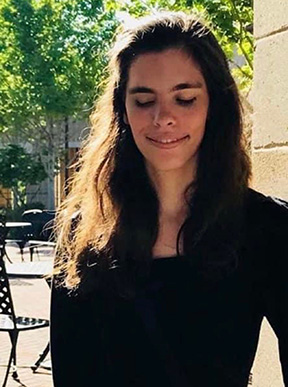 From the Editor: This was originally published in Spotlight, the Newsletter of the National Federation of the Blind Performing Arts Division, available quarterly to the division’s members. I had never given any thought to the combat scenes that are sometimes played out in the performance of opera, and until this article, I never wondered about how a blind person would do more than sing. I hope you find this as informative as I have.
Before moving to the article, let’s learn a little bit about its author. Madie Hendrix is a blind coloratura soprano currently residing in Atlanta, Georgia. She has performed at churches throughout the southeast and has sung Carmina Burana and Beethoven's 9th Symphony with the Alabama Symphony Orchestra. Notable operatic highlights include her portrayal of Jennie in Street Scene by Weill and Fanchette in Le Mariage Aux Lanternes by Offenbach. She recently won the Harrower Scholarship for Voice and the 2023 Georgia State University Honors Recital. She completed her BA in voice at the University of Montevallo in 2020 and received a master’s degree in voice performance at Georgia State University in May of 2023. She is currently pursuing an artist diploma at Georgia State, where she is expected to sing the role of Genovieffa this fall in GSU's production of Suor Angelica.
Madie aims to bring access and equality to the operatic stage and wishes for her blindness not to be a barrier to performing, but rather for it to open the door for diverse and inclusive casting. Here is her article:
When I learned a stage combat instructor was coming to do a seminar for my Opera Workshop class, I was very excited, but also quite nervous. I really wanted to participate, but, being a blind singer, I wasn't sure how. I knew that sitting in the back listening (even if I had a friend describe what was going on to me) wasn't going to truly benefit me.
I'm a pretty shy, introverted person and don't usually speak up in class, but I knew I really needed to for this. So after our instructor Marcus introduced himself and we went over some safety precautions, I let him know that I am blind but did not want my disability to limit my participation. He had such a kind, down-to-earth personality and responded with, "I'm honored to work with you. This is a first for me, but we will make it work!"
Marcus definitely kept his word! I was able to do everything my peers were doing, and it felt amazing to be included in this type of class. Below is a list of the skills I learned, along with descriptions of how I was able to do each exercise safely.
Falling
Learning how to fall was definitely scary at first. I had to trust that the space around me was clear. I started learning the concept of falling backwards with a chair. I went from standing up to sitting down in a chair that was right behind me. At first I used my normal technique of reaching behind me to make sure the chair was there, placing the palm of my hand on the seat before I sat down. Then, I was challenged to not use my hands at all—to trust that it was there. So from standing, I took a deep breath and sat down in the chair without checking. Breathing really did come in handy because next, the chair was taken away. It helped at first to have someone's hand on my back as I began to fall, but I was able to eventually fall backwards without the support.
These same concepts were applied to falling forward and sideways. If falling from a standing position is a little too scary at first, I suggest falling from a kneeling position. I found this a lot less intimidating to begin with since it wasn't as far to the floor!
Slapping/Punching
Having a tangible reference point was very important for this. My partner and I stood facing each other. I was able to get a sense of exactly where they were by standing toe to toe with them at first. Then I took two steps back (my partner remained in place). I then put my left hand out, and my partner grabbed it with their right hand. This gave me some resistance as I took one step forward and made a slapping motion out to my left with my right hand. I made sure to follow through with the gesture so it looked strong and so my arms ended up being crossed. My partner would make the slapping noise by hitting their leg with their left hand (in an opera, though, this noise might be drowned out by the orchestra). It took some time to learn how to accomplish it safely, but I'm so glad this is now a tool in my toolbox!
Hair and Ear Grabs
This wasn't nearly as challenging as I thought it might be! I learned this by folding my fingers into a claw and pressing into the back of my partner's head. Then they grabbed my wrist with their hand and held on, which created the visual illusion that their hair was being pulled. Running around the space in that position together created quite the scene!
Conclusion
I'm so grateful to have had this experience. This is something I really thought wasn't possible for me, as the liability issues were just too great. But I know it is indeed possible now, and I have gained some very important skills so that I am just as prepared as my sighted colleagues. Equality is so important to me, and I wish for the stage to be an inclusive, diverse, safe home for all who wish to perform on it.
I hope this was insightful/helpful to all of you! If you have any questions, please feel free to reach out to me. Thank you for letting me share my experience!
Follow Madie On
Facebook at https://www.facebook.com/MadieHendrixSoprano?mibextid=b06tZ0
Instagram - @MadieHendrixSoprano
YouTube - https://youtube.com/@MadieHendrixSoprano?si=SJOnO0AbQz4YvuFw